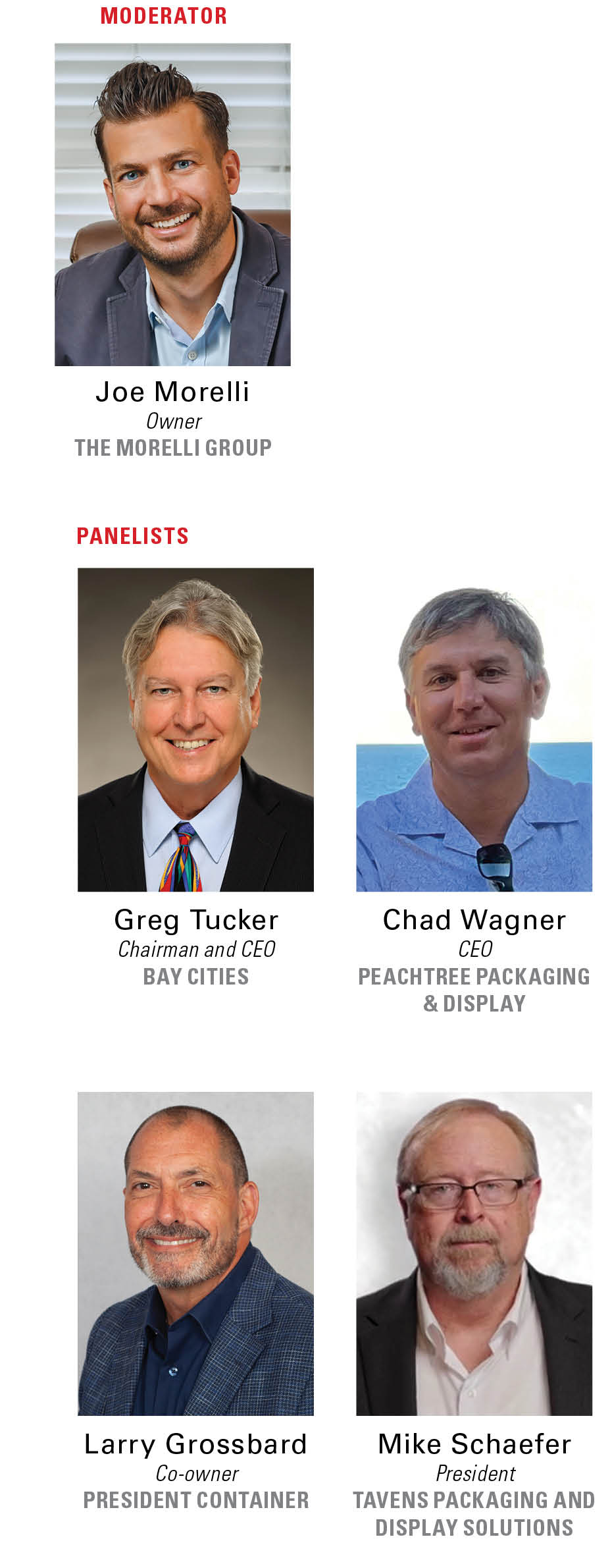
Industry leaders break down the forces reshaping boxmaking and where opportunities remain
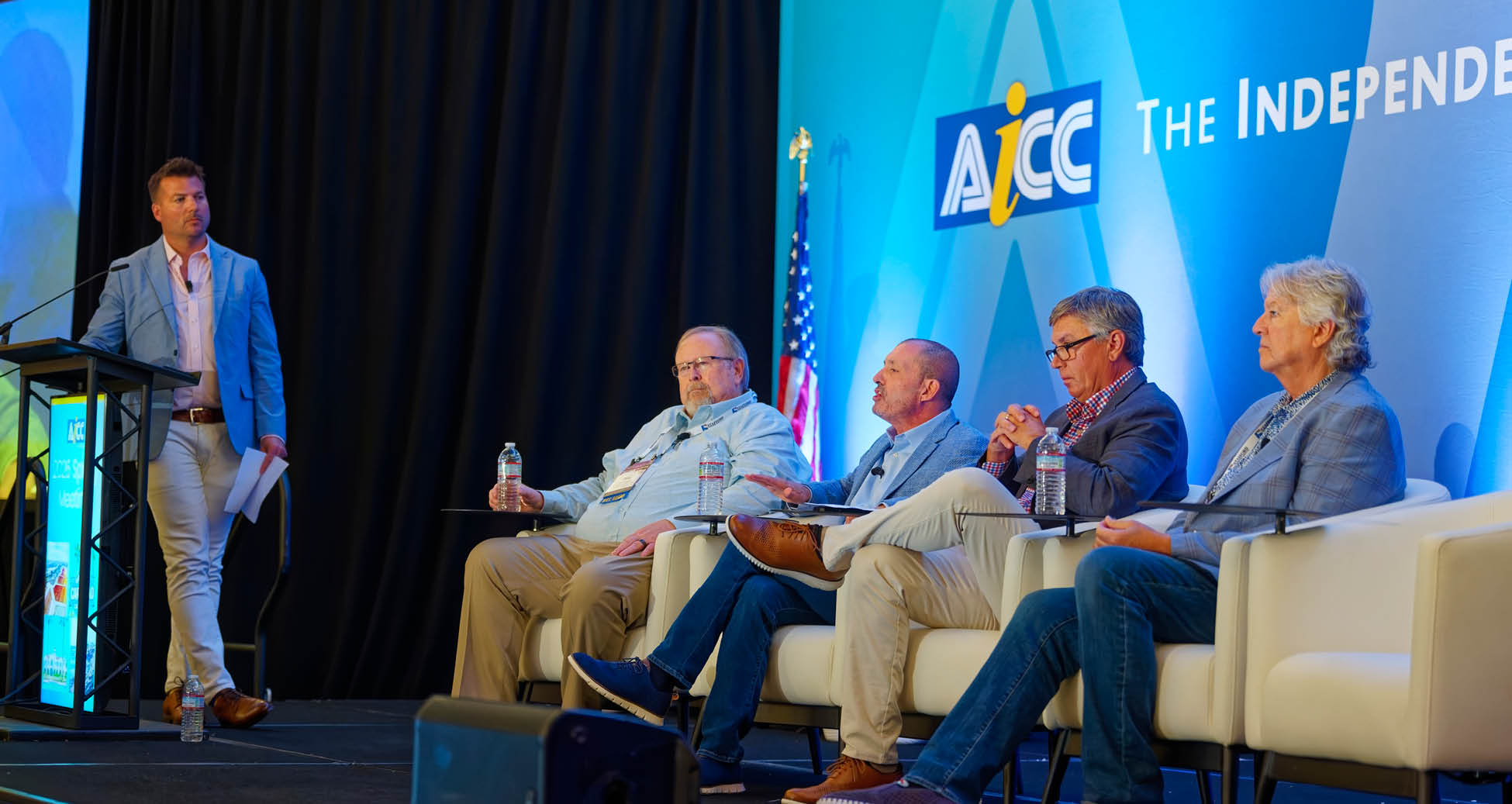
These days, boxmakers are facing a bevy of challenges—pricing volatility, shifting demand signals, and persistent workforce challenges, to name a few. In light of those challenges AICC brought together a panel at the AICC Spring Meeting in Carlsbad, California, to unpack what’s really happening in the market. Starting with containerboard price swings and supplier-driven dynamics, the discussion opened to a broader question: What does it take for independents to win right now? Here are their perspectives.
Joe Morelli: Thank you guys for participating. We’ve talked to a lot of people this week about the current state of the market. Volatility continues to come up, and we’ve heard a lot of these speakers on stage talk about the current market conditions. Some people are nervous about what’s happening right now. Larry, I’ve spoken with you a little bit about volatility. How do you look at volatility, and how does President Container capitalize on a market like this? Larry Grossbard: Volatility—you’re talking about the recent fluctuation in paper price. Twenty down, 40 up. Totally unprecedented, but it happens. And the way we look at it is, “Bring it on!” There is nothing bad about volatility. Many years ago, I had the pleasure of speaking with Jules Edelman from Greater New York Box. Some of you might have known him from the past. We always debated when is the best time to be in the corrugated market. Is it when prices are going down, or when prices are going up? And the answer was very simple: The best time to be in the corrugated market is when prices are fluctuating. When it goes down, you can pick up some points, and when it goes up, you can pick up some points. The worst time is when you go two or three years with no movement in the market, and the next thing you know your margins are eroding. So, while it’s unprecedented what happened, you deal with it. It’s not the worst thing in the world. We follow [Pulp and Paper]. We go down with the market. We go up with the market. We have an increase of X percentage for every $10 a ton, the same that most of you do. But as far as the price changes come, we welcome it. Now the $20 a ton—that’s crazy. Everybody was expecting $70, and it went down $20. They’re not so wrong. If you’re an independent buyer, we have a lot of options; we’re not just tied to the integrators, like the integrated company that’s got to buy from themselves. So, if you went out and you were searching out, you could find people in Europe that you could save more than $20 a ton. If you weren’t tied to the integrators, you can find plenty of suppliers domestically where you could get a better price than what’s out there. And the $40 a ton wasn’t wrong either, because it is not a demand-driven increase. It’s a supplier-driven increase. They took 3 million tons off the market. They have input increases in transportation and energy. All of a sudden, they all needed machine downtimes to tighten the market. Both realities are true. And at 5% of the market, which independents are, we do not control the narrative. What we do is, we react to the marketplace. What we do control is our operations. We control our sales effort, we control our production effort, we control our manufacturing facilities. So, if we worry about what we do, we take the increases and decreases as they come, we’re going to do great. We’re going to pick up margin both ways—down or up—and we’re just going to have to deal with what they throw at us. (applause)Morelli: Mike, pivot to you quickly. If anybody has followed Mike on LinkedIn and seen Tavens’ post recently, you have some strong opinions on what’s going on right now. Larry brings up paper; can you dig in and piggyback off what Larry has to say? Mike Schaefer: I think Larry’s right in many, many ways, and I think our take in our newsletter is really sort of performative for our customers. We want them to understand how we see things. Larry’s right—the increase is valid in some ways by the traditional metrics. The timing was not quite right, and the story we have to tell as independents to our customers as paper buyers is different than the story that the big guys get to tell. You’ll read in the newsletter the timing around the $70 increase, the message it sent to our customer base about the $20 decrease, what the integrators were doing to us as paper buyers, forcing increases on us when they’re giving people under contract decreases, leads to a bunch of snarkiness on our behalf. Now, I agree with Larry—price changes are a much easier time to increase your margin, and you have to control your controllables. But at the same time, the rules are changing, and we all have to be aware of that. So, we sent a snarkier message out there about the approach that the big guys take. Because, as we all experience as independent paper buyers, those numbers don’t always make it to the street in their businesses, and we don’t have a choice. We’re buying paper, not manufacturing it. We have to take it to the street or our margin gets decreased. And in many, many cases, the big guys don’t care if their box plants make money. That’s where our snarkiness comes from.
Morelli: Great follow on LinkedIn. If you’re bored like me, just refreshing your browser hoping something will happen (laughter), take a peek at Tavens on their LinkedIn. Greg, I want you to jump in here. You and I have talked about a lot over the years, and over 20 years, you and I have both seen a lot of different cycles, ups and downs, financial issues, COVID, and now this. Are we in a down cycle, or are we fundamentally different in terms of the demand environment?Greg Tucker: Well, I’m 100% different, but I believe we’re coming out of our down cycle. I believe we’ve been in a corrugator recession for more than two years. We had the greatest golden years of corrugated coming into COVID. I mean, we made more boxes than our factories ever could imagine making. I see us pulling the nose of the aircraft up; as we get off the carrier, we’re going to fly to new heights. I’m bullish about this year. I think we have a lot of things going for us. I don’t really like the fact that MAD magazine dropped us 20 bucks and then went up 40. I would imagine they get to play again, what, Friday? It’ll go up again, probably 30 or 40 bucks. Larry, I’ll bet you a shot of tequila.
Grossbard: And you know what? I would enjoy taking it from you.
Morelli: Can you just quickly talk about the “aircraft carrier pointing up”?Tucker: Yeah, I just think there’s a lot of great things going. There’s a lot of momentum. I really believe we will go through another replenishment cycle. Inventories have been drawn down to decimated, zero levels. We’re back to lean manufacturing and running just in time, but there’s nothing on the shelves. I think if we really take a step back—and you’ve got to sort out the fun things going on in Iran—but let’s just talk about the United States. Our consumer’s kicking tail. The consumer is still buying things, and that’s startling to me. If you think about everything that we’ve gone through—we have COVID, we have this, we have that—we have the most resilient consumers there are on the planet. And last time I checked, we are the largest consuming economy on the planet. This consumer has been a little bit pent-up, and I think that he and she are going to start shopping and buying a whole bunch of stuff.
Morelli:In your opinion, we are on the upside of this?Tucker: Yep.
Morelli: Are we fighting for the same market share, or is it a flat market that we’re all trying to pull from?Tucker: You mean, is there any cheese left?
Morelli:Yeah.Tucker: I think they keep moving the cheese around, but I think there’s new cheese in that, from a promotional point of view, we have the World Cup coming to the United States. For us in LA, we have the Super Bowl, we have the Olympics. All of those drive promotional things that are happening in retail, and retail drives packaging. We buy things out of what the package is telling us. The package is the product. I’m really bullish about this year. It started a bit rocky, but I think, like I said, we’re going to pull that nose up and go lift.
Morelli: Before we pivot to some manufacturing-related topics and labor-related topics, I just want to get each one of your opinions on the state of the independents right now. How do we win as an independent in this market? What is our competitive advantage? What is your opinion on how, as small, independently owned business, we can actually win individually? Give me one or two key points to take away. Mike, let’s start with you.Schaefer: For us it’s the differentiator between what AICC represents and what the big guys represent. The big guys are extracting value from a customer base, and we solve complex packaging problems. For us, it’s about our customer. Oftentimes, for the big guys, it’s about paper consumption. Fundamentally two different approaches to the business, which is fine, but I think with the consolidation and everything that’s gone on, it opens up opportunity for us to go solve customers’ problems and gain market share versus just consuming paper.
Grossbard: I like to consume paper.
Schaefer: If I had your plant, I would, too. (laughter)Grossbard: I think this is an excellent time for the independent. Everybody that’s left in this room, in this Association, we know who we are. The people that cashed out over the years, they’re gone. The people that were weak got absorbed. The people that are left in this market, in this room right now, are all strong. Some want to specialize on smaller plants, smaller lots. Some want to do a big plant like we have. Some want to specialize in displays. Some want to do marketing. The ones that are here, we are here for the future as long as we want to be here, and we could take anything that they throw at us because we’re faster, we’re nimble, we’re quicker to market, and we offer better service. We’re picking, I won’t say the integrator, we’re picking its pocket, but we’re picking its pockets because we do a better job at servicing them. And there’s even some independents that got bought out by these larger companies, and they don’t service the way they used to because they don’t have the owner involvement. They don’t have the heart and the drive that it is when it’s individually owned. So, I think the independents, we could take anything thrown at us, and we’re in great shape, especially everybody in this room, because we know what we are, we know what we can do, and we do it better than the integrateds.
Morelli: Anybody else just want to run through the brick wall right now? Boom, Larry! Let’s go! Hit ’em! (applause)
Wagner: For us, it’s service and solutions. That’s what we have to hang our hat on, and that’s what we work on every single day. We have intimate relationships with the people that we sell, all the way to the owner, and our service and our solutions are what we’re there to do. We’re not a box-pricing entity. Solutions, solutions, solutions, and relationships. That’s the value.
Tucker: We have an unfair advantage to win in the marketplace because, basically, we help the consumer buy a product, and we help the manufacturer sell a product at retail. And what we have is, just as a box, it’s got to go seven steps to retail, 18 steps to your door. We’ve got to make it pretty so you can buy it and you understand what it is inside of it. The package is the product, and now the party’s inside the box when you bring it home. I also see, right now, all the graphic people and people putting ink on paper are busy. It’s really interesting. Walking around here, people that are more in the graphic end are really, really busy right now.
Morelli: Chad mentioned the word “price” again, and that’s another theme I’ve heard often this week. Before we move on, it makes me want to ask a couple more questions. Do box prices still follow containerboard the way they used to, if you look back 20 years? Greg, what’s the rhyme or reason?Tucker: Well, you know, the big integrateds raised their liner prices, yet their box prices don’t follow. They speak with forked tongue. … I’m gonna get shot. (laughter)Morelli: Sorry—I teed you up for that. Obviously, we removed capacity. Why hasn’t that translated into stronger pricing?Tucker: I think you’ll see it. We’ve got to recoup a lot of costs. Everyone has labor increases, insurance increases. Anyone that leases property, re-leasing property, that’s at double, right? Transportation costs are up. Insurances are up. It’s a highly, highly inflated market out there for producers.
Grossbard: That’s why we need the increase. That’s why increases are not a bad thing, because we pick up the points, pick up the margins, to offset some of these labor costs, transportation costs, energy costs. It’s not a bad thing.
Tucker: And the big guys took out 10% of the capacity. That’s a lot of money, right? They need to get it back. Their stocks are not performing well.
Grossbard: They took out the capacity to control the market, to control the price. And it is a supplier-driven increase, not a demand. Demand-driven increases—I’m sorry if I stepped on some—demand-driven increases are much easier to get through the marketplace. Supplier-driven increases are much more difficult, and you’ve got to be much more diligent in communicating with your customers.
Schaefer: I think when they took capacity out, they just didn’t get the result as quickly as they’d hoped. But it’s coming.
Tucker: Yeah, well, MAD magazine screwed that up for them a little bit.
Schaefer: In spite of some of the things that we’ve heard, I think that was a reflection of reality more than a data anomaly that created that.
Morelli: You guys, three or four times, mentioned the word “labor” and issues there. I want to pivot a little bit to talk about something else that is so close to everybody’s heart right now, and that is the workforce. We talked about the market, we talked about paper. None of that matters if you can’t execute, if you can’t put a product out the door. None of it matters if you don’t have people. Chad, I want to throw it over to you right now. There’s a lot of challenge obviously going on in terms of the workforce, but you have not seen maybe as many as other people in this room. I’d just love to hear your two cents on why you’ve been more successful than maybe market average. Maybe give a few pointers here or there that could help the people in the room.Wagner: Maybe because we pay too much, I don’t know. (laughter) That’s the way I see it some days. But we’ve done little things, some creative things. We work less days per week now. We run four-day shifts and three-day shifts. People wanted that in the plant, so we provided that. One less day to sit in traffic, put gas in your car, commute. We do a daily production bonus that’s tied to safety, quality, and productivity, so they’re more engaged, and they have their hands on the wheel, and they get to drive to their destiny every day. And we do a lot of extensive cross-training. We encourage everybody that comes to work at Peachtree Packaging—they’ll get one skill when they come in to take a job. But if you’re running a load former, you need to learn how to drive a forklift. You need to learn how to run the mainline bander. You need to know how to tend to the bailer. All these little things that they learn, we try to cross-train the people to pick up extra skill. They make more money, so they’re encouraged to cross-train, and then they get paid more. I have many operators in the plant that can operate almost every machine we own. I have flexo operators that can operate the digital printer and operate the BOBST. As they learn these extra skills, they make more money.
Morelli: Excellent. Wagner: So, no “general labor,” so to speak. We try to make everybody into a skilled position to where we can afford to pay them and we can do what we need to do every day, because it’s highly variable, as we all know.
Morelli: Mike, you’re in a similar geographical market in terms of size and just pure people. Do you feel the same way as Chad in terms of the way you retain your employees?Schaefer: Absolutely. We’re in a very urban market, and we have seen the quality of candidates improve since COVID, but we really had to revamp how we train and develop people. We have the conversation regularly: We’re not a box plant, we’re not in the box business as much as we’re in the people-development business. Because without them, we can’t produce the boxes. We’ve had to really look at our internal training systems and how we’re bringing people along in order to be successful. It’s never enough, it’s never fast enough, but we’re certainly head and shoulders above where we were after the end of COVID, when our talent pool was rough because of the labor pool we had available and we were too busy to appropriately train people that were new.
Morelli: Talk about training for a minute, guys. Chad mentions the cross-training; you’re talking about training your employees. That’s oftentimes time-consuming, that can be expensive. How do you balance that versus getting product out the door? How do you weigh that internally in terms of an ROI?Tucker: It’s just like not doing maintenance. You don’t run to fail, right? You run to fail, you don’t keep your customer very happy. Well, it’s the same with people. You don’t want to run to fail with people. You want to continue to build and build and build.
Grossbard: What we did is, we took two different routes: one for the plant, one for the office. In the plant, we used temp-to-hire to get the people in. In the office, we used job fairs. When you meet somebody and you bring them in, we used to have a saying, but we had to change it because “You don’t know someone till you sleep with them” doesn’t really go very well in the marketplace. (laughter) So, we use “You don’t know somebody till you live with them.” So, once we get them in the door, we take two different routes.
In the plant, we built a comprehensive and structured training program. We have on-floor training when people come in with our technical service team. The technical service team is a group of really top-notch operators that we took off the floor and now they go to all the different shifts, they do the training of the new people, and they go to the second and third shift when we have trouble. We have classroom training for all the employees, and the trainer is somebody who’s been with us for 30 years, and he knows how to run every piece of equipment in the plant. We take them off the floor and we give them training. We also recently hired a videographer. They go around and they videotape the proper way to do a doctor blade change. How many times they put it in backwards? The proper way to set up the machine, the proper way to set up the twin box slitter. And then, after all the training, we use Vector to qualify them. So, everybody has all this training, then they’ve got to go in, whether it’s 30, 60, 90, and they’ve got to take the test. The good thing about the test is, you find out where they’re weak and where they’re not, where they need extra help. So, it might not get qualified, but at least we know the areas in which they need improvement, and we can work with them. Eventually, if they can’t get it, then they have to be disqualified. But we have one goal, and the goal is to eliminate tribal knowledge. We don’t want them to learn from the guy in front of them who only tells them 50% of what he knows because he wants to be better than the other guy who comes behind him, and he doesn’t want to look bad. By doing these steps, we eliminate tribal knowledge.
In the office, we hired a learning and development center. We created our own Corrugated 101 specific to President Container. We actually took Amtec and Kiwi and we made it virtual, where the people can go on and have examples and actually input it and it’ll tell them if they’re doing it right or wrong. So, we created our own virtual. The other thing we had to do for the office, which was much more important than the plant, which has unions, we had to create layers so they have places to move up (even though it’s really not moving up). We had an entry-level, an associate, a senior, and team lead. Because the people nowadays coming to the workplace, one of the questions of these young guys is, “Where do I go from here? What is my next step up?” So, we just took the same department and broke it down to four steps so they have a place to go. But that’s what we’re doing in terms of the office and the factory.
Morelli: You’re obviously a massively successful company, huge scale. A lot of these folks in the room might be a little bit smaller and going through a growth period. Maybe Greg, Chad, even Mike, as you guys have seen your growth as a company, can you think back 10 years to the challenging times when you were trying to train employees? What are some of the ground-level entry points to training your employees that somebody in the audience might take advantage of if they’re not quite at the scale of a President Container?Tucker: Larry, you just touched on it, but everyone can do this. We built what’s called a “matrix.” A matrix is 1) Are you a human? Can you breathe? That’s good. That’s one—you’ve got to make sure these people are alive. And then 2) We have to teach them about fundamentals of corrugated, like Corrugated 101. Then 3) What are you doing in your operation? Can you run a machine? Can you set it up? Can you do this, that, and the other? And 4) Are you highly, highly, highly talented in running that machine? Meaning, you’re hitting your expected setup time, your expected run times are there. We measure all of that in real time so that we can see how they’re doing. They can see how they’re doing. We pay them that way as well. So, we pay them to play, we pay them to really hit the expected goals in real time. But I think anyone can do that. It’s not hard to do. It’s a little bit of groundwork, but guess what you don’t have: You don’t have the inbred things that we have in our companies. Because we are all related to everybody. We have sons, grandsons, moms—it’s unbelievable what we have in our plant. But we also have a bias from the supervisor. And it was with Bay Cities; the supervisor says, “Well, you know what? My nephew Ernie needs some extra hours, so he’s going to work overtime.” We got rid of all of that, and now you work by your ability. I think everyone can do this. It doesn’t cost you anything. It’s just bringing your people up. And then assessing them. The assessments are the hardest things.
Wagner: To answer your question about the smaller companies, the hardest thing for us was creating the content if you’re going to train people and cross-train people. We didn’t have the content. How are we going to create this content? Are we going to take the time to do it? Who’s going to do it, and how are we going to do it? Figuring all that out over the last five years has been really the secret sauce for us. We have to carry a lot of designers—graphics and structure. I don’t think they’re busy full time every week, and so we got them involved in creating the content and being able to integrate what they learn from the guys on the plant floor into the CAD drawings, or into some specific setup drawings, or gluing drawings. And we also invested in some Meta glasses, so we have that ability to capture what we’re trying to train very easily with technology. Those are a few things that we had to do as a small organization that doesn’t have unlimited resources to create this training content.
Schaefer: Back in the old days, you’d put a guy on the feed end of your rotary on his second day, and the goal was to see if you could break his back. That doesn’t work today, clearly. So, we’ve had to do the same things, much like Chad. As a smaller business, finding the resources to build those programs is the challenge. But people just absolutely respond to that. When you invest in them and they see that you are, they develop so much faster.
Morelli: A lot of things that I hear are “We have a labor problem.” You guys are all talking about operational successes that create training programs. My question is, do we have a labor problem, or do we have an operator problem? Are we not training people well enough to keep the employees, or is there just not labor there to be had?Grossbard: There’s labor out there. They come in. I’m surprised how many people go to the temp-to-perm valve versus coming in and just applying for a job. I think there are people out there. I always want to concentrate on what I can control. I can’t control the labor market, but what I can control is once they get in the door, what can we do to make them the best possible operators? So, labor market, good or bad, doesn’t make any difference. I find whatever I can find, and then we see what we can do to train them up.
Tucker: I think the labor market is better than it was in COVID. In California, we’re suffering from DACA people that were immigrants to the United States and have been for a while. Now there’s pressure on them, there’s pressure on people coming into an organization, because they fear ICE is going to pick them up. That’s a big fear that’s going on in many instances. Any given day, we could have 400 to 800 people working in all of our plants, with temporary labor. Managing that is not easy. But, starting again—can they breathe? That’s an important thing. Can they understand safety? What is their goal going to be? What is their job going to be? Then, can they do their job? And then, can they do their job excellently? Those are the four things you’ve got to do. It’s either a temp in or a person you want to hire forever. I think there’s somewhat of a labor problem, but there is also a training problem in our industry. We need to spend more time doing it.
Wagner: I don’t think there’s as much of a labor problem as it is what we own and what we do about it. I think we still control our own destiny, and it’s how much we invest, how creative we are, that allow you to be successful and keeping the labor that you want.
Schaefer: We’ve had to come to terms with the amount of resources that we’re putting in people development, that they might not stay with us forever, to be OK with that. So, we developed a program where we’re building box men and journeymen and giving people a trade, knowing that if they outgrow us, [they] are going someplace else. That’s the cost of doing business today. The people that are available are the people that are available, and those that can rise to the occasion, we want to keep engaged. But eventually, if they outgrow us, we have to be OK with that and be a people-development company.
Morelli: Great insights. I think we could sit up here and talk for another hour. Gentlemen, thank you for your time and insights.