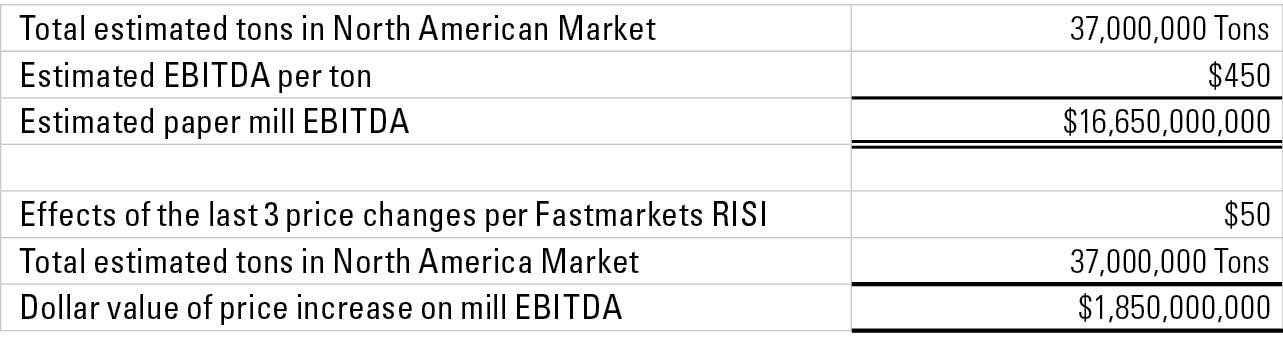
Like it or not, independent converters are the tail of the dog that represents the market for containerboard. Integrated companies that own the paper mills are the dogs in this world, and when their tails wag, independent converters sometimes have to hold on for dear life. Paper mills are both enormously expensive to build and extremely profitable. Let’s take a look at the math (see table at right).
Now the reality is that they are not necessarily going to get this $50 on all of the tons, and the EBITDA (earnings before interest, taxes, depreciation, and amortization) per ton varies from mill to mill due to variations in the cost of furnish (OCC for recycled mills and pulp for virgin mills) and other cost inputs (utilities, freight, labor, etc.). But the numbers are large and worth fighting for, if you are a mill-based company. The profits that you can make by converting the containerboard into packaging is small by comparison and a much more difficult endeavor. According to articles published by our good friends at Bloomberg, the number of tons that are subject to open-market pricing is less than 2 million, so probably less than 5% of the market. So, what this all really has to do with is customer contracts.
Large companies like to have some certainty about the cost of their products and therefore like to enter into supply contracts with their vendors. It has been estimated that the large integrated companies that own the paper mills have as much as 70% of their output tied up in such contracts, and the only way they can get price increases is to have Fastmarkets endorse these containerboard increases. Independent converters tend to have a much smaller percentage of such contracts. This is a legacy system that has developed over time, and 20 or 30 years ago, there were many integrated producers and many independent converters that were buying paper and converting the paper into packaging. The good folks at Fastmarkets were able to survey a lot of buyers to see what they were paying, and they were therefore presumably able to develop a statistically valid model of what the price being paid for containerboard was. If Bloomberg is right and less than 5% of the mill output is actually freely traded, then I don’t see how this is currently possible. Yet almost every contract that converters have with customers refers to changes in price published by Fastmarkets. This is where we are at this point in time. The market for containerboard products is trapped in this legacy system that doesn’t seem to be based on any current reality, and Fastmarkets is stuck trying to help make sense of it and not upset all of its subscribers. They publish a great deal of relevant information about the markets, do a lot of good research, and try to be informative, but their monthly assessment of the price of containerboard seems to be all that anyone is interested in. And no matter what they do, it is virtually impossible for them to come up with a statistically valid model.
The largest integrated producers reduced the papermaking capacity in North America in the last 18 months or so by almost 3 million tons (net of additions), taking the market from about 40 million tons to about 37 million tons, because at the end of the day, the laws of supply and demand are impossible to escape. The demand for containerboard-based products shrunk in 2025, has not grown in 2026, and is at about the same level as it was 10 years ago. Even if your market is controlled by an oligopoly (a relatively small number of producers controlling the bulk of production), the only way to get prices up in the face of weak demand is to cut supply, and that is what they have done. Shutting mills is financially painful, and these companies now want their reward paid to them in increased prices.
I cannot tell you what a fair price for containerboard is, and I don’t think anyone else can either, since there are no public markets where containerboard is freely traded. I can tell you that, 10 years ago, the published price of containerboard was $655 (October 2016) and that, according to a ChatGPT search I just did, the producer price index has shown a cumulative increase of 53% over that period. This would give you an implied price of containerboard today of $1,002, which is almost exactly where the published price is as of April 17. Of course, the reality is again much more complex, and the increases in all of the major underlying input costs need to be analyzed. At the end of the day, none of this matters, because the laws of supply and demand control what is going to happen. In the absence of any public market for containerboard, the only arbiter of this situation will be whether the producers can continue to control supply sufficiently. There seems to be excess capacity in all of the export markets for containerboard, and if there are tons that cannot be consumed in North America, it will be difficult to export them. I imagine, if this is the case, then there will be more mill closings.
But what will happen if a market dominated by a small number of producers continually raises the prices of raw materials but not the price of (noncontractual) finished goods that utilize these raw materials? Will they be able to find cover in a published but nonstatistically valid survey done by an independent third party? If my crude analysis that says that, based on the producers price index, the current price of containerboard appears to be reasonable, what will happen if the producers continue to indiscriminately raise the price in the absence of any objective increase in their costs? We are clearly in an inflationary economy, and the price of fuel and therefore transportation has increased greatly. But freight is a small part of the producers’ income statements.
At the time of this writing, the mills have announced another $50 price increase to take effect in June, and we are all waiting to see how much of this Fastmarkets will publish in their next assessment of the market. The real question for all of us is not whether they will likely get 70% of whatever this increase is in their contracts, but whether they will go out and commensurately increase their noncontractual packaging prices. This is what the independent sector fears. If this is the case, then those on the tail of the wagging dog may be in for a rough ride indeed.
Mitch Klingheris owner of Klingher Nadler LLP. He can be reached at 201-731-3025 or mitch@klinghernadler.com.