
June 29, 2026
What’s Changed
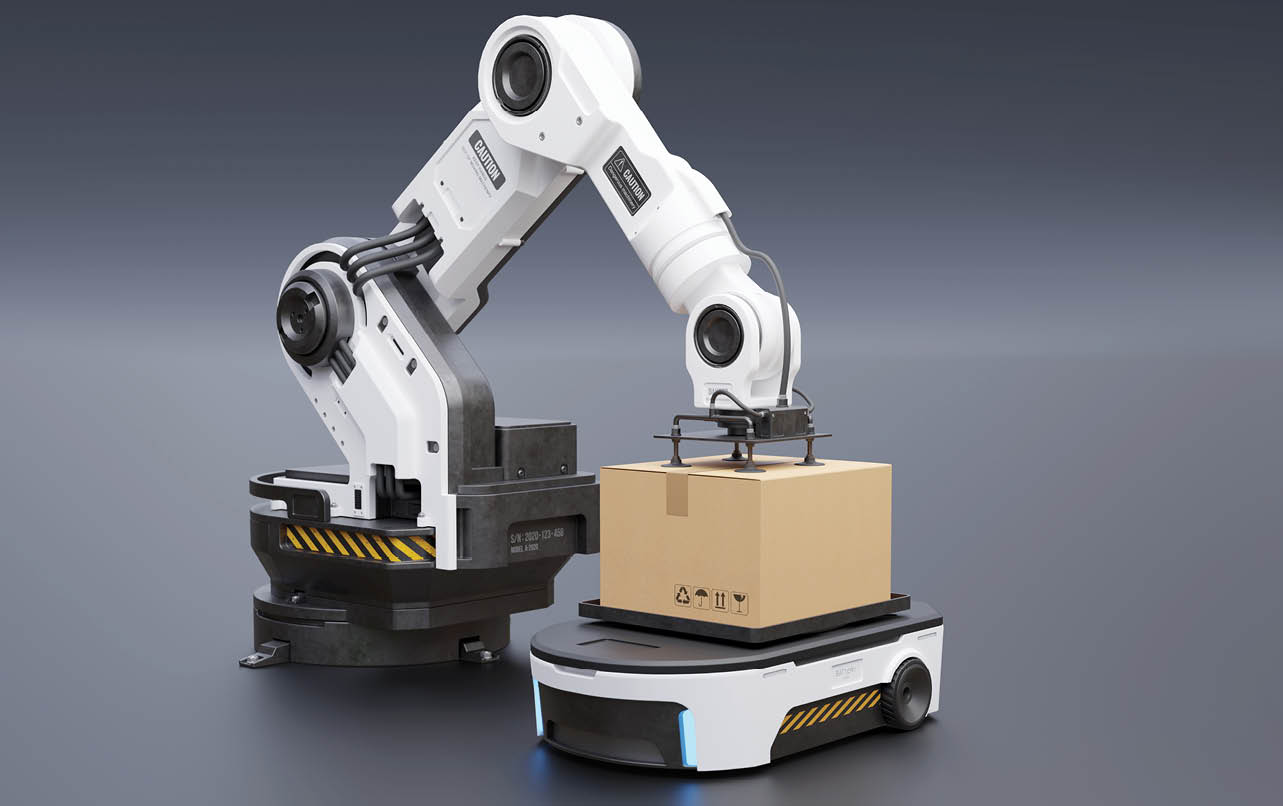
Collaborative robots, or cobots, occupy a different category than the industrial robots that have been priced out of reach for most independents. A cobot has force-limiting joints that stop on contact with a person, so it requires no caging. It plugs into a standard 110-volt outlet and programs through a drag-and-drop touch screen interface that an operator can learn in a single training session. Most models have fork pockets in the base, so you move them between lines with a pallet jack. New stacking patterns take minutes to build, not a call to an integrator. The most immediate application for a box plant is palletizing at the delivery end of a flexo folder-gluer or converting line: A cobot catches bundled cartons and stacks them onto a pallet. When the pallet is full, an operator swaps it out, or increasingly, an autonomous mobile robot handles the exchange. Universal Robots, FANUC, and integrators such as ONExia and Robotiq build production-ready palletizing cells exactly for this work. FANUC’s CRX series runs eight years maintenance-free.Robotiq has over 900 palletizing units in production, with more than 300 new deployments in 2025 alone. Palletizing is only one piece. Every plant has material-handling tasks that eat labor hours: pulling finished pallets to the stretch wrapper, staging for the dock, moving ink buckets and die boards to machines, swapping stock between stations. Autonomous mobile robots are starting to handle these. Vecna Robotics makes self-driving pallet trucks that handle nearly 8,000 pounds.Quasi AI, out of Maryland, builds point-to-point transport robots that deploy in under an hour with no infrastructure changes.Filics, a Munich startup, is testing autonomous ground-level pallet movers with DHL that lift 800 kg and recharge in 30 minutes.The component technologies exist, and corrugated-specific deployments are coming.What You’re Actually Buying
A production-ready cobot palletizing cell runs $60,000 to $120,000 depending on configuration and integrator. That’s real investment, and the instinct in any independent box plant is to benchmark it against cheaper mechanical alternatives—used load formers, new load formers, whatever’s on the auction site this week. That comparison misses what you’re actually buying. A cobot moves between lines and adapts through software. It’s a platform that grows with your operation instead of rusting behind it. For plants that can’t justify the capital outright, Formic offers cobots on a subscription: no purchase, pay per hour of use. The real payoff is redeployment. You have loyal people stuck in repetitive jobs and operator seats you can’t fill. Move your hand-stacker to the operator role they’ve earned, give them the pay bump their new skill set deserves, and let the cobot do the stacking. RNB Cosméticos in Spain deployed six cobots for palletizing, and production jumped so much, they hired more people to handle the increase.Existing staff moved off ergonomic misery and into cobot operations with a real skill on their résumé. That’s the case, not “cobots are cheaper than a load former.” Cobots turn your best plant helpers into the skilled operators you can’t hire from outside, and they do it while you’re still running.Where This Goes
Food, beverage, cosmetics, consumer goods—same end-of-line challenges, same labor shortage, same ergonomic problems that drive turnover. Bob’s Red Mill deployed a Universal Robots UR20 cobot and doubled its palletizing capacity.Setup took hours, and four operators moved off hand-stacking and into higher-value work. The only difference between those industries and corrugated is that they moved first. Some applications are still emerging. Press feeding is one: High-speed flexo folder-gluers and die cutters outrun one or two people loading sheets, and a cobot feeding flats at the rate the machine needs is a logical next step, though production case studies in corrugated don’t exist yet. Vision-guided quality inspection via cobot-mounted cameras is another natural extension on flexo folder-gluer lines, where systems such as Leary’s SureSCAN already monitor glue application. Speed is the fair objection for what is ready today. Cobots run six to 13 picks per minute where industrial robots do 20-plus. But most independents have multiple changeovers per press per shift. Flexibility matters more than peak throughput in that world. That hand-stacker posting is still up. The options for what comes next have changed. Not all of them are ready for primetime, but the ones that are will only get better, and the plants that start testing now will have the institutional knowledge to scale when the next generation arrives. The ones that wait will be learning from scratch.