
March 20, 2025
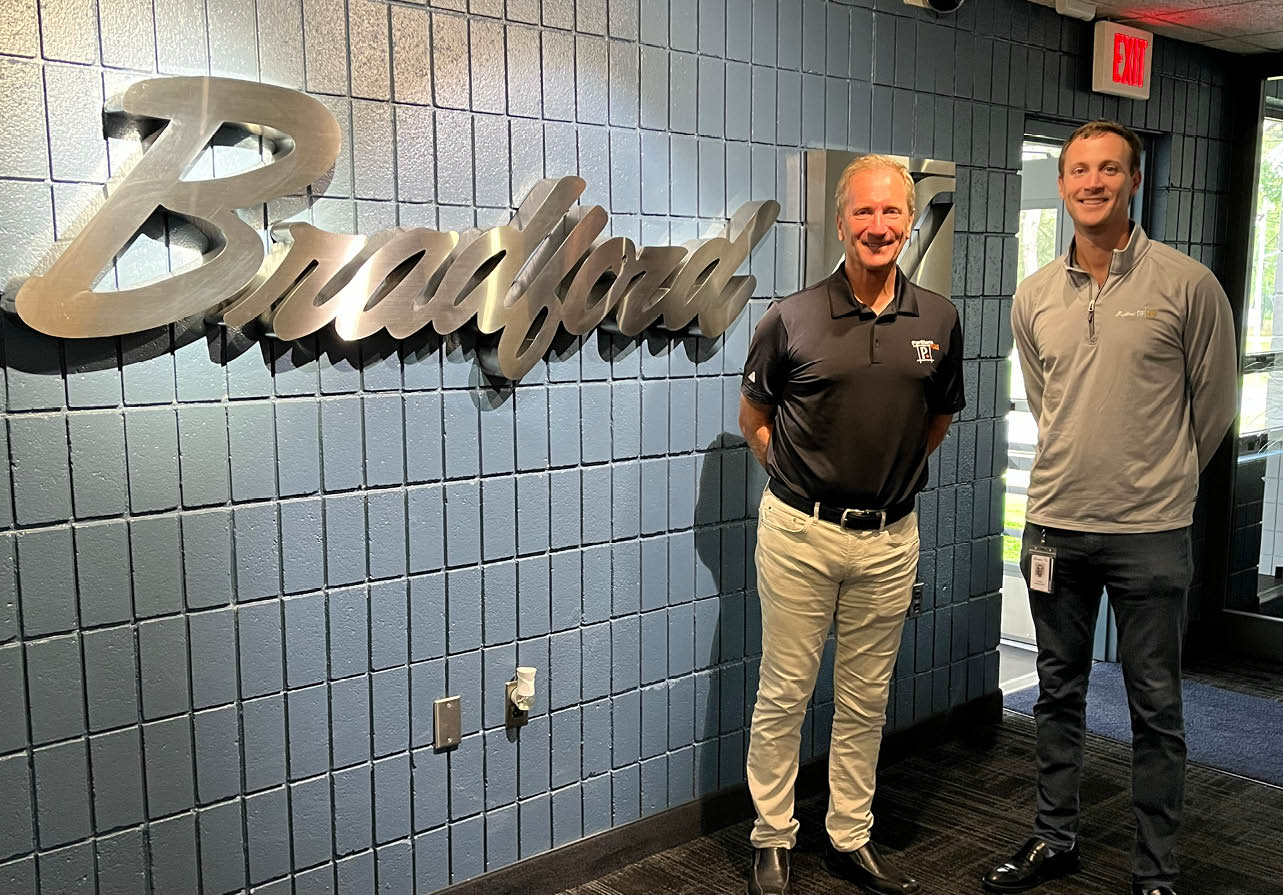
Company: Bradford Company
Established: 1924
Joined AICC: 2006
Phone: 616-399-3000
Website: www.bradfordcompany.com
Headquarters: Holland, Michigan
President and CEO: Tommy Bradford
This AICC member profile article is being written for BoxScore, AICC’s trade magazine for the corrugated and paperboard converting industries. Yet, its contents would equally find a home in Modern Materials Handling, Automotive Manufacturing Solutions, Assembly Magazine, or Supply Chain Management Review because these sectors are only a few examples of the broad swath of the North American Industrial Classification System into which the Bradford Company of Holland, Michigan, has propelled its reach.
Tom Bradford, the fourth generation in the line of Bradfords to lead the company, is chairman. In 2024, Bradford celebrated its 100th anniversary. “We’ve gone from a company that made packaging for candy to developing complex returnable systems using textiles, plastics, and steel, for OEMs (original equipment manufacturers) and their suppliers in multiple industries, and our engineered components company builds part assemblies for the manufacture of heavy trucks.
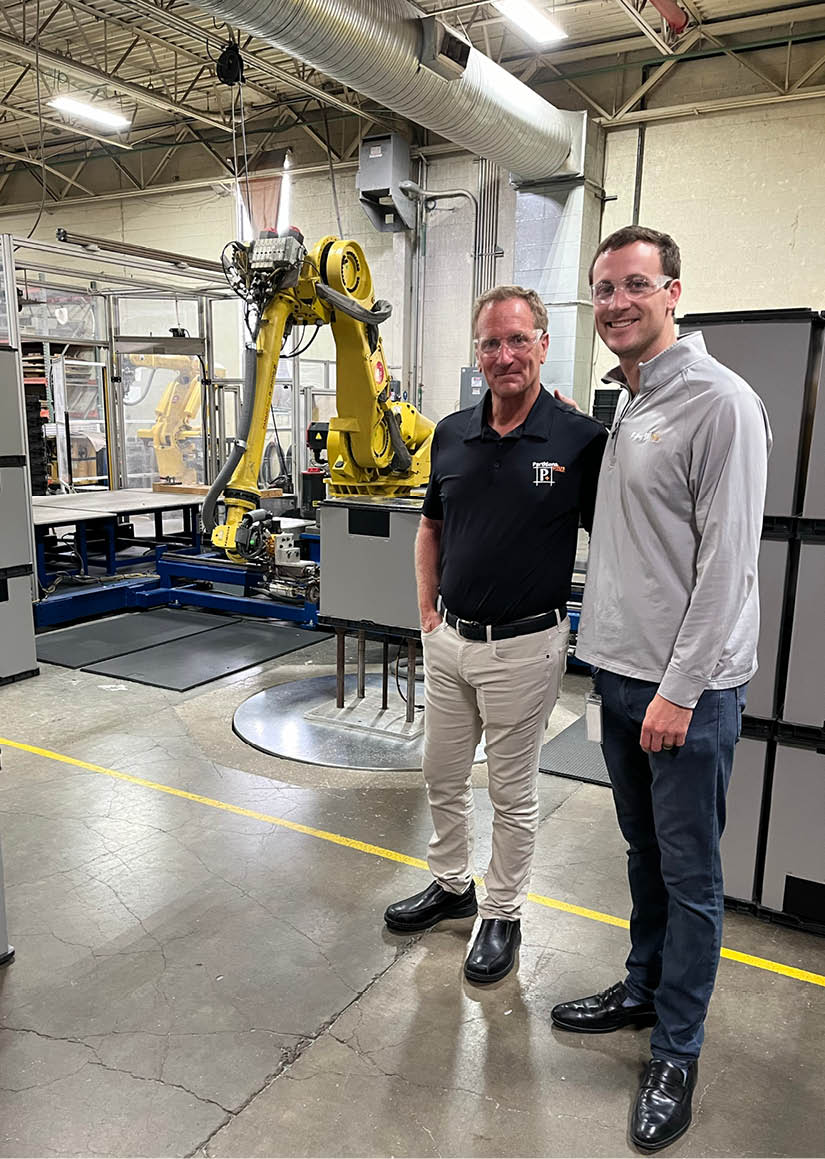
“I’m excited for what lies ahead, and I know our team is ready to take on tomorrow’s challenges,” he says.
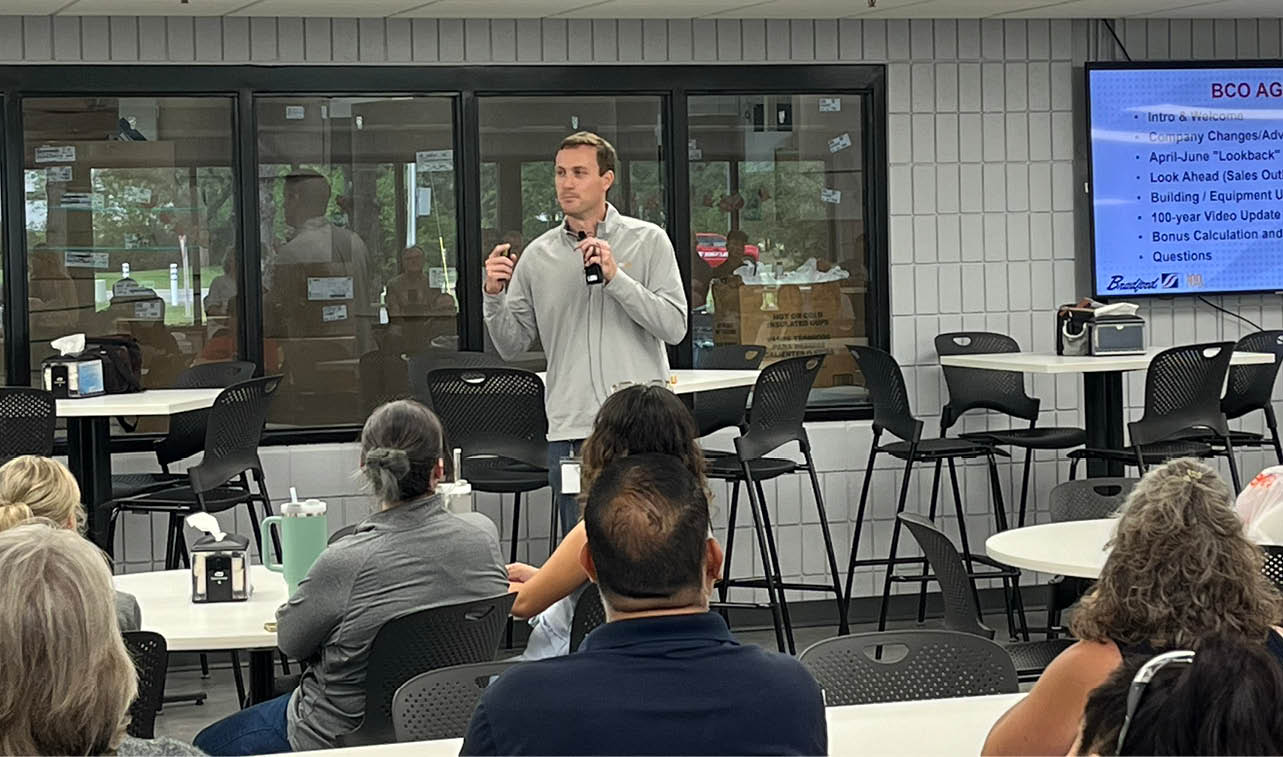
Leading the Bradford team to take on these challenges is its fifth generation: Tom’s son Tommy Bradford, president and CEO. He joined the company in 2010, with the advantage of prior experience. “My first job was in 2007 in the plant. I worked summers in between school years. I started full time in 2010 as a program specialist,” he remembers. In 2023, Tom Bradford, looking ahead, tapped his son to lead the company, and he, in turn, assumed the role of chairman.
The company’s original roots can be traced to 1897, when Tom Bradford’s great-grandfather opened W.J. Bradford Company in Chicago, which specialized in paper packaging and wrappers for the confectionary industry. But Tom says the genesis of today’s Bradford is the year 1924, when his great-grandmother provided the capital for his then-grandfather to buy out a partner and assert full family control. “She was technically the first president of the modern company,” says Bradford. “I’m not sure she ever worked in the operations, but she was the financial backing.”
From its candy-wrapper beginning in Chicago, Bradford Company today employs nearly 900 associates and operates out of nine locations in the United States, Canada, and Mexico, with European affiliates in Germany and the Czech Republic. All strategically serve the company’s principal industrial customer bases, most notably automotive and related assembly operations. In addition to its location in Holland, Michigan, Bradford operates facilities in Wixom and Zeeland, Michigan; Gallatin, Tennessee; and Findlay, Ohio. Bradford Canada is in London, Ontario, while Bradford de Mexico has locations in Querétaro, Monterrey, and Irapuato. Its partnerships with Feuer in Germany and PPO Group in the Czech Republic give the company a foothold in the European manufacturing heartland.
The company’s paperboard partition capacity is concentrated in its Holland and Findlay facilities. The equipment mix in Holland is, in Tom’s words, “designed and built in-house,” with equipment from Premier Converting Machinery, as well. Its Findlay facility was a 2023 acquisition of Partitions Plus, and its lineup of partition equipment includes Baysek, Premier, and assemblers from Solema. From these two locations, chipboard and corrugated partitions are shipped to customers nationwide.
Its other facilities are positioned in heavily automotive-focused markets, and in these plants, the company’s material handling solutions and engineered component parts are designed and manufactured.
Bradford Company’s journey to its present-day product and service diversity began over 70 years ago when the company relocated from Chicago to Holland and began making paperboard partitions for parts suppliers to the automotive, home appliance, and furniture industries.
“The company started moving more into automotive parts in the 1950s with the move to western Michigan,” Bradford says. “Bradford’s growth has been concentrated in automotive. We started packaging small decorative parts like dashboard emblems. We packaged all of that out of chipboard partitions.”
Auto industry material handling practices began to change during the 1980s, Bradford explains, when a mindset was adopted to use returnable and reusable packaging. “Roughly about 1983–1984, General Motors began talking about taking all of the paper out of their plants, specifically the Buick City plant in Flint, Michigan. There was going to be no paper coming into the plant; everything would be returnable. And we said, ‘Well, if we’re going to go out of business, we might as well put ourselves out of business.’ So, we got into the material handling arena, initially making partitions out of high-density polyethylene and trying to mimic what we were doing in paper.”
Bradford recalls it was a time of intense competition as other companies entered the plastic packaging market seeking to retain their hold on the business. “It was a low barrier to entry,” he says. “The sophistication of the market of today wasn’t there.”
Bradford’s perseverance paid off. “In probably 10–15 years,” he remembers, “most of those competitors went away as things became more sophisticated, and the sales cycle for developing returnable packaging projects would often take up to two years before receipt of an order.”
Eventually, Bradford says, these tier 1 suppliers started asking for more, from the protection of small parts to the assembly and kitting of larger components. “The parts kept getting bigger,” he explains. “They asked, ‘Can you take those three parts that you’re making partitions for—we’re going to make it into an assembly—can you package that?’ Sure, we can. We can do that.”
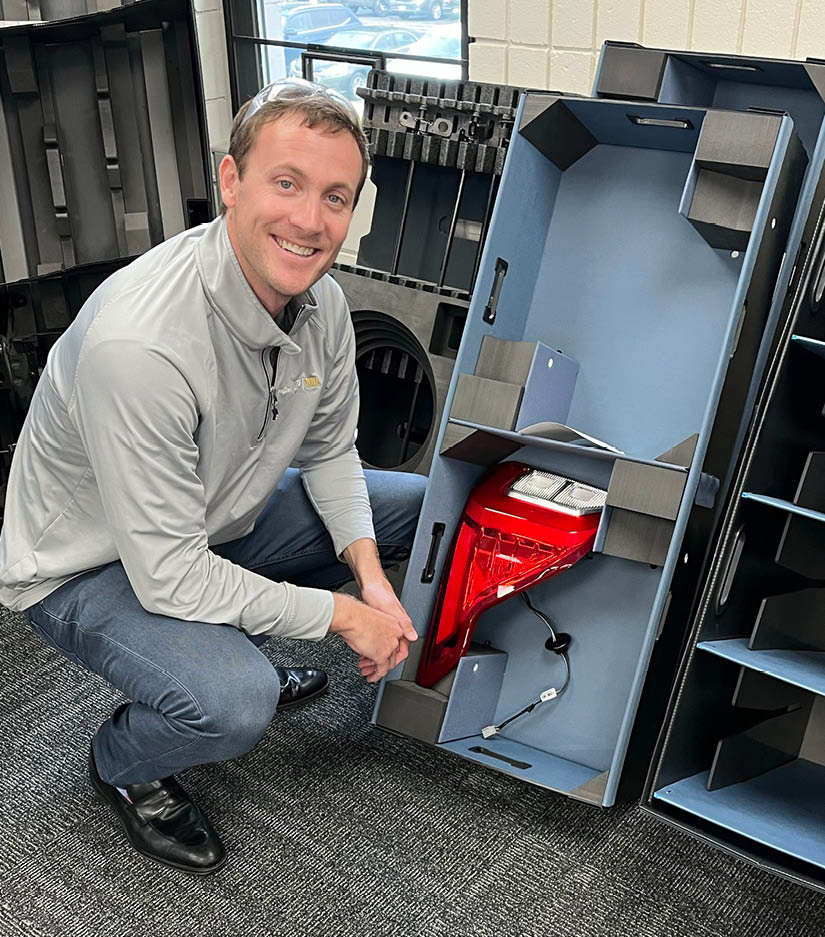
Tommy Bradford elaborates further, noting that every automaker’s assembly line is different, adding complexity to the process. Pointing to a sample part, he says, “This is an example of the same part for five different OEMs being packed five different ways. It all comes down to what their [assembly] lineside constraint is. Who is their tier 1 [supplier]? What is the shipping loop and what is the quantity, and how do they want to handle it?”
The company’s growth in the Michigan automotive sector was the impetus for its 1991 expansion south to Gallatin, Tennessee, where companies such as Nissan and Toyota had opened their first U.S. facilities, thereby christening the South Central states as the automotive region. In 1997, Bradford opened a facility in Wixom, Michigan, to serve customers along the Interstate 75 corridor and southern Ontario, and in 1998, the company opened its first location in Mexico. “One of our customers at the time said, ‘You ought to be in Mexico.’ And being young and naive, we said, ‘Sure, we can do that,’ and we went to Mexico, to Monterrey,” Bradford remembers.
A look at the company’s website is an introduction to the panoply of packaging materials and systems the company now employs to meet its customers’ product protection and shipping needs:
- Chipboard and corrugated partitions: Bradford’s original product line is in multiple point and basis weight and cell size combinations.
- Laminated partitions: Bradford combines up to nine unique layers of materials to meet performance criteria that can include improved durability, surface protection, and electrostatic discharge (ESD) protection.
- Plastic partitions: Bradford utilizes extruded plastics, which offer customers a simple, efficient, and cost-effective solution for protecting parts in a returnable supply chain environment.
- ESD partitions: These partitions are critical for protecting sensitive electronic parts from static electricity, which can damage embedded computer chips or circuits. Bradford designs these for single, one-way use, or multiuse applications. The company has a patented an engineered material, Strata-Shield® ENV, which is made with a “permanently static-dissipative, non-humidity dependent, nonsparking, and amine-free surface,” according to the product description.
- Pallet-sized containers: Bradford’s geographic footprint in the durable goods heartland provides a diverse market for pallet-sized containers and larger-than-pallet steel racks for parts sequencing and work-in-process applications. The company has multiple patented designs in its
pallet-sized product offerings, including AdaptaPak™, which combines the strength and durability of an injection molded pallet box with custom collapsible interior dunnage, and Redi-Rack®, a patented lightweight design that provides freight savings and requires less space for storage lineside in assembly plants. - Totes and hand-held containers: Bradford’s catalog of injection-molded totes and customized hand-held containers complements its industrial-sized products, and this line, too, contains patented items designed by the company’s packaging systems designers.
Bradford internally differentiates this broad array of product offerings in “expendable,” “material handling,” or “engineered components.” “We define ‘expendable products’ as our paperboard partitions either out of solid fiber or corrugated materials,” Tom Bradford says. “It’s a decades-used descriptor within our company to differentiate products that are generally used only once versus our material handling plastic or returnables that are to be used many times over several years. Our engineered components, on the other hand, become part of the vehicle.”
The company’s material handling product line involves the use of multiple materials designed to serve more complex material handling systems. These materials can be as common as plastic, corrugated, textiles, steel, or foam, but they often include proprietary materials to meet customer needs. Illustrating the complexity of material combinations, Bradford says, “Regarding extruded plastic, while some of those materials look similar, they can have very different properties, which we design in. Our specialty plastic materials are sourced from niche manufacturers across the globe.” Noting that the chemical properties and physical attributes of these materials differ widely, he adds, “For instance, some plastic materials are omnidirectional. They do not have a flute and have an equal strength in length and width, while some have special properties related to ESD characteristics.”
Internally, Bradford Company handles this complex mix of materials, designs, products, and related services through automation, specifically its homegrown specification and order software, in which the focus is on developing and streamlining the order entry and workflow process for Bradford’s multiple lines of material handling products.
Tom Bradford explains, “About 25 years ago, we developed some custom tools. Ten years ago, we began retooling, and we rewrote it from the ground up and built it on a new foundation. There have been a lot of advancements in code, and so we incorporated a lot of that to create mobility.”
Alex Slager, sales manager, demonstrates for visitors how Bradford’s customer service team can select substrates, basis weights, partition cell size, and any number of customer requirements to create fast and accurate quotes and factory job specifications for its paperboard partitions. “Customer service and our sales team are somewhat proficient in this program, so essentially, our customer service and sales team act as designers for the simple, straightforward partitions,” Slager says.
Tom Bradford adds that the simplicity and ease of use of the system’s design frees up the company’s material handling design team to work on more complex material handling projects. “Every location we have has designers, and that’s their full-time job,” he explains. “Our designers probably could figure this [order entry] system out, but they’ve probably never used it before. It’s more for our customer service and sales teams.”
The breadth of Bradford Company’s market coverage and its customers’ diverse engineering demands motivate its laser focus on quality assurance and early detection of defects. A snapshot of Bradford’s quality and process certifications reflects its global reach and status as a principal, multitier automotive supplier, to wit:
- International Organization for Standardization (ISO) 9001, U.S., Canada, and Mexico.
- ISO 14001, an internationally recognized standard that helps companies improve their environmental performance.
- International Automotive Task Force (IATF) 16949, a technical specification outlining a quality management system for the automotive industry. The goal of IATF 16949 is continuous improvement, waste reduction and defect prevention, and improved efficiency.
In addition, Bradford operates International Safe Transit Association-certified testing laboratories at each of its nine locations. Bradford also utilizes comprehensive computerized documentation systems, including photo work instructions, control plans, and Process Failure Mode and Effects Analysis (PFMEA) for each of its product lines. PFMEA is a risk assessment and mitigation tool that identifies potential failures in processes such as those that could affect productivity, quality, or safety.
The talent to design, engineer, manufacture, and oversee production of Bradford’s broad line of material handling systems is homegrown, that is, native to and a particular advantage of Michigan’s manufacturing economy. “We are very lucky here that in the triangle from Holland to Grand Rapids to Muskegon—that metropolitan statistical area—we have the most people in manufacturing per 100,000 population. Everyone thinks automotive, but we have boat building, office furniture, heavy truck, automation design companies, and now a variety of battery and energy systems manufacturers,” says Bradford.
These industries have provided Bradford with the kind of thinkers needed to take a project from concept to finished product. “Most of our designers didn’t come from what you might consider a classic packaging design background,” he says. “One of them is a landscape designer; another is a furniture designer. Our question is always, ‘Can you think conceptually?’”
Even someone with a résumé as a corrugated or folding carton designer—those closest in background to Bradford’s core business—will get the same scrutiny. Bradford says, “One of our designers was a box designer. ‘Well,’ we said, ‘can you think conceptually about multimaterial designs? Can you mix in a variety of materials and think conceptually out of the box?’”
The nature of Bradford’s automotive customers demands no less, Bradford says. “When we come at it from that creative side, we say, ‘Hey, every solution might be different. Just because we did it that way before doesn’t mean it’s the right solution again.’
“Tesla’s a great example. They’re building greenfield facilities, and they have a blank slate. They’re going to have different requirements for their operations. So, the way we do something for Ford or General Motors isn’t going to be correct for them. They all have their own idiosyncrasies that require us to be intimate with their way of doing business.”
Bradford Company’s attention to its customers’ needs is in its DNA as an independent company, and customer service is the keystone of Bradford’s culture. Tommy Bradford explains, “We challenged ourselves for years to ask, ‘Are we a manufacturing company that provides a service? Or a service company that happens to manufacture?’”
Out of this, Tom says, comes the company’s operating philosophy, FAST: “We operate the business on a FAST model of forward-thinking,
agile, simple, and trustworthy. If we do all four of those things, we will
be successful.”
Indeed, the company’s growth was recognized in 2020 when it received the Outstanding Growth Award from the Association for Corporate Growth of Western Michigan. The annual award honors a local company that demonstrates sustained growth in sales, profitability, employment, and community involvement.
Bradford continues to build on this trajectory and maintains a level focus on all of the cylinders of its production engine. Maintaining fealty to its paperboard partition roots, Bradford in 2018 brought in Bill Baumgartner, senior vice president. Baumgartner’s résumé in the corrugated industry provides the experience to build the overall operation across chipboard and corrugated partition lines. “He’s senior vice president with a big eye on this end of our business,” Bradford says. “He’s really good at the external-facing and meeting with customers and suppliers due to the connections he has.” Bradford’s 2023 acquisition of Partitions Plus in Findlay was also a key move to bolster its position in the partition market. In Holland, Bradford is expanding its engineered components capacity to a larger facility nearby to allow its partition lines room to expand.
At one point in our visit, Tom Bradford describes himself as a “pretty reserved person.” Yet, his enthusiasm for his family, his business, and its people is infectious. In an article about the company’s centennial celebration, he calls this unique relationship a “camaraderie of service.”
“Our legacy is steeped in traditions of listening to our customers and developing packaging solutions to help them meet their product protection and handling requirements,” he says. “That has kept us at the forefront of the industry for 100 years. This camaraderie of service has extended to multiple generations of Bradford employees and owners—an approach that continues as Bradford begins its second century of operations.”

Steve Young is a Virginia resident and AICC’s former president.
