
October 25, 2024
* North American Industry Classification System
Source: U.S. Bureau of Labor Statistics
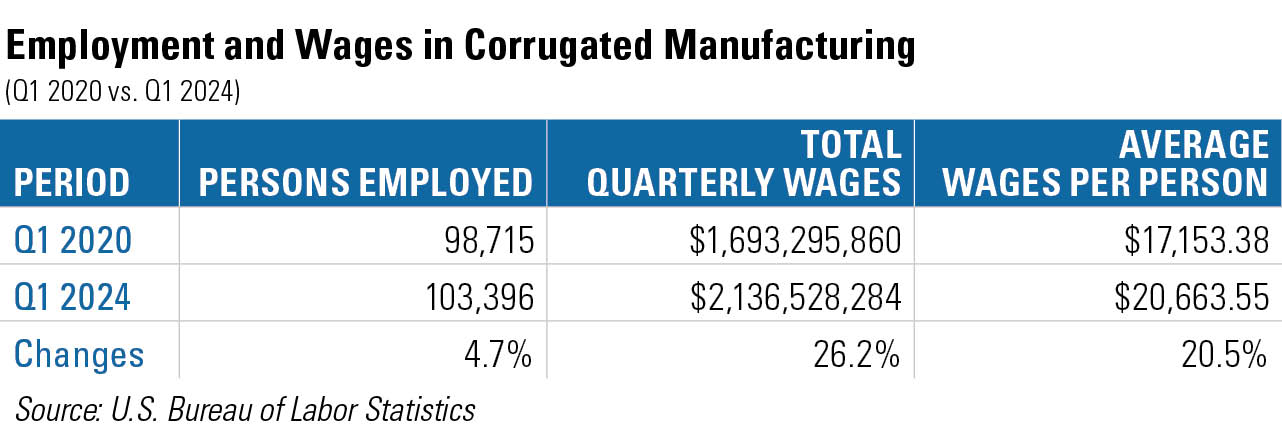
The fundamental landscape of corrugated boxmaking has changed since the COVID-19 pandemic, with demand bolstered by an e-commerce boom. From Q1 2020 to Q1 2024, corrugated manufacturers increased their number of employees by 4.7%, while total wages rose 26%, according to U.S. Bureau of Labor Statistics data (see table at top right).
Despite the past few years of industry growth, the longer-term trend has been more muted. In 1994, corrugated box shipments totaled 374.8 billion square feet (BSF) and were valued at about $18.7 billion, Fibre Box Association data shows. Almost three decades later, box shipments in 2023 were up just 1% at 380 BSF, and 2024 didn’t look much better through the first nine months. Last year’s shipments were valued at $39.9 billion, roughly the same as in 1994 adjusted for inflation.
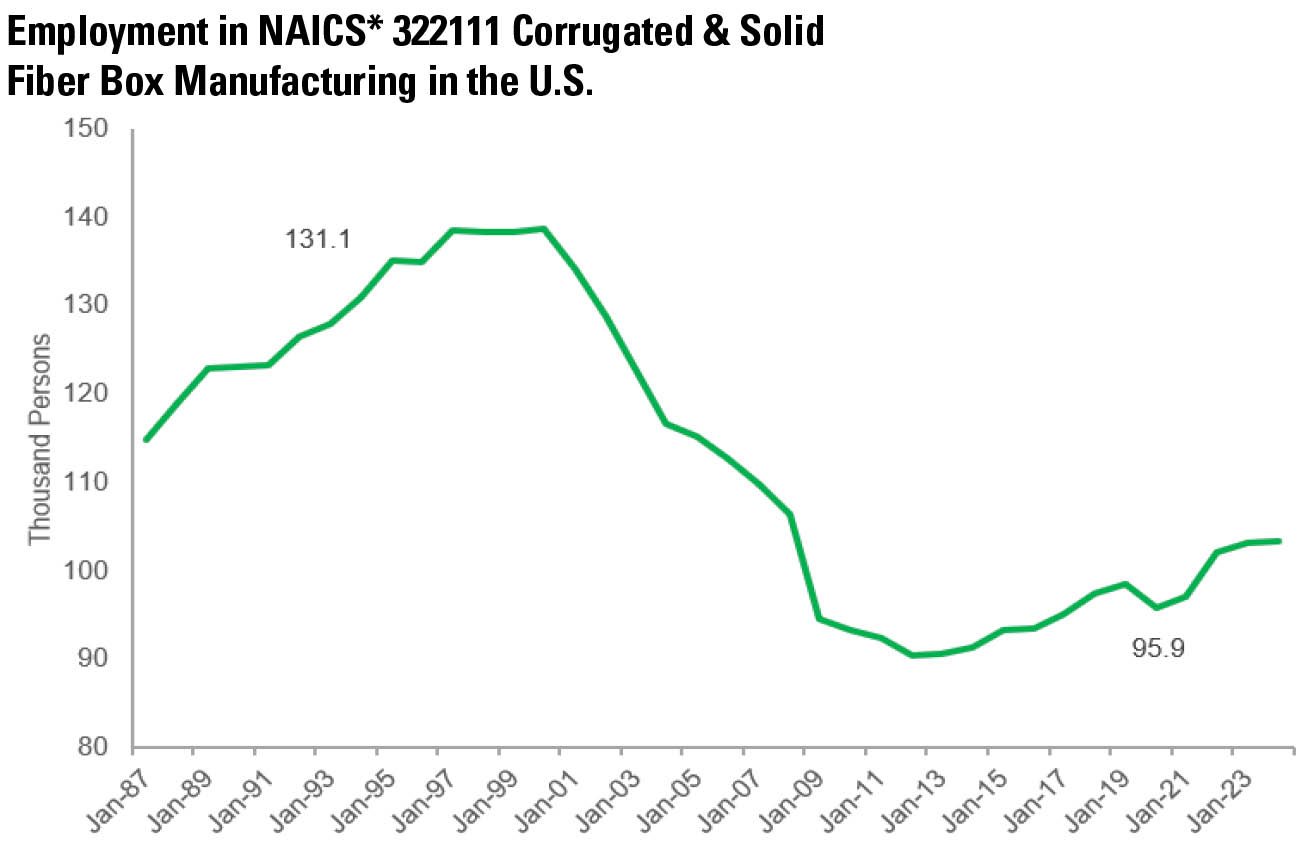
Thirty years ago, 1,467 box plants in the U.S. employed about 131,100 people (see chart at bottom right). Those numbers have shrunk since to 1,150 plants and 103,000 workers, down 22% and 27%, respectively. Today’s smaller workforce faces the increasing demand for graphics, on-time deliveries, and perfect quality. That’s a tall order, but the industry has kept up so far, shipping more product with fewer plants and people while generating similar revenue.
Technology has made that possible. Sheet plants in 1994 largely used hand-me-downs and old equipment. Converted letter presses or similar basic printer slotter machines from the 1960s were popular. Many required a second pass to glue the boxes. Conveyance, automation, and elaborate workflows were absent from the average plant. Almost every machine was manual and required wrenches and tape measures, and the typical press operator might have had 20 years of experience. It wasn’t uncommon for family members to work together on a machine.
If a sheet plant had a conveyor system, it was likely manual. When boxes came off the printer slotter, they were stacked on a cart (basically, a big pallet with four swivel wheels) and pushed by employees through the plant to the next machine. Finding employees was easier than today, and they were the answer to most problems.
The cost to replace old equipment has outrun the ability to generate sufficient profits compared with 1994. New machine prices today are up 30%–130% in inflation-adjusted terms. That’s largely because they’re asked to do far more than they did 30 years ago.
Customer needs have dictated that producers buy new equipment with the ability to print more colors inside and outside of the box. To keep up with orders, machines are highly automated and store box specifications internally. This produces faster setups without the need to turn wrenches. To meet productivity goals and mitigate employee shortfalls, box plants have opted to buy pre-feeders, conveyance, robots, stackers, bundlers, and more.
These advancements and productivity gains have a downside for profitability. The industry’s expanded capacity has prompted some boxmakers to lower box prices to levels that were previously unprofitable to fill up their machines. That widens the gap between prices of containerboard and boxes—and fuels a need for bigger moves in containerboard.

Ryan Fox is a corrugated market analyst at Green Markets, a Bloomberg company.
