Box Company of America Savors a ‘Pallet-able’ Mix of Business
Box Company of America Savors a ‘Pallet-able’ Mix of Business
By Steve Young
May 16, 2025
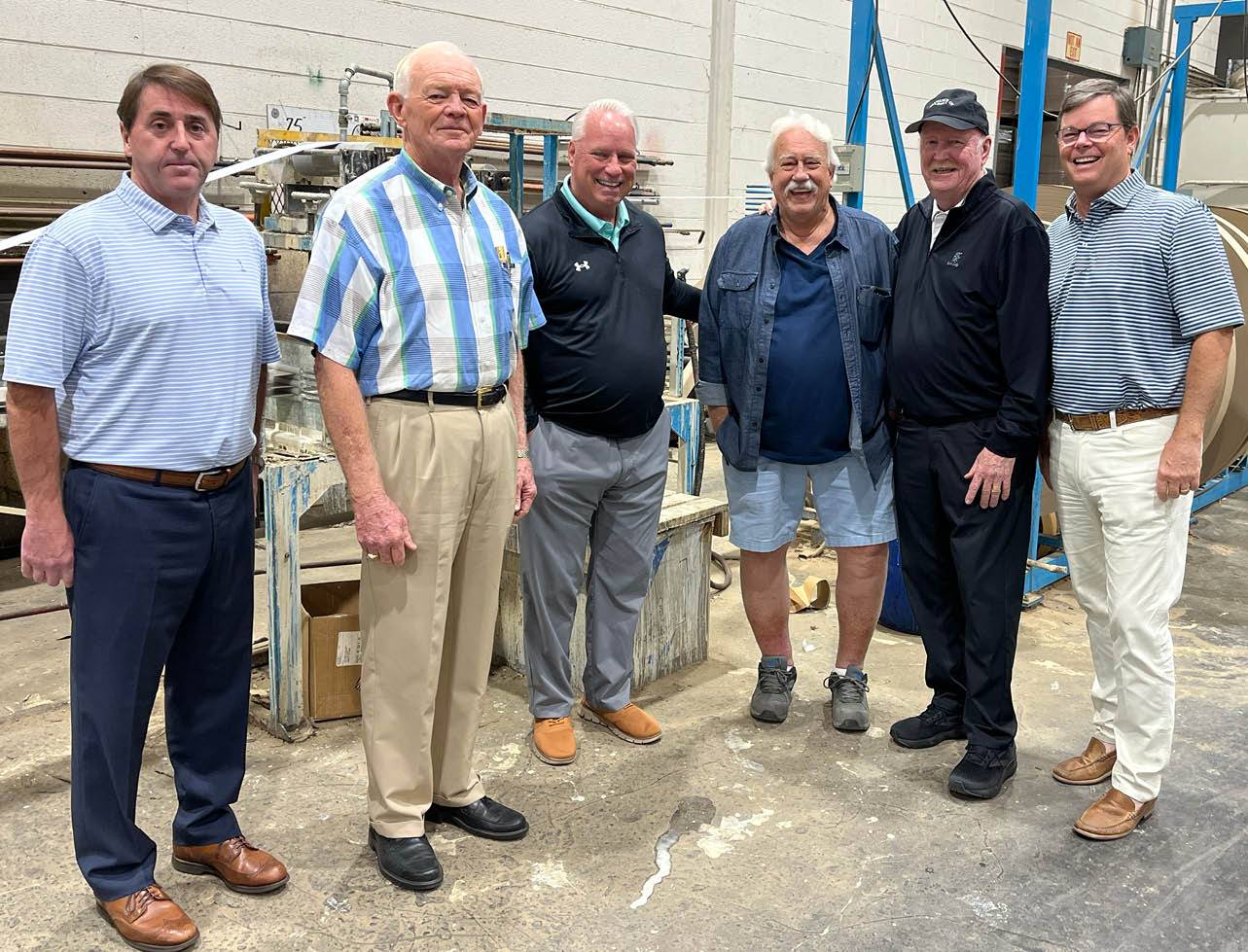
Box Company of America’s ownership team, from left: Scott Fowler, chief financial officer; Gary Harris, partner; Matt Daniels, CEO; David Young, operations manager for honeycomb and edge board; Linwood “Red” Dail III, partner; and Vic Medlin, sales manager. (Photos courtesy of Box Company of America.)
Company: Box Company of America
Established: 2023
Joined AICC: 2024
Phone: 910-582-0100
Website: www.boxcompanyofamerica.com
Headquarters: Hamlet, North Carolina
CEO: Matt Daniels
There’s a certain excitement in the air at Box Company of America LLC (BCA) in Hamlet, North Carolina. The company, founded 35 years ago under the name of Cortek, has new owners, a new name, and, in the words of CEO Matt Daniels, “a new opportunity for growth.”
“Our vision for growth in the manufacturing sector focuses on driving value for our customers by increasing sales and building a stable, highly skilled workforce,” he says. “We are dedicated to creating stable, long-term employment opportunities for our employees while consistently investing in state-of-the-art equipment. These efforts are designed to boost productivity and ensure our customers receive the highest-quality and most innovative solutions.”
Daniels is joined in this new endeavor by his four partners: Vic Medlin, Linwood M. “Red” Dail III, Gary Harris, and Scott Fowler. The five purchased the company in February 2023, with each partner bringing his own talents. For his part, Daniels brings a lifelong career in corrugated sales at Smurfit-Stone and its predecessor, Stone Container.
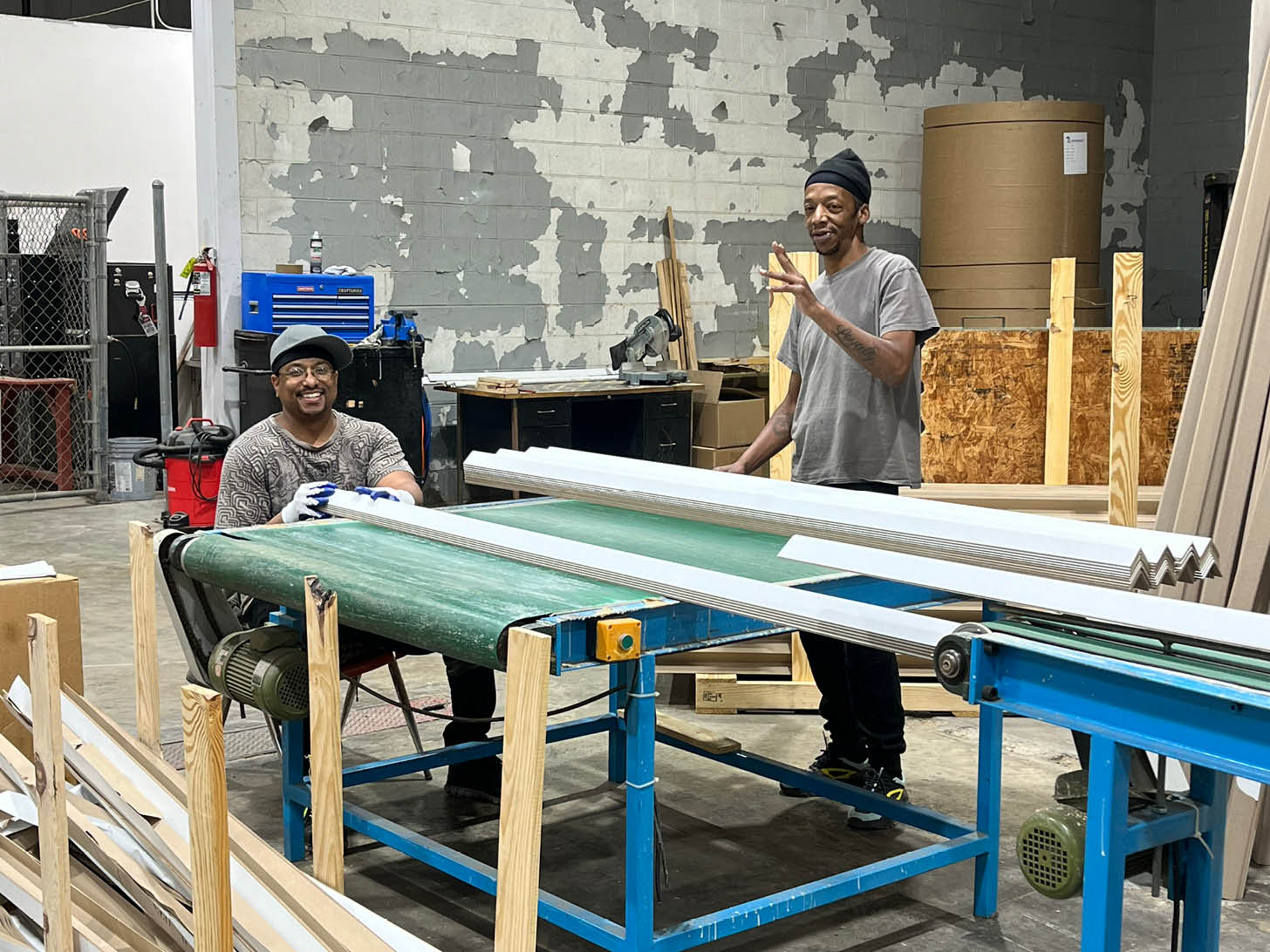
Edge board operators Jimmy Ingram and Tommy Covington in Box Company of America’s Edge Board Division.
Medlin, BCA’s sales manager, has been in and around printing and packaging for most of his 30-year career, beginning with his family’s printing business and then brokering packaging supplies. Eventually, he found himself the global packaging buyer for a large produce company, and from there, he transitioned to brokering corrugated, primarily to produce customers.
Dail is a 41-year industry veteran who began his career at North Carolina Box, where he started as a rookie and worked his way up to general manager. The company was later acquired by Pratt Industries at which point he became a broker and then a partner in a new venture, Welsh Corrugated Container in Butner, North Carolina.
Harris is the quintet’s silent partner. “I’m not a box person,” he confesses. “I’m just a friend and partner of the business.”
Fowler, chief financial officer, worked as a public accountant and later joined Harris at his financial advisory firm, Harris Asset Group Inc. Thus, he found his way into the BCA partnership.
Dail sums up the quality and integrity of the five when he says, “I couldn’t ask for a better group of partners than you’re sitting with.”
The backstory of today’s BCA begins with Daniels losing a big chunk of his Stone Container business to Cortek. “Cortek started 35 years ago under a gentleman by the name of Lynwood Dunn,” he explains. “Lynwood was a friend of Red’s and mine, and he was a buyer for an industrial supplies company down the street that made staples and nails.”
Referring to the lost business, Daniels continues, “I had some of their pad business, and Red had the box business. One day I took Lynwood to lunch, and he asked me how hard it was to make these pads. And I said we just need a slitter and a bandsaw, and you can make pads all day.”
A month later, Daniels says, he returned to get the bad news. “Lynwood was no longer there,” he remembers. “The new person said, ‘Oh, you’ve lost all the pad business.’ ‘To whom?’ I asked. ‘Lynwood Dunn.’ He had started his own business—Cortek.”
Relationships being what they are in the corrugated business, there were no hard feelings. Dunn, Daniels, and Dail remained confidants over the years. “Lynwood Dunn was a very good friend of mine,” says Dail, “and Matt and I both knew him intimately. When we had our business in Butner, Welsh Corrugated, I did business with Lynwood. We helped each other out from time to time because as you know, when a machine goes down, you’ve got to have some kind of a backup plan if you don’t have a duplicate machine. I helped him, he helped me, and we became extremely close.”
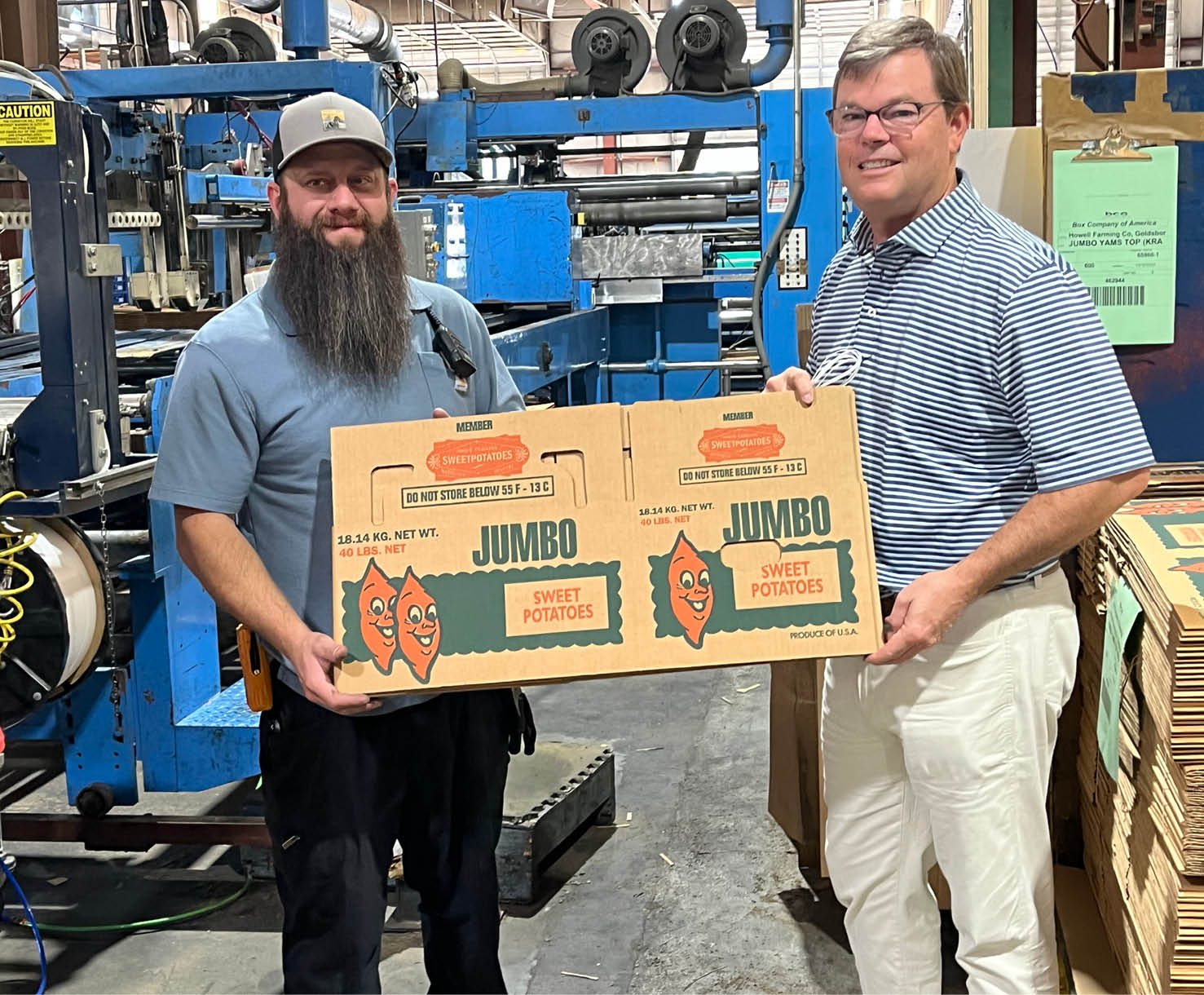
Bryan Ramsey (left), operations manager, and Vic Medlin show off one of the company’s produce boxes, a strongsuit for Box Company of America.
Health reasons prompted Dunn to put the company up for sale. As Dail and Daniels explain, he had other offers, but because of his longstanding friendship with Dail and Daniels, he agreed to sell it to the partner group before his death in February 2022. Negotiations continued with his wife, Terri, and in February 2023, Cortek became Box Company of America. It was not the first choice, says Daniels. “We came up with American Box Company, and we thought we had a good catchy name, and it was patriotic. And then at the last minute, some lawyers we had involved in the acquisition said, ‘Wait a minute; there could be a conflict with that name.’ So, that’s when we came up with Box Company of America.”
Under this new name, the new owners set out to build upon Dunn’s prior success. In their favor are loyal associates whose long-term tenure speaks to the company’s legacy core values. Amy Elsenpeter, customer service manager, is a 10-year veteran; David Young, operations manager at the company’s honeycomb and edge board division, has been with the organization for 30 years. The relative newcomer to the team is Bryan Ramsey, plant and production manager, who joined in spring 2023. He brings 15 years of experience in maintenance, production, and machine installation with Box Board Products and Greif’s CorrChoice Division in Concord, North Carolina.
Daniels and his partners have made upgrading BCA’s infrastructure and business mix a priority. “We’ve really been focused on our own equipment,” Daniels says. “We have made significant improvements to machinery in virtually all areas of our plants, with repairs, replacement, and additions as appropriate. The equipment that was here wasn’t in original equipment manufacturer spec condition, so we’ve really spent the last year and a half getting it to where it can handle our business. I would say we recently just accomplished that.”
The company’s original equipment mix, just out of its yearlong retooling and upgrading, is well suited to support such a diverse mix: an 86″ x 210″ two-color Curioni flexo printer-slotter—the largest in North Carolina; a 50″ x 110″ two-color Curioni flexo folder-gluer; a 66″ x 113″ Serenco die cutter; a 66″ x 170″ two-color jumbo die cutter; and a 50″ x 118″ four-color TCY flexo folder-gluer with die cut section.
A sheet plant, BCA serves a diverse industrial market primarily in North Carolina, South Carolina, and Virginia. The immediate area of Richmond County, North Carolina, is home to food processors, pharmaceutical manufacturers, and textile and agricultural customers, and business is again growing after years of decline in once-prominent industries. Daniels and his partners, through their decades-long experience and long-standing relationships, bring accounts representing varying facets of this market. Harris, having worked closely with the textile industry in their financial services firm, brings those relationships. Fowler, as a certified public accountant with Harris’ firm, brings similar experience. Medlin’s global positions in the produce sector offer another rich corrugated customer base. And Daniels and Dail have operated across the wide spectrum of general industrial packaging.
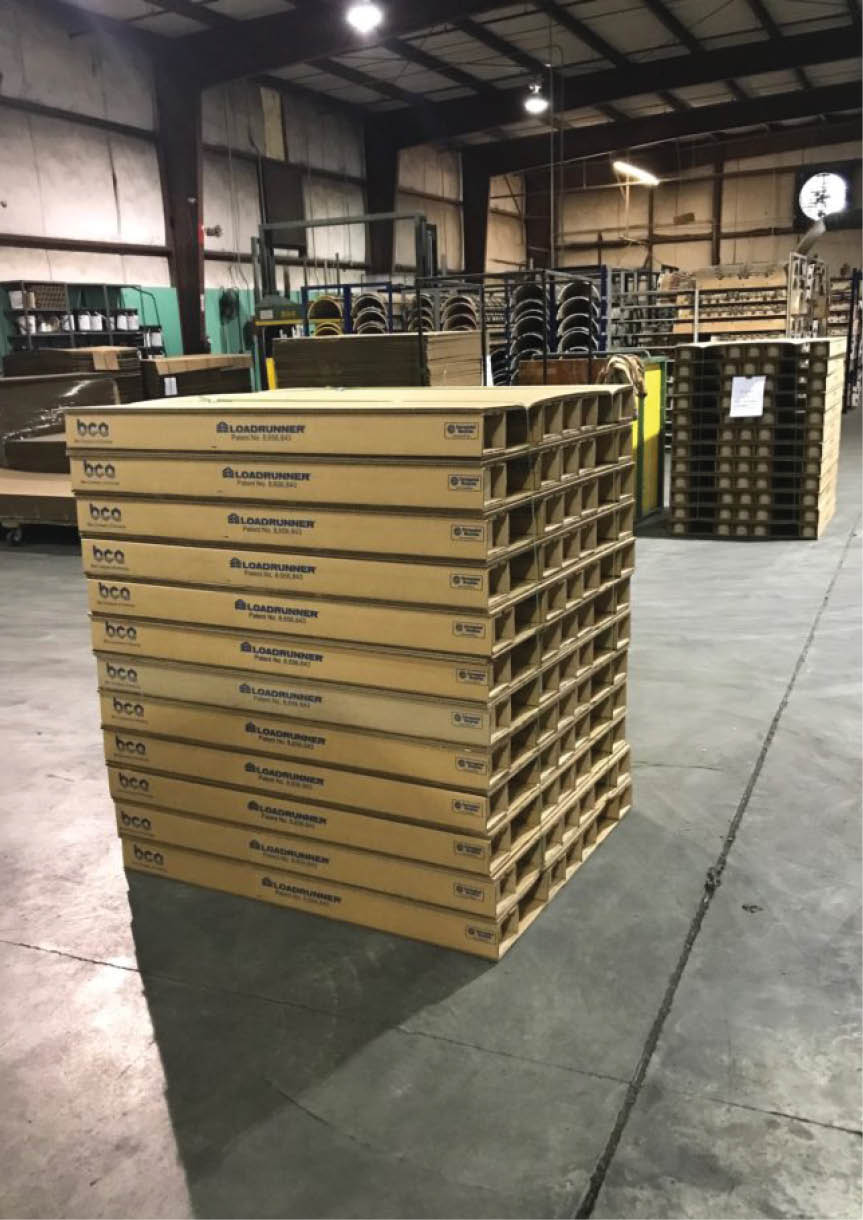
Box Company of America’s patented LoadRunners™ corrugated pallets are expanding the company’s footprint beyond traditional corrugated markets.
Yet from these varying perspectives, the BCA owners are single-minded in their sales and marketing philosophy, adopting what Daniels describes as an “extremely innovative approach” to serving customers.
“Every customer we visit has a way of doing things that they’re happy with,” Dail explains. “But when we go in, we look for things that have never been suggested to them in terms of service and quality, but also in products that we have available that they’ve never considered using. I think that’s what we’re good at.”
Daniels, with another perspective, shares his concern that as the corrugated industry’s principal players grow larger, they risk losing focus on the customer’s real needs. “I think the main part of our industry is focusing on internal operational efficiencies and not really focusing on the customer,” he says. “We’ve gone back to the old school of ‘How do we fit them? How can we make them happy, and how do we do business with them?’ without worrying about having to spend a little extra time on this order.”
Medlin lays this lack of customer care on the inexperience of some corrugated industry sales representatives. “The people calling on accounts are not as experienced as they need to be,” he says. “When you get people who have been doing it for 20 or 30 years, they know where to help the customer. They may look at an item and say, ‘I can make that a better product for you and a lot of times for a lesser cost.’ And it is still a good, profitable piece of business for us.”
Medlin notes this as an advantage for BCA: “We differentiate ourselves from other suppliers in that our people have on average 20 to 25 years’ experience.”
BCA employs 45 people in a single-
shift operation. Its manufacturing capacity in Hamlet is housed in two buildings: a 60,000-square-foot sheet plant and an adjacent 35,000-square-foot specialty plant producing honeycomb and edge board. While 60% of the company’s sales portfolio is in the traditional sheet plant mix of industrial packaging, the remaining specialty items, particularly its unique honeycomb and pallet products, offer what Daniels and his partners see as greater opportunities in their current market and in corrugated industry trade sales.
Corrugated and honeycomb pallets were for many years a part of the former Cortek’s original product mix, and it was a part of the business the new owners saw as prime for further investment. Thus, the company’s recent acquisition of a robotic corrugated and honeycomb pallet line—which came about by sheer serendipity—has driven and expanded this business, with Box Company of America now shipping these items as far west as Nebraska and north to Pennsylvania.
Sonoco had a large honeycomb, corrugated pallet, and fiber core and cone operation near Charlotte that served the North Carolina yarn and textile industries, Daniels explains. On a visit to the plant, the CEO of Sonoco, seeing the automated robotic pallet assembly equipment, inquired what it was. “The Sonoco CEO comes in and asks, ‘What’s this here for?’ They said, ‘We combine honeycomb and make these pallets for the yarn companies so they can make what they call a full yarn pack.’ The Sonoco CEO says, ‘That’s all great and wonderful. Get rid of it and put in four more [fiber] core lines,’ ” Daniels says.
So, BCA, being a honeycomb customer of that same Sonoco plant, was approached by David Monteith, general manager, about taking the equipment off their hands. “ ‘I think you guys might be interested in purchasing this,’ ” Daniels recalls. “ ‘You’re an innovative group, and you can probably utilize this to do things that we haven’t.’ ”
BCA’s management group agreed, seeing the need in the company’s diverse market for custom corrugated and honeycomb pallets designed to specifications outside the normal footprint of 40″ x 48″. They purchased the equipment in October 2023 and have been actively marketing its production to prospective end users.
“It’s a robotic system that manufactures pallets and variations of things we have designed,” Daniels explains. “We purchased the equipment and got the patent rights and the trademark on the name. They’re called LoadRunners™. They’re made with a corrugated runner, and that is put between a top and bottom piece of either honeycomb or corrugated. This is where we can get innovative and work out with our customers what they need.”
Their investment, Daniels says, is starting to bear fruit. The BCA team is eyeing new market opportunities for their pallets throughout the Southeast, particularly the tire, food, furniture, automotive, and pharmaceutical industries. “We’re working in places that we’ve never gone because these places don’t always buy a box,” he says. “It’s opened a whole other stream of revenue for us.”
Asked how they identify and qualify potential pallet customers, Daniels says, “If these companies don’t typically entertain box company salespeople, we go into the back, and if we’re seeing pallets, we’ll see a plant manager or shipping manager. They’ll tell us the pallets are $48 apiece, and we’ll say, ‘Well, we can make them for $45.’ ”
Medlin believes leveraging connections is an important part of the sale. “You have to be creative,” he says. “You have to figure out if you know somebody who might work there who knows somebody who might know somebody. Cold calling is not very successful, normally.”
Harris adds that the products’ features are attractive to customers in today’s plant and shipping environments. “The way our pallets are engineered and built allows us to compete in things that a conventional pallet couldn’t stand,” he says, noting that some of their designs can hold up to 7,000 lbs. in a dynamic load environment such as a moving trailer or containerized rail or ocean freight. “I also think the story behind these pallets is helpful. They’re sustainable, and they don’t require chemical treatments or heat treating for shipping. They’re clean, environmentally sustainable, and recyclable. There are a lot of companies that these features play well to. And it’s a competitive product.”
Commenting on the competitiveness of corrugated pallets, Dail makes the distinction between price and cost, saying, “If you’re looking for the price of the pallet, then it wouldn’t be competitive necessarily, but if you’re looking at the cost, now you’re competitive, and the things that Gary just pointed out, those are the things that we use when we get in to see someone.”
Dail, however, his decades-long experience showing, sums up the most effective tactic the BCA team is using to move their pallets into the market: “It comes down to one word: persistence.”
BCA is similarly positioning its honeycomb line of products and edge protection, and the marketplace is receptive for many of the same reasons as it is to the corrugated lines. “A lot of companies are moving out of foam,” says Daniels. “Wineries and the liquor business like it because it gives them cushion and support so there’s no damage. Retailers are asking not to have foam in their stores, and so we’re able to take honeycomb and replace that. It’s 100% recyclable, and it’s chemical-free.”
BCA and its new owners see a promising future, not only in their collective vision of their growing market but in the state and local business climate, as well. North Carolina, long being a right-to-work state, rolls out the red carpet for business expansion and relocation. “The political environment and growth of North Carolina are going to help our company,” Daniels predicts.
Indeed, the list of new manufacturing installations in recent years proves him right. Toyota is building a battery facility near Greensboro, and silicon carbide manufacturer Wolfspeed is also building a large plant near Durham.
“There are a lot of companies that supply them that need corrugated, and they’re going to need corrugated, as well,” says Daniels. “Plus, they’re going to need all the products that we have.”
The other development that augurs well for Box Company of America is the fundamental shift in the corrugated industry away from smaller sheet plants to megaplants. “The larger integrated companies have shut down the small and medium-size corrugated plants and built one big plant. This means they don’t want to even deal with our kind of business, so we think this is a positive for us. There are a lot of customers out there that need smaller quantities and faster service,” says Daniels.
Box Company of America, an established corrugated and specialty business with a new name, new owners, and a new outlook, sees an optimistic future in a part of North Carolina that is seeing an economic renaissance after many years of decline. As a closing testament to the commitment of BCA’s new owners to their customers, their employees, and their community, Daniels speaks for his partners in restating their mission. “At Box Company of America, we specialize in understanding and meeting the unique requirements of our customers by delivering top-notch corrugated box solutions, including corrugated boxes, edgeboard/cornerboard, honeycomb products, and corrugated/honeycomb pallets,” says Daniels. “We are committed to providing meaningful job opportunities and fostering community development in an economically challenged area. Our core principles of customer satisfaction, superior quality, and continuous innovation drive us toward excellence in both our product and social impact.”
Steve Youngis a Virginia resident and AICC’s former president. He can be reached at 202-297-0583 or syoung@AICCbox.org.