
November 6, 2024
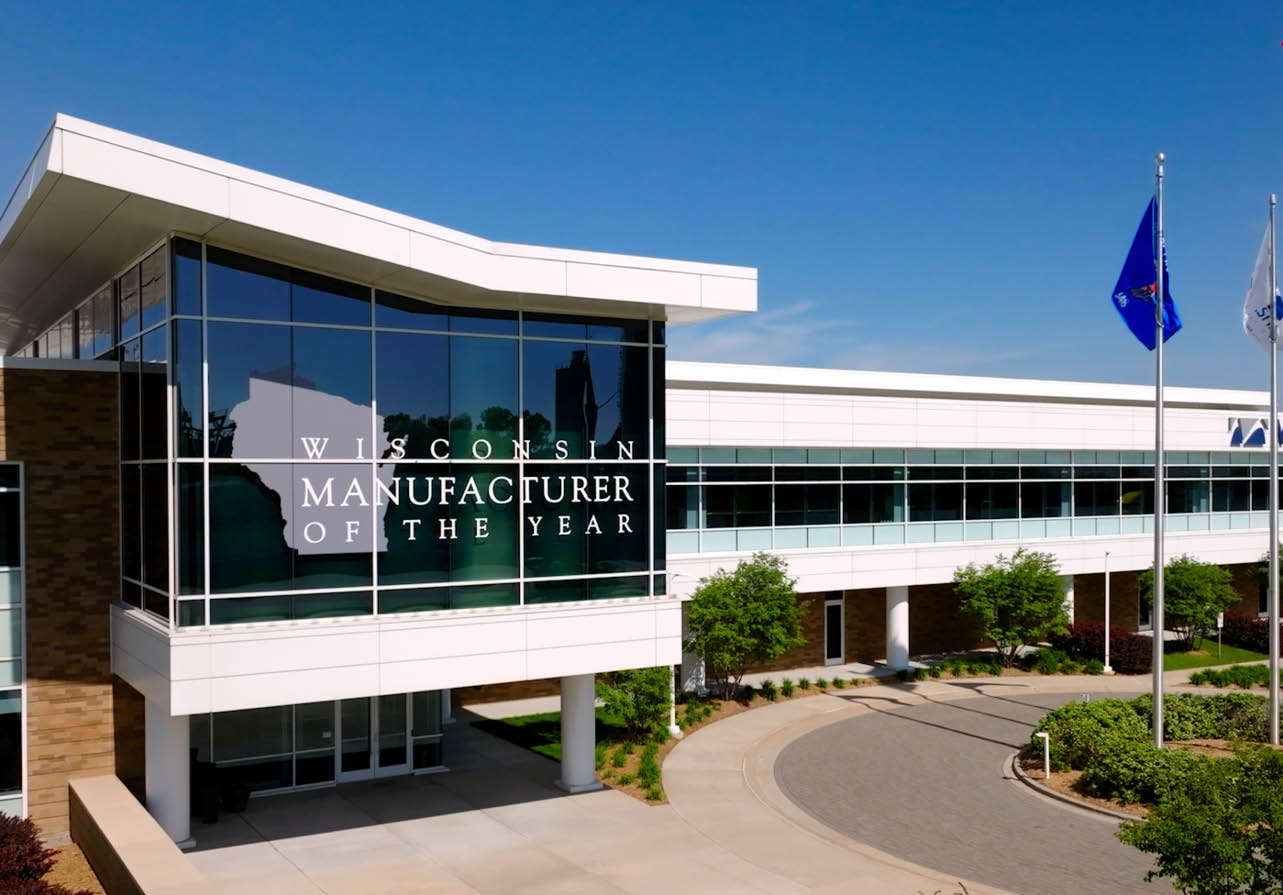
Company: Menasha Corp.
Established: 1849
Joined AICC: 2023
Phone: 920-751-1000
Website: www.menasha.com
Headquarters: Menasha, Wisconsin
President: Mike Riegsecker
Anyone who’s been in the corrugated industry for 20, 30 years, or more can be forgiven for thinking of Menasha Corp. as an “integrated” forest-products company. After all, it did own paper mill assets and timberlands during much of its long history.But Mike Riegsecker, president of Menasha Packaging, is quick to set the record straight. “We’re a 175-year-old private company that’s owned by the same family that founded it,” he says. “We’re now in the seventh generation of family ownership.”
Menasha Corp., based in Neenah, Wisconsin, this year celebrated its 175th anniversary as an independent. Riegsecker recalls the company’s legacy of entrepreneurial innovation and commitment to customers, employees, and their communities. “The industries we serve continue to evolve, and that has evolved the expectations our customers have with their packaging and supply chain requirement,” he says. “These evolutions have taken place for 175 years, and as they do, we have remained focused and committed to growing and investing in the solutions we offer—always focused on helping our customers solve the challenges they are facing today while remaining out front and in tune with the challenges that are on the horizon where new solutions will be required.”
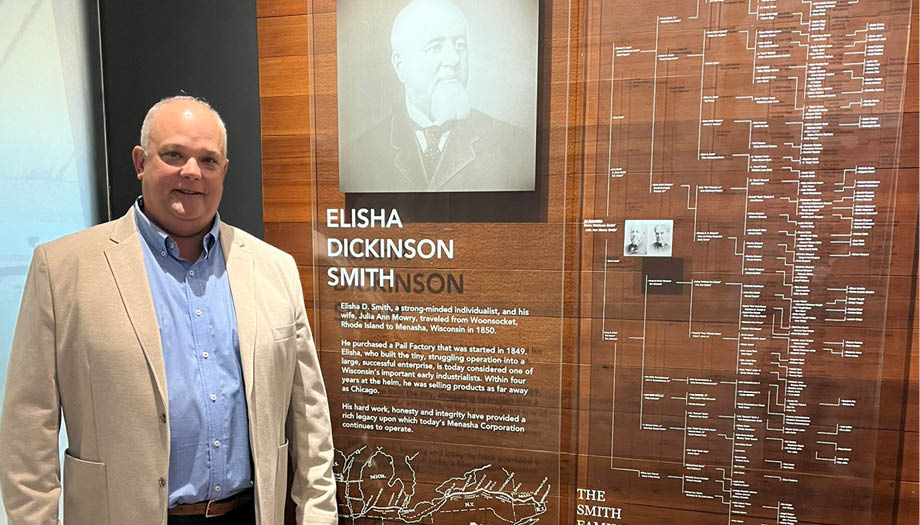
The company was founded in 1849 in Menasha, Wisconsin, as the Pail Factory, a maker of wooden buckets, barrels, and kegs. It floundered in its early years, however, and in 1852, a young transplant from Woonsocket, Rhode Island, Elisha D. Smith, seeing an opportunity to exploit the growing volume of trade in the newly admitted state of Wisconsin, acquired it for $1,200—money borrowed from his father-in-law in Rhode Island. In 1872, the firm reorganized under the name Menasha Wooden Ware Co.
Though the privately held Menasha of today lacks vertical integration in timber resources and paper mill assets, its founder recognized the need to secure his sources of raw material supply. In the early days of the Wisconsin territory, canal and rail transportation made possible the bulk-shipment of products such as vinegar, sauerkraut, beer, and sausage from the interior of the territory to the Great Lakes ports of Green Bay and Milwaukee. Abundant timber resources there provided the hardwoods needed to produce the barrels and kegs to support this trade, so Smith acquired timberlands in Wisconsin, Michigan, and Minnesota to supply the company. Later, after these sources grew thin—reforestation was little practiced at that time—he bought lands in Washington, Oregon, and northern Idaho. Downstream timber processing facilities such as lumber mills, stave-making plants, cooper shops, and painting facilities completed Menasha Wooden Ware’s supply chain and drove much of the company’s success in the last decades of the 19th century.
With the passing of Smith in 1899, his son Charles Robinson Smith took the reins of the company. But it was his son Mowry Smith Sr. who, as a new member of the company’s board of directors in the 1920s, recognized the value of a new, nascent industry: corrugated paper.
By the late 19th and early 20th centuries, the development of corrugated paper and fiberboard shipping boxes provided an alternative to heavy wooden crates. Shippers, impressed with the lightweight durability of corrugated paper, saw it as a viable alternative. Gina Shaw, writing in Living Our Values: The Story of Menasha Corporation, named the Lawrence Paper Co. in Lawrence, Kansas, and Fort Wayne Corrugated Paper Co., as two of the earliest entrants into this market, calling them “the first mass corrugated box producers in the United States.” However, the railroads, the predominant carriers of freight in that era, objected to the introduction of paper-based packaging and began charging a tariff on products packaged in it. A landmark decision for the future of the corrugated box as a shipping container came in 1914 with the Pridham case in which the Interstate Commerce Commission ruled that there were no differences between the movement of commodities in fiber and wood boxes and thereby removed the added tariff. This decision paved the way for the young corrugated box industry to compete with its wooden counterparts. It was thus, in 1927, that Menasha Wooden Ware, seeing shrinking demand for its wood-based packaging, converted a four-story butter-tub warehouse into its first corrugated box plant. The corrugator installed was from the Samuel M. Langston Co., and its principal linerboard supplier at the time was the John Strange Paper Co. of Menasha.
According to author Shaw, the company struggled in its early years but recovered even as the Great Depression gripped the nation. Although the company grew into profitability, Menasha was dependent on outside suppliers of linerboard and corrugating medium. Lacking the capital to build its own mill but seeking more control over its sources of supply, Menasha in 1939 acquired a stake in the Otsego Falls Paper Mill, a manufacturer of linerboard and medium located in Otsego, Michigan. Then, beginning in the 1940s, the company expanded its converting capacity through box plant acquisition, starting with Durham Container Co. in North Carolina. And in what could have been the prototype for today’s sheet-supplier or joint mill-ownership consortia, Menasha and four local box companies in 1946 purchased the John Strange Paper Co., the original supplier to its flagship plant in Menasha.
The corrugated box industry was propelled by a post-war economic boom, and vertical integration was a principal driver of the industry’s capital investment decisions. Shaw, in Living Our Values, writes that during this time, Menasha expanded west, with the 1954 construction of a greenfield corrugated box plant in Anaheim, California. Concurrently, the company parleyed its timberland holdings in the Pacific Northwest into lumber and building products for the postwar housing boom as well as constructing a corrugating medium mill in North Bend, Oregon, to serve the expanding West Coast box market. The company still operated under the name Menasha Wooden Ware Corp., until 1957, when Menasha shipped its last wooden product and closed its wooden products arm. In 1962, the company changed its name to Menasha Corp.
Today, Menasha Corp. consists of two principal divisions: Menasha Packaging and ORBIS (see sidebar below). Overall, it has nine corrugated printing and converting sites across North America. Each of these sites receives graphic packaging preprinted rolls or top sheets from Menasha’s North American Preprint Hub in Neenah, its litho-printing facilities in Neenah and York, Pennsylvania, and a litho-lamination plant in Richmond, Indiana. Menasha also maintains a network of 32 packaging service sites across North America. These sites perform co-packing, display assembly, and kitting services, which round out the company’s focus on supply chain efficiency for its diverse customer base.
Menasha’s contemporary focus on graphics has deep roots, as well, going back to founder Elisha D. Smith, who once said, “A good-looking package is worth more money.” That philosophy was translated into action during the company’s acquisition spree between 1969 and 1980, when it acquired several plants, including Wisconsin Container Corp., Crown Corrugated Containers in Greensburg, Pennsylvania, and Hartford Container Co. in Hartford, Wisconsin. Hartford became Menasha’s color division, maturing now over 40 years and enhanced by further acquisitions of independents, including Triangle Container Corp. in Philadelphia, the Strive Group (formerly Pride Container) in Chicago, and Pearce-Wellwood in Brampton, Ontario. The company’s 2022 purchase of Georgia-Pacific’s color box division put an exclamation point on Menasha’s graphic emphasis and broadened the company’s reach not only in the Midwest but also in the South and Northern California.
Riegsecker, now with Menasha for 31 years, witnessed the company’s growth, especially its graphics services and capabilities. An Indiana native and graduate of Purdue University in Indiana, he joined the Menasha color division out of school. “I spent the first eight years or so in manufacturing operations before I got into technical sales roles,” he recalls. “I ran sales for our whole company and had different regional jobs along the way. So, I’ve done a lot of different things over the 31 years before coming into this job in 2018.”
In the past 25 years, the corrugated industry has shifted its marketing and sales focus as the North American manufacturing base shifted to lower-cost manufacturing environments. “We really started with what was going to stay in the U.S., and we decided that we were going to focus on food, personal care, and household products in a big way as our core market segments,” he says.
The company has engineered a finely tuned system of printing and graphics application, from direct print, litho-lamination, preprinted linerboard, and sheet-fed digital—what Riegsecker calls “integrated services and vertical integration of the way we apply graphics to corrugated or other material.” From its graphics houses to its finishing operations, product is shipped to one of its 32 service facilities for final packing and delivery to retailers.
Menasha considers the customer’s entire supply chain, and its introduction of automated systems drives costs out of the chain for their direct customers and their customers’ customers. Says Riegsecker, “We asked ourselves, ‘Could we become part of a revenue conversation with our customers versus just a cost conversation?’ And we started to develop relationships, and we now have offices next to the major retailers all over the U.S.”
Menasha’s commitment to its customers and their retail customers began in earnest in the early 2000s. The company, under the newly minted leadership of President Mike Waite, was still seen as a commodity brown-box supplier. To counter this, writes Shaw in Living Our Values, “Waite and his team established the Retail Integration Institute (RII), a strategic merchandising consultancy housed within Menasha Packaging.
“The intent behind RII was to create a mechanism for co-developing merchandising solutions with customers, wiring packaging’s value proposition more tightly to its customers’ needs and goals.”
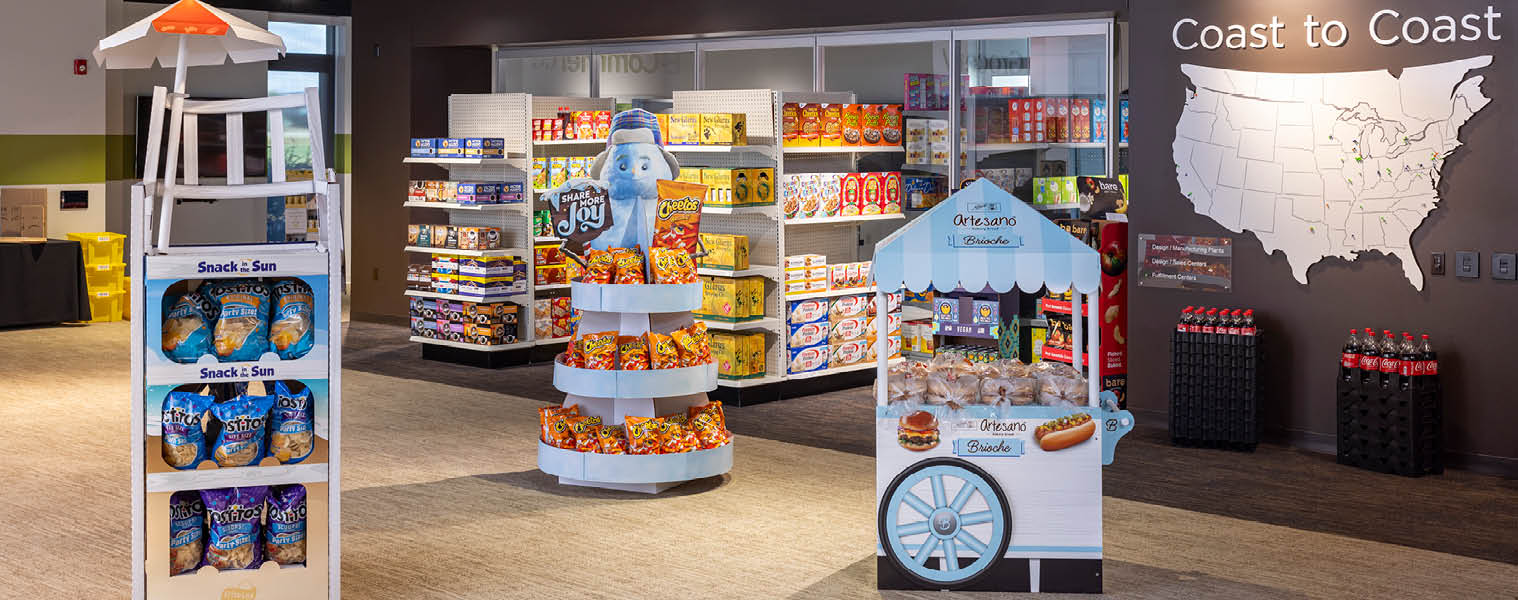
Visitors to Menasha Corp.’s Neenah headquarters will find their way to the RII showroom, where the company’s retail promotion expertise is on full display for primary market segments such as food and beverage, personal care, pharmaceutical, and automotive aftermarkets, among many others. According to Shaw in Living Our Values, Menasha’s first successful project in RII was with the H.J. Heinz Company (now Kraft-Heinz). Ketchup and mustard were profitable for Heinz, but pickle relish was not. “On RII’s advice,” Shaw writes, “Heinz created the now-familiar ‘picnic pack,’ a bundle of ready-to-go ketchup, mustard, and relish sold at chains like Walmart, Sam’s Club, and Costco. The solution increased the package’s appeal, saved Heinz about $500,000, and generated record sales.”
While a success for Heinz, it was a significant learning experience for Menasha. Riegsecker, recalling the case, says, “We didn’t understand all the cost drivers, what the costs were of holding the merchandise, and how to price it.”
All these, he now says, are at the heart of Menasha’s continuous effort to improve efficiencies by enlisting automation to streamline the process for their customers. “It’s almost like we’re providing packaging systems, not just displays. And so, how do you do that efficiently? How do you look at the total cost through that lens?
“Menasha’s original strategy of evolving with the industries we serve as they grow has driven many investment decisions around the expansion of our footprint, state-of-the-art assets, automation, robotics, and new products and services. This continued network modernization is critical to the longevity and success with customers.”
From the start, Smith was a man of integrity who considered the well-being of his employees as a cardinal virtue of his company. Even as the former woodenware business was drying up, no employees were laid off. Writes Shaw, “It probably would have made more business sense for Menasha to lay off many of its longtime employees when the [corrugated] box plant opened [in 1927], but true to its values as a people-first company, Menasha wasn’t about to turn loyal workers out in the cold.”
These values hold true today, seven generations later. “It’s interesting,” Riegsecker notes. “Everybody’s got the same equipment in this industry, right? So, it’s people who are the differentiating force, and you know, I’m proud of our people in Menasha. There’s just a tremendous longevity in the company, and our people really have a passion for our customers and our communities. It’s one of the reasons I’ve stayed here for 31 years.”
Menasha has engraved this ethos within its very name, declaring with each first letter of the following values its people- and value-centric culture:
- Meet our commitments.
- Excellence in serving our customers.
- Neighborhood involvement and improvement.
- Ability to see and embrace change to continually improve.
- Sincerity, candor, and teamwork in everything we do.
- Honesty, integrity, and respect at the highest level.
- Accountability to customers, employees, communities, and shareholders.
The Menasha of the postwar era presented a textbook model of vertical forest-products integration: vast land holdings in the Upper Midwest and Pacific Northwest; pulp, timber, and building materials; paperboard and corrugating medium; and converting facilities in the form of corrugated box and sheet plants.
By the 1980s, however, the company’s leadership decided to sell its West Coast assets, including its North Bend, Oregon, medium mill and Anaheim, California, box plant, to Weyerhaeuser. This divestiture allowed Menasha to focus on the growing graphics and display markets, especially serving the large food, beverage, and consumer products customers in the Midwest. The company retained its 225,000-ton-per-year medium mill in Otsego, Michigan, having rebuilt the two paper machines there in the mid-1990s. But by the early 2000s, the Otsego mill was also diluting Menasha’s focus on its core businesses, and in 2005, the mill was shut down and later sold. The company then became one of the largest open market buyers of containerboard, which today Riegsecker says is a decided competitive advantage. “That was a major transformational event for us,” he says, referring to the Otsego closure, “because we became one of the largest net buyers of liner and medium in North America. I think it’s an advantage because we’re able to utilize different kinds of paper, different recycled content. We’re not locked into one way of doing things with a mill that we’re invested in.”
Riegsecker and his team at Menasha Packaging are energized by the company’s rich 175-year history and its status as a seventh-generation family-owned independent in the corrugated and paperboard industries. “Menasha’s mission,” he says, “is to ‘help customers protect, move, and promote their products better than anyone else.’ One hundred seventy-five years ago, Menasha would have been focused on helping customers ship products like candy and butter in bulk. Today, Menasha is a leader in high-end graphic packaging, protective packaging, promotional displays for retail, and the fulfillment of solutions for over 1,500 global brands in the U.S. and Canada.”
“Yet,” he adds, “we’re independent. We’ve niched and created value and hustled entrepreneurially just like the rest of the AICC membership does every day. We’ve learned to provide value to some of the biggest consumer goods companies in the world but in the same entrepreneurial way.”
And so, to those in AICC’s membership who remember Menasha as an integrated company, Riegsecker says, “Think again. We’re excited to get back in AICC. The entrepreneurial spirit is exciting to us.”

Steve Young is AICC’s ambassador-at-large. He can be reached at 202-297-0583 or syoung@AICCbox.org.
Sidebar: ORBIS: Customers Also Need Plastic
“Well, I can see that plastics are becoming a threat to paper packaging. We ought to have a foot in the door.”
With that quip, Mowry Smith Sr., grandson of Menasha founder Elisha D. Smith, in 1957 set the stage for what is today Menasha Corp.’s other principal division: ORBIS. Menasha had already identified a need for industrial companies to transport parts in-plant and from warehouses to production lines—and for bakeries to deliver to retail stores. The company thus acquired a majority stake in a pioneer closed-loop plastics packaging manufacturer, G.B. Lewis, and thus diversified its product offerings for a growing customer base. Over the years and with several acquisitions, Menasha’s plastics division became a vehicle for balancing the cyclicality of the corrugated packaging business. In 1996, these several entities were combined to form ORBIS.
Today, ORBIS supplies reusable totes, pallets, containers, dunnage, and racks to a wide range of global manufacturing, distribution, and assembly industries. Headquartered in Oconomowoc, Wisconsin, ORBIS has 3,300 employees working in 12 North American manufacturing and 34 service-center sites. Operating under the banner of ORBIS Reusable Packaging Management, ORBIS service centers sort, inspect, clean, refurbish, and repair all types of reusable packaging.
