
August 29, 2025
AICC’s education pathway offers a more focused way to train and lead
The road to leadership can be filled with potholes, especially in a complex industry such as boxmaking.
Now, the new AICC Pathway to Success is filling gaps between existing programs while striving for the high level of learning and engagement established by AICC’s existing leadership outlets.
“Better leaders aren’t born,” says Terri-Lynn Levesque, vice president, administration, at Royal Containers, and incoming AICC chairperson. “They are built through a trajectory. That’s how you’re going to grow within this industry.”
The AICC Pathways to Success, newly depicted in the useful diagram below, rounds out AICC’s learning and networking opportunities with three new elements—a Management Group for midcareer professionals, an MBA-level certificate steeped in industry principles, and an executive coaching program for future C-suite inhabitants.
Building on and converging with AICC Packaging University’s excellence in learning, the pathway continues providing exclusive educational opportunities that keep career-minded talent in the industry.
And it comes, as always, from ideas generated by AICC members. “We truly are addressing specific needs of the industry that provide value to an enormous part of our membership,” says AICC Senior Manager of Education Rebecca Rendon.
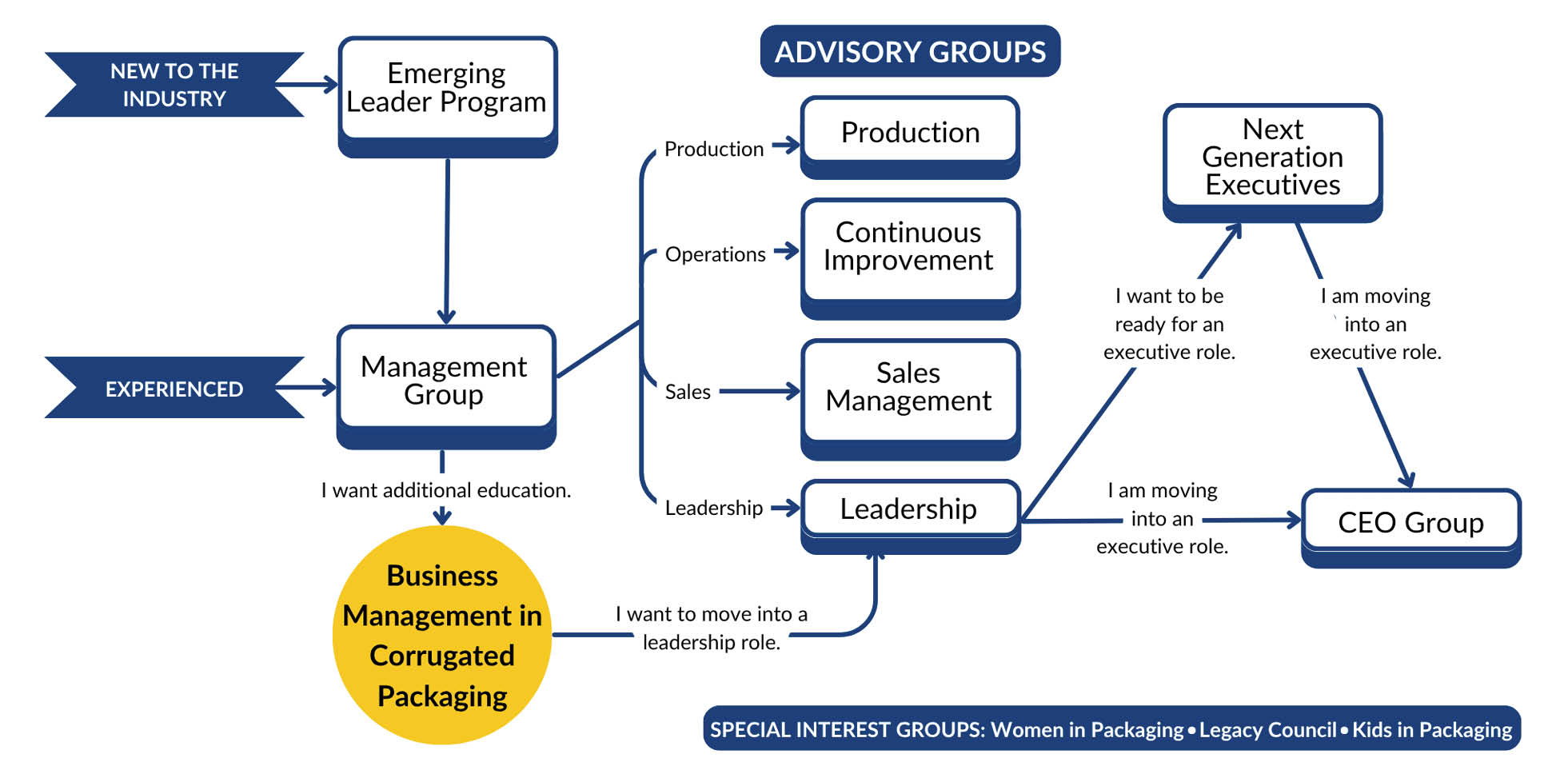
Stepping Stones
AICC’s Emerging Leaders (EL) program, CEO Group, and advisory groups—specific to production, continuous improvement, sales management, and leadership—are well established. All generate opportunities for future and current leaders to learn from each other and keep pace with industry trends.
These ever-evolving and expanding leadership options, plus Packaging University courses and university partnerships, “bring awareness to our industry,” says Levesque, an Emerging Leader alumna.
Josh Sobel, account manager at Jamestown Container Cos. and AICC Education Committee chair, agrees that education “is huge in this industry.”
“Attracting young talent to the corrugated industry isn’t the easiest thing,” he says. “When you hear about it in college, it’s not something you think would be a glamorous business. When you get talent in your business, you have to figure out a way to keep it, and training them to be successful in whatever they do is probably the best way to keep people around.”
After she aged out of the EL program, Levesque found that joining AICC’s Leadership Advisory Group, with its regular meetings and plant tours, fulfilled her search for opportunities to continue developing as a leader. Through the group, she connects with peers one-on-one to problem-solve and plug into industry trends.
Still, even the advisory groups can have a shelf life, she says, and she wonders, “What’s next?”
The issue was that “all these great things” offering leadership education and engagement were disconnected, says Taryn Pyle, AICC director of education and talent development.
Challenge accepted, said AICC staff and members. Working in collaboration, they created three new offerings—the Management Group, the Business Management in Corrugated Packaging certificate, and the Next Generation Executives program.
The connecting lines among the programs are now illustrated in the AICC Pathways to Success diagram on page 39.
Management Group
The Management Group, inserted between ELs and the advisory groups, helps midcareer pros “learn how to manage people and resources,” says Rendon. “It doesn’t matter what type of management role you’re in or how long you’ve been in it.”
She adds that it’s a strong transition for EL graduates looking for “the next challenge” in career growth, educational opportunities, and peer networking that produces actual tips and practices they can implement in their own workplaces.
“It offers a place to go in the middle part of their career,” she says. “They’re ready for their next role. They’re not newbies in the industry anymore. The Management Group is a matured EL group, essentially.”
The Management Group is led by well-known, highly respected industry managers. One portion will target boxmakers, creating a safe space to discuss plans out of earshot of suppliers, while segments on such topics as finance and budgets will be applicable to AICC’s membership roster of box plants and suppliers.
Business Management in Corrugated Packaging
The second new addition to the AICC pathway is the new Business Management in Corrugated Packaging certificate. The 18-month certification track immerses participants in high-level leadership principles, but with a difference: It’s meant for industry professionals who don’t have MBAs but who plan on growing their careers in packaging.
“You’re going to learn about marketing as it relates to packaging, and you’re going to learn about finance as it relates to a box plant,” says Rendon. “All of these have a lens of packaging, and that adds to the value of the program.”
Certificate students choose a concentration, attend an in-person corrugated-focused seminar, and craft a customized slate of courses.
The certificate culminates with a capstone project, presented to a board, that addresses a challenge specific to the industry or the candidate’s company. “They’re going to come out of that having a strong understanding of not only corrugated but also these MBA fundamentals,” says Rendon.
Next Generation Executives
The third addition to the AICC Pathways to Success is the Next Generation Executives program, suggested by a board member who needed to advance a team member quickly. The group provides executive coaching for industry professionals slated for the C-suite—and as always, with a boxmaking-specific focus.
“It covers all the challenges that would affect a person who is going to lead a company,” says Pyle. Although tailored to box plant members, any AICC member could get value from it, she adds.
Unlike generalized executive coaching programs, Next Generation Executives connects participants with “people in your industry who know your pain points,” says Rendon.
Next Generation Executives is ideal for future box plant owners and the second-, third-, and fourth-generation businesses paying outside agencies to prepare children, nieces, and nephews to assume leadership.
“Why not create a program that is a benefit to our members? It’s specific to our industry, and it gives them all of the skills they’re going to need when they step into that role.” Rendon says.
A Viable Next Step
The AICC Pathways to Success answers the “never-ending question” discussed among AICC members about how to move the EL program forward and help graduates explore new elements of their leadership styles, says Sobel.
“It’s giving these young professionals some direction and helping them
move forward,” he says. “The ELs
spent three or four years in the program, but what were they going to do after that? Providing them with these opportunities is big and helps them with direction.”
The focus on the industry and training from experienced corrugated professionals makes AICC’s new programming stand out from other programs such as MBAs, where “you know you’re going to get a great overall business training, but you might not get that training in the corrugated industry,” says Sobel.
The Foundation for Packaging Education will provide scholarships for the Next Generation Executives program and the Business Management in Corrugated Packaging certificate. “It’s a full-circle investment,” says Rendon. “Members and industry leaders contribute to the foundation, and those same members get the opportunity to benefit as recipients. The funds go directly back into the industry—supporting education, developing talent, and strengthening our workforce for the future.
“Placing someone in a peer group is one of the simplest and most effective ways a manager can keep top talent engaged,” she adds. “It helps them feel seen, supported, and invested in. The network they build becomes invaluable—these are the peers who will challenge, inspire, and grow alongside them.”
Packaging University Evolves
The new pathway approach builds on and dovetails with the continuously evolving Packaging University.
Ox Box President Guy Ockerlund chaired the AICC Education Committee when it helped organize the curricula into university-style programs. Colleges were created. Prerequisites and required classes were determined.
His first employees enrolled in Packaging University were two customer service team members, because they represent “our face in front of the customers,” he says.
Packaging University helps spread knowledge of the industry throughout his company, keeping it from getting siloed among a handful of people, he added. His employees have overwhelmingly enrolled of their own initiative, but he also makes it known that course completion earns a pay bump.
Ockerlund sees a difference in the growing confidence and capabilities of his team members. “Our communication with customers is more professional,” he says. “We’re not trying to sell customers on product. We’re trying to help them find what they need.”
The Education Committee has been “driving the growth of the education platform,” including Packaging University and its status as “a staple of AICC,” says Sobel.
In the wake of Packaging University’s organization into 10 colleges coalescing more than 150 courses, the next step is tailoring the courses to “what’s needed today,” says Sobel. Courses are updated as information and industry processes become outdated. More courses are being translated into Spanish.
“We’re just making sure the information is there for people that need it to succeed,” he says. “The amount of colleges we have is good. It’s just continuing to grow the courses within the colleges.”
As Pyle notes, the backbone of many AICC member companies is the team of floor workers—many with high school diplomas and eager for learning that helps them advance. AICC often hears from production managers, HR managers, and other midlevel employees at member companies, looking for guidance in leveraging Packaging University for their teams, she adds. “It’s not always the owner or executive calling,” she says. “Our members companies want their whole team to
be educated.”
New Directions
Journeys along the pathway can also open doors to AICC committee and board service, with their conjoined opportunities for growth and development, Sobel notes.
“AICC does want to provide that structure to grow within the Association, but ultimately we’re looking to provide that structure to grow within your company outside of the Association” he says. “Whether it’s the Next Generation Executives program or whether it’s Packaging University, all of that is tailored so that you can grow within your own company as a professional and continue that path forward.”
Levesque agrees that AICC groups and programs provide a steppingstone to Association leadership. “By saying yes to everything, that’s part of what has helped me get to this position of being chairwoman,” said Levesque.
The future of AICC’s Pathways to Success and Packaging University is built on AICC’s philosophy that the reward for learning is more learning. The pathway diagram puts the journey in context, Rendon says.
“AICC has always had impactful programs,” she says. “However, being able to see it on a chart and find your spot and visualize your future within our industry, that’s a powerful graphic that sparks a powerful conversation with yourself about where you are and where you want to go.”
Rendon referenced AICC’s motto, “When you invest and engage, AICC will deliver success,” explaining, “It means AICC will provide members with the tools, the pathway, and the peer group. But it’s up to our members to take that first step, get involved, and make the most of the opportunities available.”

M. Diane McCormick is a freelance journalist based in Pennsylvania.
