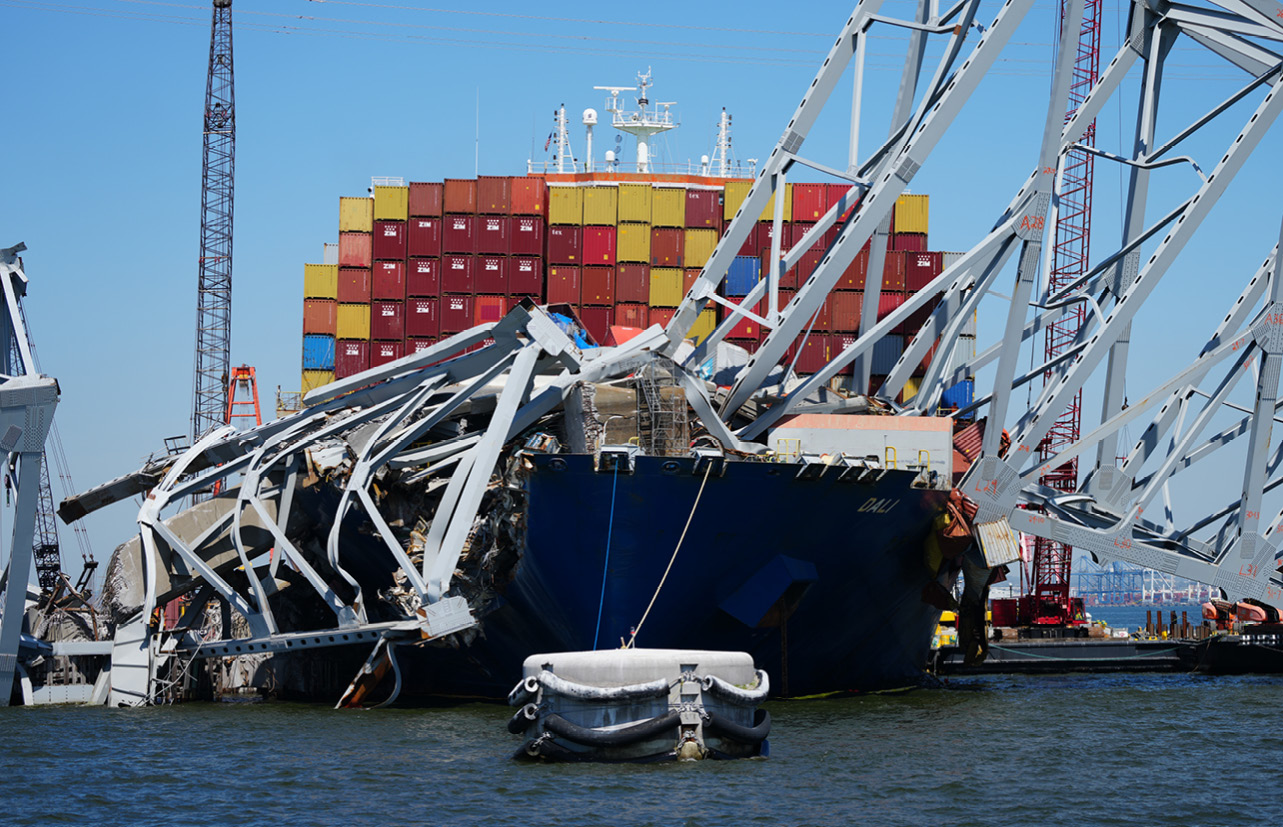
Operations Management: Does Your Plant Have a ‘Key Bridge’?
Operations Management: Does Your Plant Have a ‘Key Bridge’?
By Dwayne Shrader
July 3, 2024
At approximately 1:27 a.m. on March 26, 2024, the Dali, a container ship weighing 53.2 million tons, made contact with Baltimore’s Francis Scott Key Bridge. Three seconds later, the bridge collapsed onto the floor of the Patapsco River, halting all water traffic outbound and inbound to the Port of Baltimore, one of the busiest seaports in the United States. Quick action by the ship’s pilot, the Port Authority, and police saved many lives, yet six souls perished.
The structure, known locally as the Key Bridge, was completed in 1977, and 31,000 vehicles crossed its 1,200-foot main span every day. Much of this was truck traffic from the port and mills at Sparrows Point.
The bridge’s continuous truss design was a landmark and icon of Baltimore. However, its design had one fatal flaw. It lacked redundancy. Each member of the bridge carried its engineered load. If one member failed, no other member was available to take up its load. Therefore, catastrophe was inevitable. In three seconds, the lives of thousands of port workers, ship crews, truck drivers, and commuters would be affected for the foreseeable future. Not to mention all the people who rely on the products that travel through the port daily. For the families of those lost, their lives have been changed forever.
Does your plant or organization have a Key Bridge? Is there a “member” within your organization (human, process, or equipment) that has the potential to halt your operation for the foreseeable future? If there is a catastrophic event, do you have a plan that minimizes the impact on your business, employees, and customers?
The trend to streamline our businesses often comes with the risk of removing key backup systems. We try to smartly optimize our resources, but in doing so we sometimes, often unintentionally, eliminate the member meant to share the load. The COVID-19 pandemic exposed weak points in many operations. Many scrambled to keep their machines running and orders flowing. We have all adapted and hopefully now have processes in place should a comparable situation occur again.
What is your plan to address a similar natural or human-made event? Have you discussed bilateral contingencies with a friendly competitor? Do you have a plan for another plant in your organization to share the load? Do you have a FirstPak partnership you can rely on?
Most operations likely have contingency plans. It’s important to have them and equally important to keep them up to date. Have you reviewed yours lately? Have they been adjusted to meet changes in your business growth, technology, and workforce changes?
I know I’ve asked more questions than I’ve given answers. However, these questions roll through a mind at 3 a.m. I thought I would share. Let’s hope they don’t keep you up at night.
Dwayne Shrader is president of Shrader Studios, a communications consultancy that represents several AICC members, and has four decades of experience in corrugated. He can be reached atdwayne@shraderstudios.com.