
November 6, 2026
With skewing and fracturing issues, the machinery often has to be ruled out or in as the causative agent. Many times, it is as simple as reversing or flipping the material to see if the issue follows a similar pattern or if it actually continues as it was, which can verify an equipment or tooling issue.
In one case, the scoring issue seemed to have a random repeatability with two or three poorly scored sheets among seven or eight that were acceptable. This is possibly identified once a series of 10 or 12 are placed in a row to determine if there is indeed a repeatability in the actual distance between the defective scores by a simple measurement. If seen, it can sometimes lead to a defective cylinder, tooling, etc.; always look for a cylinder circumference that may closely match your defect repeat length for starters.
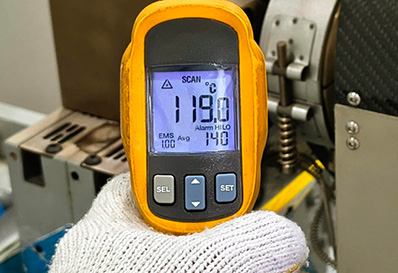
An IR sensing heat gun along with a magnetic mount dial indicator can also be used to determine if there is an excessive runout on a particular tool or cylinder. It could also help identify if excessive heat may be causing a premature bearing failure. Concentricity and runout are two very common ailments, particularly when any cylinder face length exceeds 50″ and is supported by only two end journals. The cylinder’s middle deflection is the enemy of accuracy in most cases, regardless of whether we are printing or die cutting and scoring.
For this particular set of issues, discussions I’ve had have centered around various tooling issues. Whether you are using a platen cutter or rotary can drastically affect the scoring profile for your finished products. It is best to have a micrometer and depth gauge handy to measure your rule heights to ensure there are no issues with either manufactured tooling or excessive wear or damage in your plant. In all cases, it is also critical to gauge your die rubber by height and durometer if possible. The release characteristics, closeness to the rule, and height can vary wildly and “hold off” proper cutting and scoring with too much resistance pressure.
That’s it for this issue!

Tom Weber is president of WeberSource LLC and is AICC’s folding carton and rigid box technical advisor. Contact Tom directly at asktom@AICCbox.org.
