
August 30, 2024
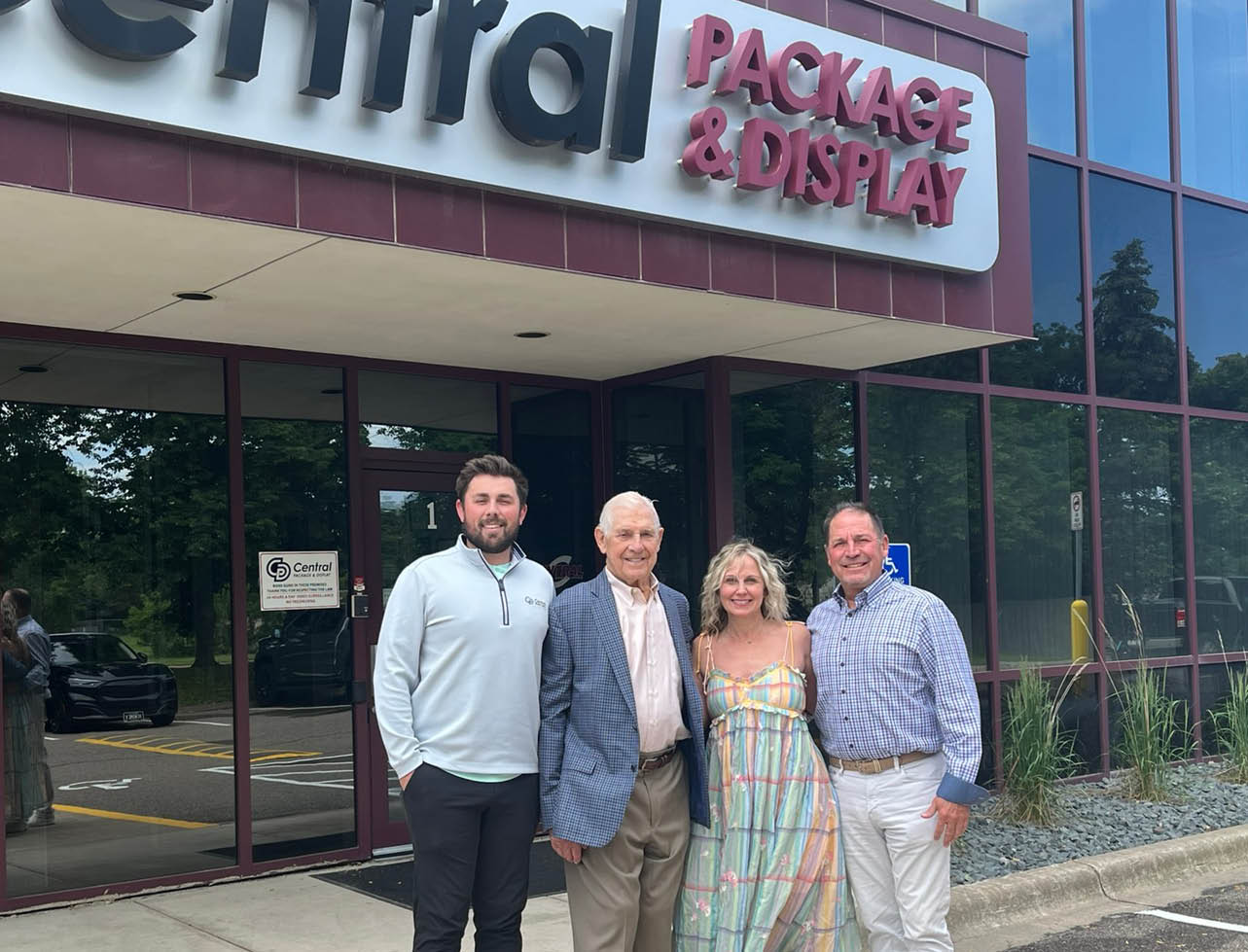
Company: Central Package & Display
Established: 1959
Joined AICC: 1996
Phone: 1-800-523-BOXS
Website: www.centralpackage.com
Headquarters: Minneapolis, Minnesota
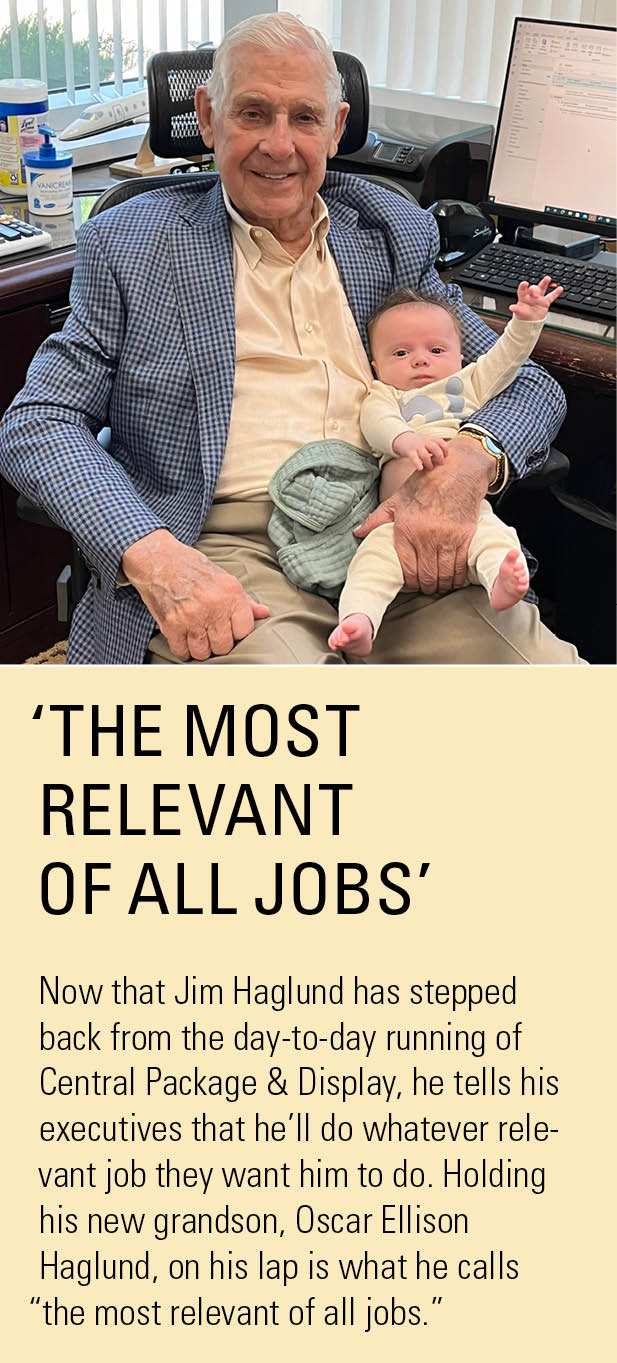
Chairman: Jim Haglund
In order to get somewhere, you have to be somewhere first.” Jim Haglund, chairman of Central Package & Display in Minneapolis, has harnessed this homespun philosophy throughout his 65-year career in the corrugated and paperboard packaging business.
“I always wanted to go where most other companies did not want to go,” he says. “I always wanted to put a toe in the water somewhere else. That’s what has served us to this day.”
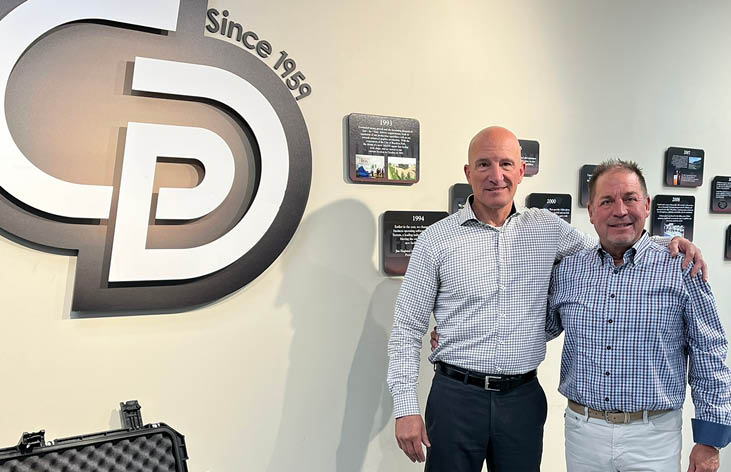
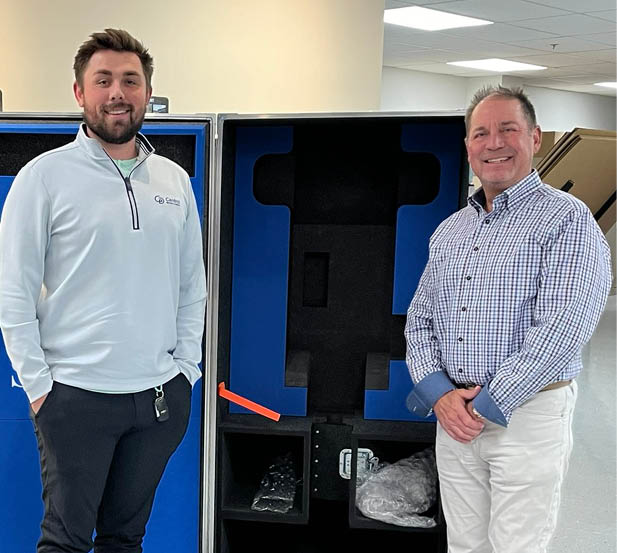
Today, Central Package & Display is a global supplier of specialty packaging products, including corrugated, setup boxes, engineered foam, and industrial crating and casing for electronics and sensitive instrumentation. The company also provides fulfillment and kitting services to its diverse customer base. Central Package employs 140 people working in two shifts out of its 175,000-square-foot facility in Brooklyn Park, a Minneapolis suburb, with another 35,000-square-foot off-site warehouse nearby. Bucking the conventional shipping models of most corrugated sheet plants, Central Package shipped 30% of its products outside of the state of Minnesota in 2023, with 9% going overseas to far-flung destinations such as Malaysia, Costa Rica, Puerto Rico, and Ireland. To support this worldwide reach, Central Package also has a third-party logistics warehouse in Canada, with plans to open a second in Ireland.
Early Years
Jim Haglund’s career started in the sample shop of a Minneapolis printing company. The young Haglund, fresh off the farm in northern Minnesota, assembled dummies of customers’ print jobs and delivered them throughout the city. Besides the benefit of a $250-a-month salary, Haglund says the job gave him the geographic bearings that would serve him well in his sales years ahead. “That’s how I learned Minneapolis,” he says, “because when you’re from out of the area, you have to learn it numerically and alphabetically and not just from local landmarks.”
Playing his strong suit, Haglund sold, first traveling for Federal Package, then going out on his own brokering boxes in the Twin Cities. It was during this time that he came to know Jerry Hinitz, Jack Persten, and Dick Page, who owned Central Container Corp., one of his regular suppliers. Haglund, knowing the company’s potential and learning of Persten’s impending retirement, offered to buy his half of the business. Persten demurred, however, saying he was committed to selling to his other partners. “Then around Christmastime, he called me back,” Haglund remembers. “He says his retirement is based on the company succeeding. ‘I know you can do it and they can’t, so I’m going to sell you my half.’”
The price, Haglund says, was quickly set: The book value of the business was $238,000; half was $119,000. So, Persten and he agreed to $25,000 down with the balance over 11 years at 7% interest. “I says, ‘OK.’ The only problem was, I didn’t have $25,000!”
Buying the Company
It is a familiar memory for any successful entrepreneur: the scramble to raise that initial capital to start the business. For their part, the Haglunds—Jim and Kathy, his wife of 62 years—sold their house and pulled out $15,000 in equity. Haglund borrowed the remaining $10,000 from his brother who did not give him a break. “I remember he charged me 7% interest over seven years,” Haglund says.
Within five years, Haglund owned 100% of the company, buying out Hinitz and Page. At that time, the Minneapolis packaging market was changing dramatically, from an industrial base of brown box users to highly specialized, technology-driven industries such as health care and medical equipment and instrumentation. In fact, that segment of the Minnesota economy grew so prolifically in the 1950s, ’60s, and ’70s that the Twin Cities area became to be known as “Medical Alley.” The growth of companies such as 3M, Medtronic, and Boston Scientific, aided by the University of Minnesota’s well-endowed medical research and development labs, created a demand for a highly specialized base of professional services and material suppliers. Against this backdrop, Haglund saw his early opportunities for investment and growth. “Selling is 50% personality,” he says. “If the customer likes you and you come in with a new product, you’ve got half the sale completed.”
Growing and Acquiring
Looking for those new product offerings for his customers, Haglund acquired two additional companies in the early ’80s: one, a local sheet plant, and the other, a manufacturer of setup boxes, Fisher Paper Box. It was this latter acquisition that Haglund points to as the driver of the company’s new direction. “Because we now had Fisher and they were in the folding carton business and the chipboard business, it led us to other industries,” he says. “It really was the foundation of our company today; it got us into the medical industry.”
Calling on the spectrum of companies making up the Minnesota “medi-sphere,” Haglund and his team then recognized that these customers frequently had other needs such as foam and partitions. “My theory is that once you’re in front of the customer, you say, ‘What do you need? What aren’t you getting?’ And then they would say something, and we’d look into it and find a way to do it. … This included foam, partitions, and inserts—the things that integrateds didn’t want to run.”
To Move or Not to Move?
The company’s growth through the 1980s and early ’90s strained the company’s capacity at its existing location in Minneapolis. Haglund considered the need to improve efficiencies, quality, and service levels, and move to multigraphics. Housed in a century-old building on Hiawatha Avenue, an original industrial corridor in the city, Central’s operations were hampered by low ceilings, support posts, production on different levels, and small dock doors, to name a few of the obstacles. The choices for Haglund and his team were to add onto the main plant, add onto an existing addition on the plant, move to an existing building, build a new building, or do nothing. The company’s growing volume in the cramped space was a serious drag on its efficiencies. Hence, the last option of “do nothing” was easily ruled out. The limitations of its existing location also made expansion or improvements impractical.
“Never make future investment decisions based on the current economy,” Haglund tells his team. And in the case of Central’s future location, he took his own advice. The economic slump of the early ’90s gave Central a favorable build-to-suit environment of low interest rates, “hungry” contractors, and local communities competing for new businesses.
Brooklyn Park offered an ideal location and attractive incentives. In March 1992, the first spade of dirt for Central Container Corp.’s new location on 85th Avenue North was turned. Haglund marked the event by inviting then-
Minnesota Gov. Jesse Ventura to attend the ceremony, and he did. The official ribbon cutting was held in November.
Equipped for Quality and Precision
Central Container Corp.’s new location, now 31 years young, is a showcase of efficiency. (Haglund is meticulous about maintaining the property.) The corrugated side of the business is equipped to support its diverse customer base of medical,
high-tech manufacturing, food and
beverage, retail distribution, and industrial companies. Three flexo folder-
gluers from Latitude, TCY, and Ward form the standard box production line, with Eterna, Brausse, Apstar, and TCY rotary die cutters augmenting the mix. In addition, Central’s specialty folder-gluers from Bobst, J&L, and Brausse, plus a Herrmann Ultrasonic welder, provide the capacity needed for the intricate designs demanded in medical and electronic instrumentation packaging. On the setup box side of the business, Central maintains an Emmeci automatic rigid box line.
Haglund follows a simple equipment acquisition guideline. “One thing I have always believed: reinvest, reinvest, reinvest,” he says. “We have always reinvested in equipment to improve quality. The medical industry has pushed us.”
Haglund was an early adopter of converting and finishing equipment from Asia, buying his first TCY flexo folder-
gluer from Taiwan 40 years ago. It was a decision, he says, made from necessity. “We were kind of pioneers,” he remembers. “Everyone was concerned about how do you get parts from Taiwan? But I could get a part from Taipei as fast as I could from New Jersey because Northwest Airlines had all these daily nonstop flights between Minneapolis and Taipei. When I say it was a gamble, it really wasn’t. I didn’t have a choice. We couldn’t afford anything else at that time.”
New Name and New Image
By the early 2000s, the North American supply chain had taken on a new
form—containerization—and the
term “container” took on a meaning beyond a simple corrugated, rigid box,
or folding carton. Ocean and rail freight had co-opted “container,” Haglund felt, so he sought a new identity for his company. After some careful consideration and taking what Haglund calls “a poll of one,” Central Container Corp. became Central Package & Display. “I felt ‘container’ had too broad an implication,” Haglund says. “Changing the name to Central Package & Display better described who we were and what we had become.”
Haglund remembers the excitement the change generated among the company’s employees and, significantly, among its customers. “When your customers see you moving forward like that, that’s a really good sign,” he says. “It gives a good feeling that the company will be around for a while.”
A Family Business Always
Being “around for a while” is important to Haglund. A devoted family man, he has always considered his family to be an integral part of the business, as well as its path forward. His son, Mike, is CEO and vice president of sales. He came full time to Central in 2001 after an early career in the scrap recycling business and, later, the packaging supply and fulfillment business. Like many offspring of box company owners, he worked in the business from an early age. “I started mowing the lawn over on Hiawatha Avenue,” Mike says, “and later maintenance and painting—the aesthetics—because it was all a wood building back then.”
His early experience at Central did not guarantee him a future place, however. “When I graduated college, my dad says, ‘Well, you’re not going to come in here and work,’” Mike remembers. “Jim always worried about people’s perceptions.”
Mike worked five years in the scrap recycling industry when a small local assembly company came up for sale. “I bought that company for $90,000 over a five-year period,” he says.
Having his father’s entrepreneurial nose, he then bought out a local packaging supply business, The Box Stop. “We had our own facility, doing about $5 million in sales, and we were brokering boxes, too,” Mike says. “Then in 2001, out of the blue, my dad called. He says, ‘I want to get you involved in Central, so Central’s going to buy you out.’ I didn’t know I was for sale!”
Today, Mike is firmly grounded in his role in the company. “As far as the title or role, yes, I’m CEO,” he says. “But I still oversee a lot of the sales. That’s what I’m good at, and that’s what I like to do.”
Kristin Haglund, Jim’s elder daughter, joined the company in 2014. But her employment at Central, like Mike’s, was not guaranteed. “I started in drafting for an architectural firm right out of school. Then, I went to work for a small local government consortium that served as an information technology hub,” she recalls.
There, she honed her skills for systems management and information technology, but her heart, she says, was not in it. Then in a chance conversation, Mike planted the seed for her to come to work at Central. Kristin notes, “‘You need to make a move,’ he says. ‘You and I work well together, why not join Central?’”
Kristin recalls approaching Jim with the idea. “I actually went to my dad to propose it,” she says. “He was bowled over; he had no idea we were discussing it.”
Referring to Jim’s vigilance in guarding the company’s reputation, she adds, “He wanted to say yes, but he says, ‘OK, well, let’s give this some thought and make sure it sounds right, it looks right.’”
Kristin’s focus at Central plays on her strengths in information technology, systems, and human resources. The company is a union shop, so Kristin has a key role in employee relations. “I could just interact with people in such a different way, so I got very involved in employment issues and the things more outward facing,” she says.
Enter the Third Generation
Austin Haglund, 25, is Mike’s son and is the third generation of Haglunds to enter the business. He joined the company in 2019. Like his father, he started by working summers. “I started coming in and working in assembly when I was 15,” he says. “I had seven friends come in, and we all worked in the back for five years through the rest of high school and all of college.”
From there, he worked in design and sample-making, customer service, and then in quality assurance. He’s now on a sales track, managing accounts of his own. “It’s not the most glamorous industry,” he says when asked why he chose to come into the business. “But I’ve always enjoyed it. I grew up with it.”
In 2013, Jim and Mike had a conversation about the future of the business and what role the Haglund family would play in the years ahead. Says Mike, “I had an illness in 2013, so we weren’t quite sure of the future. Once things got better, we started talking about bringing in someone to run the company. I don’t have the day-to-day skills to run the company, and I didn’t want to run the company. I wanted to be involved in sales. We were growing, and my dad was 76 years old, and he was wanting to slow down, too.”
It is not unusual for family businesses to bring in nonfamily members in key executive positions, but the decision can be difficult. Says Jim, “I’m glad I was such a good salesman because first I had to sell myself on the idea.”
Shortly after that, Jim was touring a local Taylor Corp. printing facility; at the time, Taylor was the largest privately owned commercial print house in the United States. There, he met Michael Gallagher, a division director for Taylor overseeing six printing plants across the U.S. “I was actually very interested in acquiring Central for Taylor,” recalls Gallaher. “But I always say Jim acquired me, so it got flipped around.”
In Gallagher, Jim found the new president of Central Package & Display. The timing for Gallagher was right. A graduate of Macalester College in St. Paul, he became a licensed certified public accountant (CPA) and immediately worked for Taylor, where he spent 20 years and rose to the level of director. The travel involved was taking a toll on his growing family, so he was looking for something local. He checked all of Jim’s requirements: someone local, with a Master of Business Administration or CPA, a family man, and someone young enough to grow with the company. To Gallagher, the choice was easy. “The commonality between Taylor Corp. and Central is that we never wanted to be in the mainstream. We wanted to be in niches,” he says. “There are a lot of similarities between the two companies.” He joined Central in 2014.
Gallagher says his strength is his focus on day-to-day operations. “We’re an execution company, and I’m very involved in the day-to-day,” he says. “Some people say, ‘Well, don’t work in the business, work onthe business.’ But our business is being in the business. It’s focusing on today and executing. I’m very hands-on.”
Gallagher’s hands-on focus and the Haglund family’s commitment foretell a productive and profitable future for the company. Some of their initiatives for growth include adding sales representatives, investing in new equipment to increase capacity, and focusing on key industries to build on existing strengths—an extension of Jim’s philosophy of staying away from the mainstream.
Central Package & Display reflects the personality of its founder, Jim, and his commitment to family, employees, and customers. Gallagher says it best when talking about his 10-year tenure at Central: “I’ve never come into a company that’s successful like Central Package & Display. But it’s not just about the work; it’s about the family.”

Steve Young is AICC’s ambassador-at-large. He can be reached at 202-297-0583 or syoung@AICCbox.org.
