
January 23, 2025
Latest facts you should know about Scrap & Dust Systems
For the past 41 years, ASDI has been providing quality Pneumatic Conveying and Mechanical Belt Conveying Systems for the Corrugated Paper Industry. There are several types of systems being “turnkeyed” in this industry. The most popular over the past few years are the cyclone system, the indoor separator system, and the mechanical conveyor in a trench system.
For the Sheet Plants, the sequential system using one fan for as many as four machines has offered them savings on the electrical power and starting investment by using less CFM. Regardless of the type of system that is used, ASDI provides a design that is safe and maximizes the production for each machine.
Corrugator Plants themselves are now using shredders in different areas of the corrugator. ASDI has installed shredders at the “rotary shear” section and the waste eject at the “cut-off knife” area. ASDI has used a wide conveyor to take reject sheets from one area to another allowing the use of one shredder instead of two. More shredders are being used at the wet end as well. The new plant systems over the past few years have been using as many as three shredders all able to run at one time, demanding a larger baler for the plants.
Planning a better waste system in a new facility would involve getting a building with an elevation of 40 feet in height or more if you want a better indoor system. A baler’s volume relies on several feet (or more) of feed chute above the ram.
The dust that comes from shredders and paper handling fans is becoming more of a housekeeping issue than ever before. ASDI had been using state-of-the-art filters with bags or cartridges, as well as 3 different style drum filters. All of these are under negative air and use a clean air fan with a VFD to match the CFM that is coming from the cyclone or separator system. This keeps the baler room very clean, and the dust captured is going to a briquetter. All filter equipment meets the NFPA guidelines.
Addressing noise on the roof and/or inside the plant has also driven our corrugator customers into new projects. Some noise is caused by the board hitting the fan wheels and/or coming out of the cyclone discharge. ASDI has a full line of fan sound jackets, sound enclosures, and we make the new cyclones with an option to reduce the noise by using a proven sound board in particular areas of the cyclone that suppresses the noise. Also, we use in-line silencers on the fans, which also helps lower the noise coming from the cyclone.
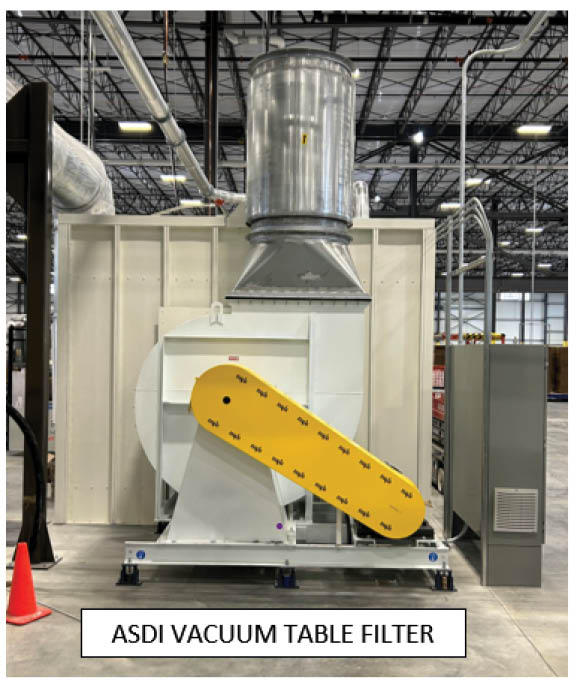
Vacuum tables and their dust have added a large new investment for box manufacturers. Trying to find something that does not involve the NFPA is ideal. The systems out there that are not ideal are ones that are relying on the blowers for the vacuum tables to reach the dust vessel. The average fan on the vacuum table is good for 2 inches of static pressure. That is enough to blow 20 feet into an open space. The average wet system needs 5 inches of static, and every dry system with a clean air fan needs 6 inches of static. Therefore, whichever vessel chosen to do the cleaning needs to be under negative air, which is the cleanest system you can offer. ASDI offers a continuous cleaning media inside an enclosure with a secondary filter rated for a Merv 12 all under a negative air (a clean air fan on a VFD) and continuous cleaned with a 15 HP high pressure blower and conveys that dust into the scrap duct. The clean air is released after the clean air fan into the plant. With the use of the clean air fan, it overcomes the media at its dirtiest pressure and halfway down the ductwork to the vacuum table fans. Therefore, they do not see an additional pressure they cannot handle.
Air Systems Design, Inc.
50 East Court, Mandeville, LA 70471
Sales@airsystemsdesign.com
985-875-7777
Bob Zacary Jr.
President
Bobjr@airsystemsdesign.com
985-875-7777
