
November 6, 2024
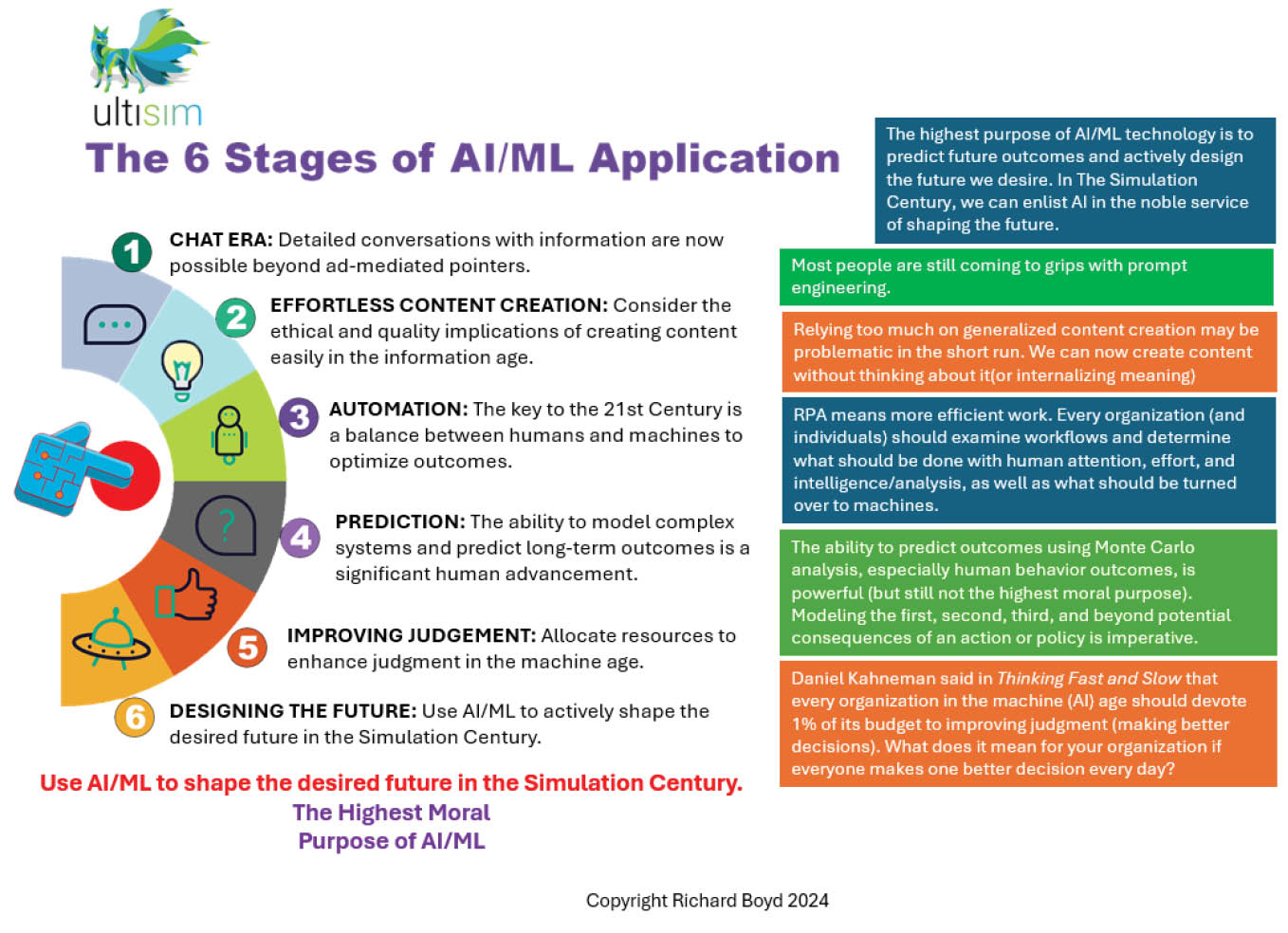
The landscape of industry is undergoing a seismic shift, fueled by the rapid evolution of technologies that promise not just to automate but to transform the way we live and work. Leveraging my decades of experience working with artificial intelligence (AI), I’ve identified six progressive stages that act as a road map from simple automation to genuinely transformative impacts of this evolving technology. We’ll begin this journey in our current phase, the “Chat Era,” and work our way forward, learning the challenges and possibilities in designing our future for the greatest good.
Stage 1: Chat – The Dawn of Conversational Companions
We find ourselves at an exciting inflection point in the evolution of AI. In the Chat Era, AI has shed its old skin of basic, scripted responses to emerge as a versatile conversationalist capable of much more than a simple Q&A session. Chatbots have transformed our interaction with the digital world, humanizing the technology we’ve used for years.
By harnessing the full potential of AI chat systems, we can enhance production and create efficiencies across various sectors. Chatbots can provide real-time updates on production statuses and delivery dates in corrugated packaging, reducing operational costs and improving customer satisfaction, contributing to an agile and responsive supply chain.
To transition gracefully into the next stage of AI—content creation—AI must deepen its understanding of complex human interactions. It’s about evolving past basic keyword recognition to grasp the nuances of language and context. Most importantly, upholding stringent ethical standards in data collection and use is imperative, ensuring user trust and privacy are always maintained.
Stage 2: Content Creation – The Double-Edged Sword
With the second stage of AI development, AI’s capabilities in content creation spark tremendous excitement and ethical concerns. AI’s proficiency in tasks such as drafting legal documents and written correspondence or creating digital artwork marks a giant leap in productivity and creativity.
However, as AI begins to shoulder more cognitive responsibilities, it’s become clear this advancement is not without its dilemmas. In particular, the convenience of relying on AI for creative and analytical tasks could inadvertently weaken our critical-thinking skills, relegating us to the role of technology supervisors rather than active creators. We must learn to prompt AI for productivity without relying on it for all original creation.
Then, there’s the moral landscape of AI-generated content. Now that we have technologies capable of producing hyperrealistic fake images and audio, the potential for misuse skyrockets. Scammers can now create convincing forgeries that can be used to spread misinformation or commit fraud, posing serious challenges to ethical norms and legal frameworks. We must develop robust systems to monitor and evaluate AI outputs to advance our collective goals, not hinder them.
Stage 3: Work Efficiency – The Automation Advantage
Process and workflow automation isn’t a new concept, but recent advances have elevated it to new levels of efficiency and intelligence. While traditional automation handles straightforward tasks, modern systems redefine processes, manage complex workflows, and analyze vast volumes of data with remarkable speed and accuracy.
Beyond administrative efficiency, these advancements are transforming the workplace by reallocating routine and repetitive tasks to machines, freeing up humans for higher-order thinking and creative problem-solving. This shift can boost productivity while enhancing job satisfaction so workers can focus on more engaging and meaningful work. The key to these transitions is thoughtful integration, ensuring automation complements rather than replaces human expertise.
Stage 4: Prediction – Navigating the Simulation CenturyTM
A huge leap for humanity in what I call the Simulation Century™ is the ability to deeply model complex systems and predict outcomes far in advance. Understanding not only the first-order consequences but also the second, third, fourth, and beyond consequences of an action is a superhuman power. Digital twins and knowledge graphs have become essential tools, offering detailed simulations of physical processes and systemic interactions.
Digital twins, for instance, allow cities to test and refine systems virtually before implementation, greatly enhancing urban efficiency and safety. Similarly, in the manufacturing industry, they can predict equipment failures before they occur, minimizing downtime and extending machinery life. Knowledge graphs complement these simulations by mapping intricate organizational data into actionable insights, aiding in swift, strategic decision-making. This stage of the AI journey requires a sophisticated blend of human and machine intelligence in which predictive capabilities surpass reactivity and enable organizations to analyze potential outcomes with remarkable precision.
Stage 5: Improved Judgment – Harnessing AI for Better Decisions
Improved judgment is the ultimate goal of AI and machine learning technology. Daniel Kahneman said a decade ago that in the machine age, every organization should allocate 1% of its budget to modeling its actions and improving judgment. This critical capability is being overlooked in the ChatGPT era of talking to data and effortlessly producing content, much of which could be considered mediocre.
AI’s potential to supplement human judgment, particularly through tools such as knowledge graphs, is an untapped treasure in decision-making processes. Influential thinkers such as Kahneman emphasize AI’s significant value in areas requiring complex decision-making such as governance and public policy. Knowledge graphs visually organize extensive data sets, helping decision-
makers find connections and patterns that inform better judgments. Integrating AI with human intuition creates a powerful synergy, making decisions more comprehensive and forward-thinking.
Stage 6: Designing the Future – AI as a Force for Good
The final stage of AI development is about harnessing AI to shape outcomes that benefit society deliberately. As I’ve often emphasized, the ultimate moral purpose of technology is not merely to predict complex future outcomes but to actively design the future we desire. We can create and work toward achieving our aspirational goals by harnessing AI. Alan Kay once said, “The best way to predict the future is to invent it.” In this spirit, we use AI not just as a tool for forecasting but as a fundamental force in shaping a future aligned with our highest ethical standards.
On this front, particularly within the corrugated industry, the adoption of AI offers substantial possibilities. AI’s ability to advance sustainable and efficient production can be transformative. By finely tuning material usage and improving machinery efficiency through predictive maintenance, AI not only elevates operational effectiveness but also can support organizational sustainability goals.
This vision of AI as a catalyst for good emphasizes the importance of proactive design. It challenges us to think creatively and responsibly about how we program and deploy AI, ensuring it positively contributes to our collective future. Through such efforts, AI can help us navigate and shape the complexities of the modern world, making it a better place for future generations.
Envisioning Tomorrow: The Expansive Future of AI
As we journey through the Simulation Century™ and its possibilities, we should focus on technological advancement and how these technologies can be harnessed to reflect our highest societal and ethical values. AI offers more than efficiency and convenience; it presents an opportunity to design a future that embraces sustainability, equity, and human dignity. The path we pave with AI today will dictate the landscape of tomorrow, challenging us to envision and strive for a future that transcends our current limitations and fulfills our most aspirational goals.

Richard Boyd is founder and CEO of AI and machine learning company Tanjo Inc. and co-founder and CEO of Ultisim Inc., a simulation learning company that utilizes gaming technology and AI.
