Longtime AICC members share their experiences with entrepreneurship and their respective family businesses
At a unique session at the AICC Spring Meeting in Palm Desert, California, attendees were treated to an insightful and highly engaging panel discussion. Moderated by Joe Morelli, vice president of sales and marketing at Huston Patterson and Lewisburg Printing Co., and Jeff Pallini, CEO of Fosber America Inc., the panel discussed entrepreneurship, family business dynamics, and more. That session has been transcribed and edited, and the following is the majority of the discussion, presented exclusively in BoxScore.
The Wagner Story
Joe Morelli: Chad, I want to start with you. And if anybody listened to the [Breaking Down Boxes] podcast, you know his story well. Chad did not grow up in the family business. He’s unlike the other gentlemen on stage. He was outside of the family and started sweeping the floors when he was young. And as he mentioned, he met the owner of Peachtree on the golf course.
When you were 14, 15, sweeping the floors, when you came out of the U.S. armed services and went to work, could you ever picture yourself sitting here as an owner of a business, giving a talk on entrepreneurship?
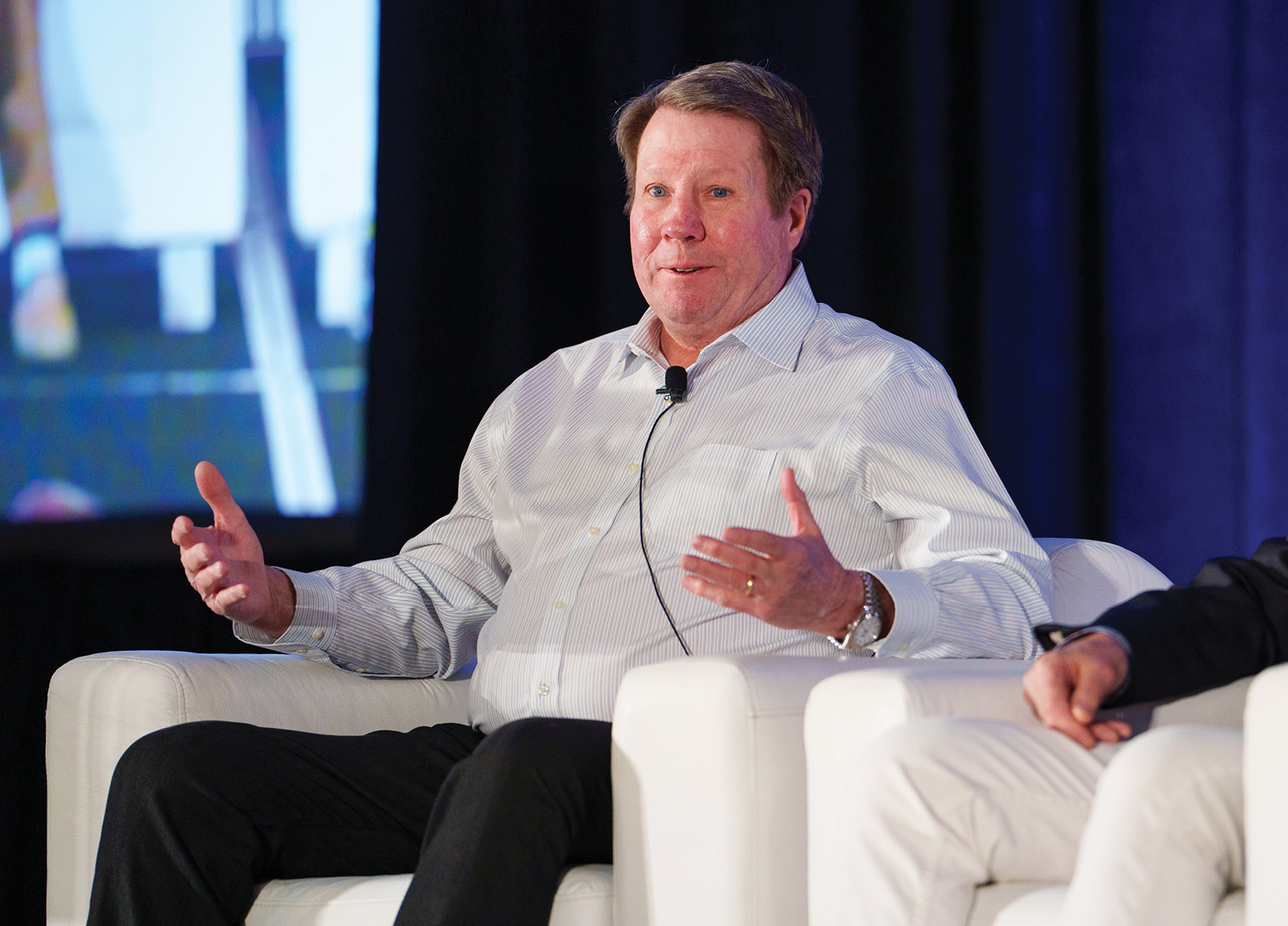
Bill Akers of Akers Packaging Service Group. (Photos courtesy of AICC.)
Chad Wagner: No, that wasn’t part of the original plan. The opportunity to go from $4 an hour to $6 an hour—that was a big opportunity.
Morelli: So tell me. When was it that you had the idea of buying into the business during your journey?
Wagner: I would say in the first five years that I was there, I started to understand the landscape of the business. The business was built in a way that it allowed all of the key employees or the star performers to be shareholders there.
That wasn’t given; that was earned. It was a merit-based almost fraternity. It’s the who’s who of the business, and if you got an opportunity to get into that club, that was pretty important. So I set my sights on that very early on, worked very hard, hoped an opportunity would come along to get invited into that club, and ultimately, it did.
So that was the very first step toward how I thought what we would do with this company and how we could buy into that company. When we got into that, I had gone to the shareholder meetings and started to align myself more with some of the other shareholders. I found a few peers in that group.
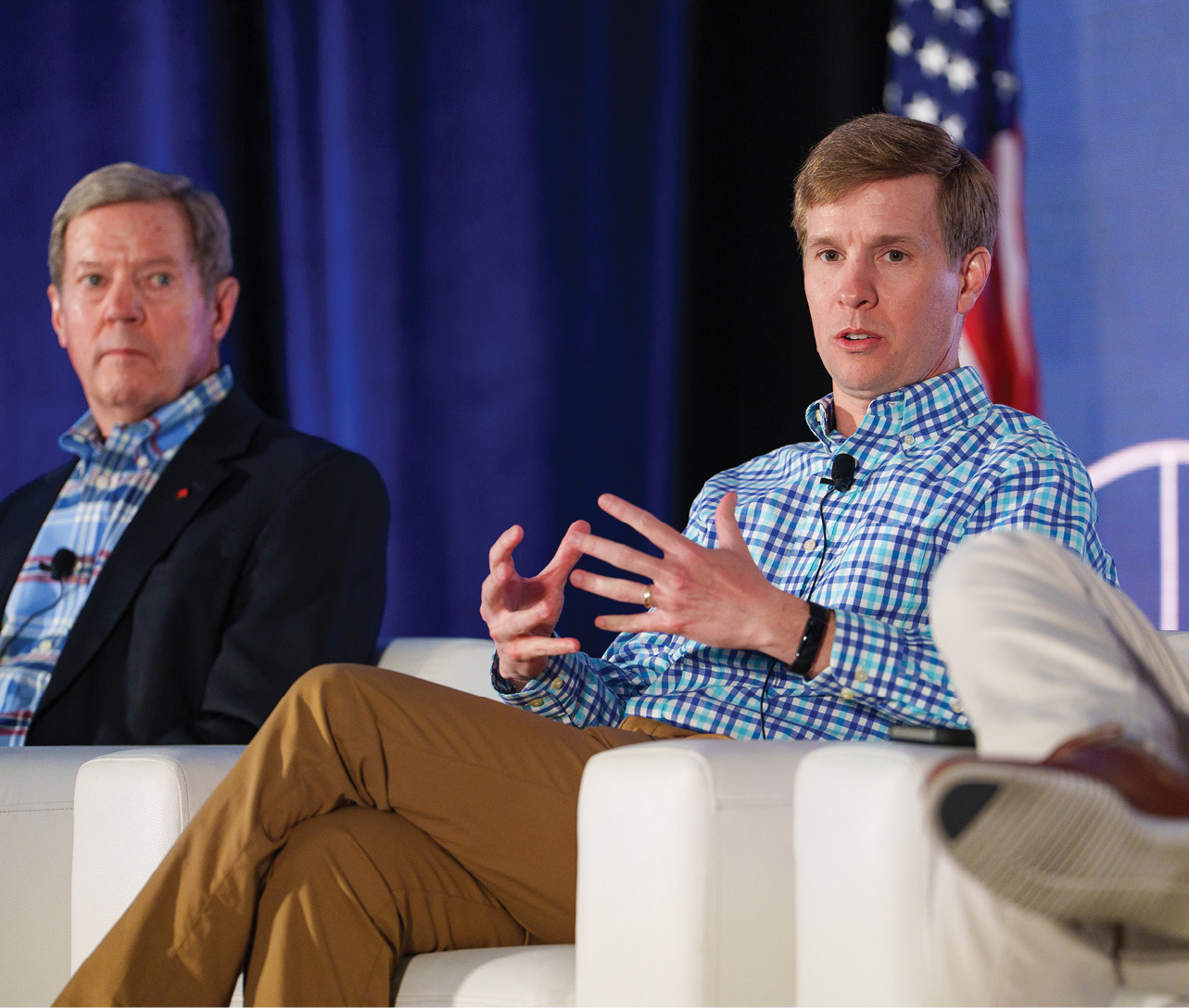
Jim (left) and Andrew Akers of Akers Packaging Service Group.
One stick is weak, and a bundle is not. I felt like if we could gather in a line in that group, maybe a second generation of ownership could be born out of that.
Morelli: How many initial stakeholders were there in those early years?
Wagner: I think there’s always been somewhere around a dozen or so shareholders in the business. The names have changed, but it’s normally just all the key roles: the CFO, CEO, leader of our design, leader of production, customer service manager. It’s kind of always been that way.
Jeff Pallini: So we just heard Jerry Frisch speak. What an interesting story. A lot of those stories are in this room. What advice would you have for someone young who might be in an executive position and would love to own the business sometime on their own?
Wagner: I would just say that if it’s something that you really want to do and you have a passion for, you need to jump in the deep end, both feet first. Don’t be scared. And I think the biggest thing that I’ve learned so far, since we’ve been in this—this ownership group, me and my two business partners—is that you have to be willing to look in the mirror and you have to be willing to evolve because things change. And with change, if you don’t evolve, you’ll get left behind quickly.
Pallini: And did your military experience help you as well? Because you kind of had that stint in between. Did that give you a lot of either confidence or direction as you moved forward?
Wagner: I definitely had confidence from the military time, without a doubt. The ability to manage time and the ability to be organized and be prepared for a good day every day are kind of what I learned in the military. And that is definitely forward and applies to each day today.
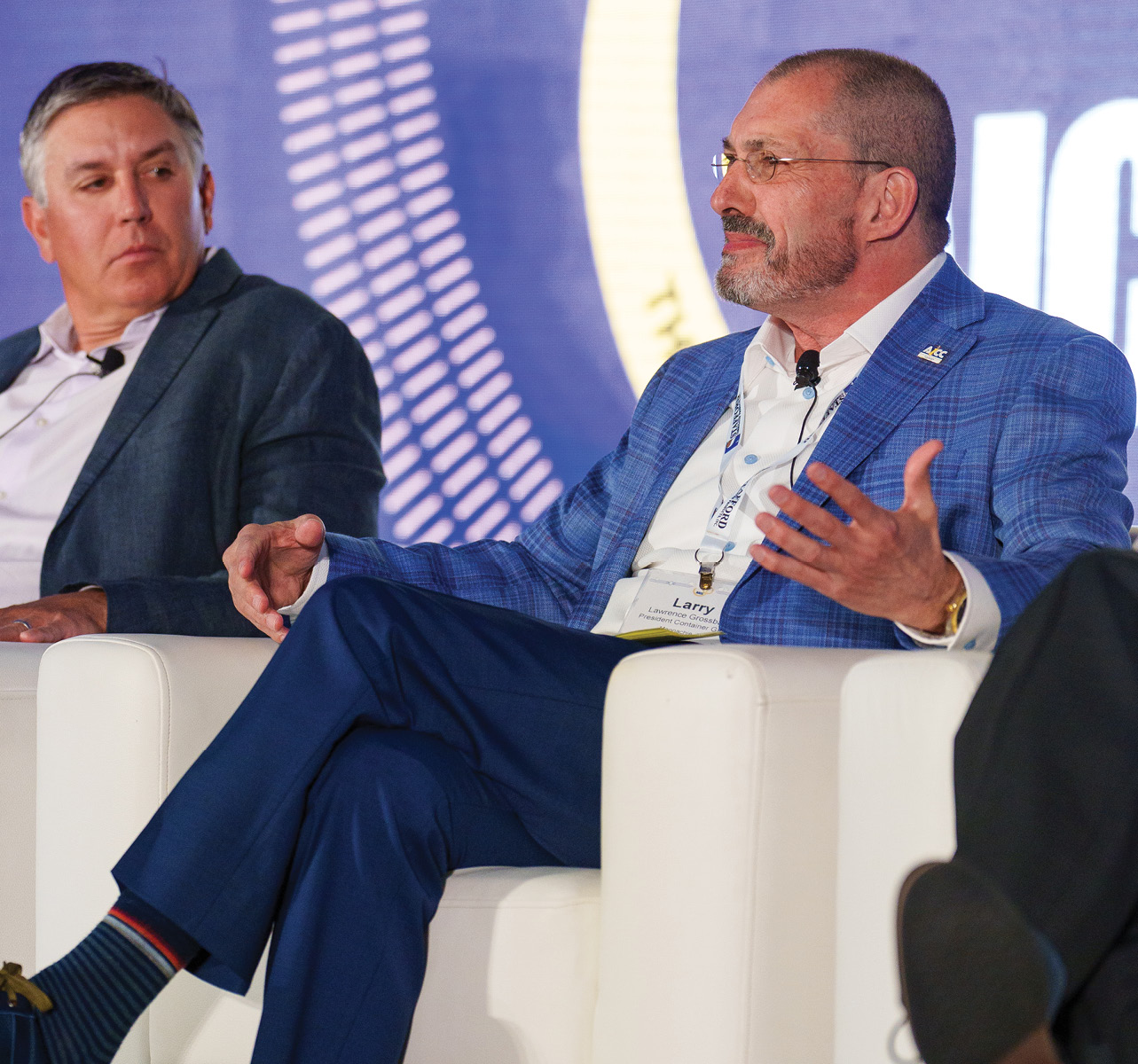
Chad Wagner of Peachtree Packaging (left) and Larry Grossbard of President Container Group.
Morelli: Chad, what during the years where you were a minority stakeholder, what challenges were you facing that made you want to take more and more ownership? Were there certain moments where you said, “Man, I gotta take the bull by the horns here and take the lead on this”?
Wagner: Yeah, so the two gentlemen that I aligned myself with were salesmen there as well. We were all in the sales field, and all of us had opportunities inside of some of our biggest customers that we couldn’t capitalize on. What we saw in Peachtree was a great company full of hardworking people, but maybe it lacked in equipment capability. And maybe it lacked in systems, whether that be quality control systems or maybe prepress stuff on the front end. These opportunities were there, but they were always things that we couldn’t capitalize with. So, our initial business plan was to try to advance the capabilities of the equipment when we bought the business and advance the systems behind the new equipment. And that’s what we have been busy doing for the past seven years.
And I think it’s an easy way for everybody to understand to grow your business if you’re already there—land and expand. And that’s what we were constantly chasing the owners for, to do. And that’s ultimately what ended up for the transition of the business. They knew that the capital needed to be spent. They knew at that point in their career that they weren’t really going to spend the capital. And so they told us, “Why don’t you guys buy the business? And then you can do all this great stuff that you want to do.”
Morelli: You’re a sales guy. You’re talking about process improvement. You’re talking about operational changes. Where the hell did you learn how to do that? Who did you lean on? Were there people outside the business that maybe you looked to to help guide you through that whole process?
Wagner: We quickly surrounded ourselves with a couple of really excellent, talented consultants. Chris Heusch helps us a lot with manufacturing equipment and process. And Mackie Davis helps us a lot with our business analytics; I would say all the numbers and preparing all the numbers and reports and distributing those reports to the staff. So those two people were great mentors for me. Like Jerry [Frisch] talks about, surround yourself with mentors for sure.
And then this industry has been a big help for me. My business partner, Eddie Davis, is here for the first time. I’m sure he’ll tell you he’ll find great value when he walks away from this meeting. But I’ve tried to come religiously since we took over. I’ve met countless people and have built great relationships, and the business is very cooperative. And people have been willing to open doors, and we’ve learned a lot.
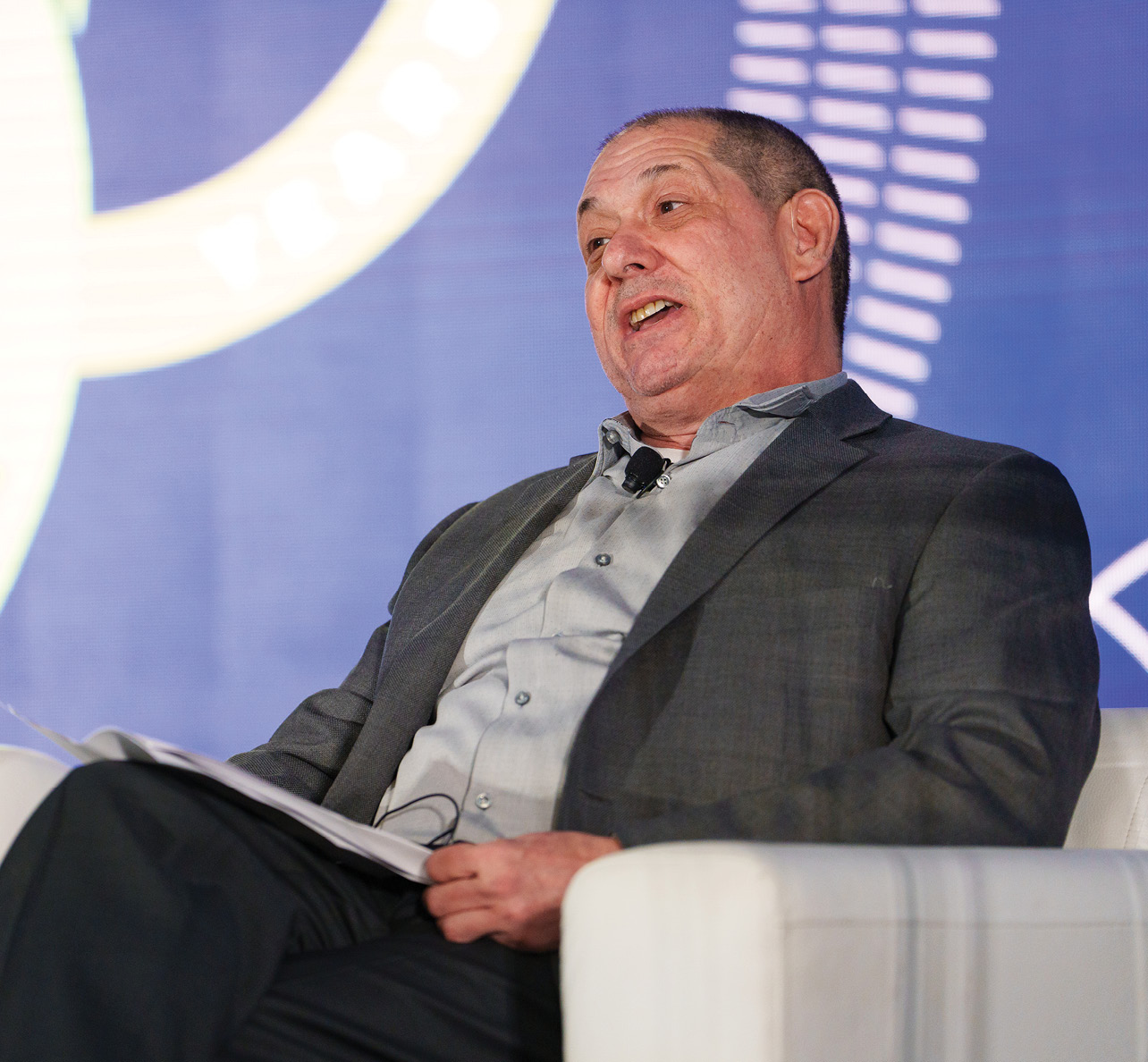
Richard Grossbard of President Container Group.
Morelli: Can you touch on that, maybe as a last question here? You know, sometimes, those types of deals can be hostile. Those can get ugly. In your experience, how did you manage through that to make it a peaceful transition during those times?
Wagner: The way we approached that was, we gave the five remaining founding fathers of the business an opportunity to present to us what they wanted. Instead of us coming with any kind of presentation, we just showed our hard work, our dedication to the company, and our willingness to help them build the business over 30 years’ time. We would all have been there almost 30 years, and they valued and trusted us. And we just allowed them to tell us what they wanted and how they wanted to exit. And then we said, “If you’ll give us that information, then maybe we can get together and figure out if we could.”
Make a plan, and if there’s something reasonable that we can execute on, then we’ll be back in touch and we’ll present what we can do. We did that, and the owner financed some of it for us. A few of them left immediately. Some of them stayed behind and worked for a few years. And so it was just an opportunity for them to kind of paint a white canvas the way they wanted to exit the business. And that allowed it to be very amicable and fruitful for all.
Morelli: I’m far from an expert. I just listened to the experts talk, but in our experience in the podcast, the way you just outlined, that has happened to half a dozen or seven or eight of the people that we’ve talked to and seems to be the easiest way to transition when you ask them what they want, rather than tell them what you need, right?
Wagner: Yes.
Morelli: Chad, thank you very much for your time on entrepreneurship.
The Grossbard Story
Pallini: So, we’re going to turn to [President Container Group] now. Larry and Rich, you guys can split these questions up any way you want. I’ve been through some of the journey with you, so I think what might be interesting is your areas of expertise. It’s innovation that we’re asking you to speak about, but your journey from Moonachie up to New York and all the investments you’ve made in the past 10 years, which are unmatched. So, just tell us a little about that journey.
Larry Grossbard: President was started in 1947 by my father. We moved to Moonachie, New Jersey, in 1964. Fast-forward to 2007. I’m walking around the plant, everything is going great, the machines are humming—it’s a dangerous place to walk through.
But I look around and I go up to Richie’s office and I said, “Is this it?” We’re in our mid-40s. “Is this all we’re going to be going forward?” We had raw stock coming from one building. We had a sheet plant in another building. We had to pack out an assembly in a third building in manufacturing. And I said, “There’s got to be more to it. We’ve got to do something.”
It was at that time we decided to embark on a journey to find another facility in order to combine all the factions under one roof. It was very risky. It was very expensive, but we decided to either go big or go home. We made the decision that we’re going to find a new facility.
We have a 625,000-square-foot facility today. We have miles and miles of conveyors, all of the latest equipment. And one of the nice things that it did enable us to do, by making this move to go to New York, was—and I do sound like I’m from New York, I know that. Everybody loves to build enterprise value. And what this gave us, it gave us the opportunity, if we ever wanted to get out, which we’re not gonna do, it gave us the opportunity because we could sell in a heartbeat to any one of the companies who would want a facility our size. That was what made us want to make the move. We were just done—at 40 years old, done. You’re not done at 40 years old. We’re at 60, and we just did another expansion.
We’re looking to continue, but I just wanted to just take a moment to congratulate AICC on its 50th anniversary. What this group has accomplished is truly amazing. I’m very happy that President was a founding company, and my father, Marvin Grossbard, was a founding member. I’ve been coming to AICC’s meetings for 40 years now, and my son went through the Emerging Leaders, and we’re looking to have our future generations be part of this great organization. So thank you to everybody for all you’ve done and provided this for us.
Morelli: Guys, I’d like to know, sitting around the table, talking about growing to that point is the easy part between the two of you guys: How did you drive the innovation through the organization? Culturally, what did you do to really make everybody buy into your vision?
Richard Grossbard: Let me tell you a little bit about innovation and what we’ve done and how we drive it with our team. Innovation is key today in order to run a corrugated carton company. Yeah, we have a large company up there. We’re currently at 600,000 square feet. We have two files per 110-inch corrugators. We have a lot going on in one plant. And in order to continue the growth and continue to keep it all under control, you have to have innovation. Now, what is actually innovation? It can be many things.
In equipment, the innovation to allow you to run more efficiently, to try and run with less people. You know, people is a killer in our industry, we all know that. We all need them, but innovation will allow you to run a little bit more efficiently and give you an opportunity to increase your throughput without increasing the head count.
There’s a lot of different kinds of innovation. It could be equipment. It could be computers. I’ll give you an example. We utilize a tool right now called Power BI. For any of you who are not familiar with Power BI, it’s a Microsoft product. Not a tremendous amount of money for the product, although you do have money having people developing it. But what that product will do, it’s an analytical product. When you run a company like we’re running, you know, we have a goal to hit 3 billion feet. God help us, but that will be the goal. When we go and we try and hit that, you need a lot of tools and part of our innovation. We integrated the Power BI to help analyze, whether it be payroll, whether it be managed inventory for our customers, whether it be paper stock analysis. There’s so many different things. We could tailor-make and create the program to what we need, not to what a software company will tell you what you need. It’s a great tool, not too much money, but a good opportunity to get what you need for your individual operation.
Larry Grossbard: Just one thing to add to what Richie is saying. The first time we went to the bank, and we had this pro form and what we were going to do, and they said, “Let me ask you a question: Do you have the business to support this expansion?” I look at it, I’m like, that’s the stupidest question I’ve ever heard. Of course, I don’t have the business. I said, “Our philosophy is very simple. We’ve all seen the movie Field of Dreams. ‘Build it, and they will come.’” And that’s what I told the banker. And thankfully, they did come.
The other thing we did that really changed the look, the feel, and the culture—and if anybody’s ever gone through, the hardest thing in the world to change is the culture of a business, and especially the culture in a factory—we spent a four-year investment on 5S. We had our consultant, and I don’t want to give any unnecessary plugs, but Les Pickering did a great job. He came in every week, and we redesigned every workstation. We built every apparatus. And the biggest compliment we ever had: We had Aluf Plastics, one of our biggest companies, come for a plant tour. They’re walking around the facility, and they were so impressed. They went back, and he started a visual workplace, 5S, at their company. And they asked me, my son, and one of our managers to come speak and give a presentation. And that’s how you build the camaraderie with the customer and the relationship.
Those two things were huge that we did. It’s not just machinery. And remember one thing about machinery, today’s machinery is a two for one—you guys did it, and we did it. You take out two old legacy machines, you put in one high-speed machine, and it’s two for one. We do setup times, increase productivity, increase quality. The jump in today’s machinery from 10 years ago is night and day. So don’t be scared of the investment. It’s well worth it, and it’s a twofer.
Pallini: I’ll give one final question on innovation, and just real briefly from a high level, what do you see a future box plant looking like? Five to 10 years from now, anything big that you see that’s gonna change a lot in the design or layout or machinery side of the business?
Richard Grossbard: Well, if I could touch on that a little bit. The future of a box plant is unique to each individual company. You know, part of AICC and the independent, moral independence, right? In our case, PCG (President Container Group), we looked at it where we do a lot of the specialty work, but we’re bigger in volume.
We look to compete with the big integrated plants, and we go in that route. But the future and talking about what a box plant would be doing and how they will succeed. You’ve got to do more with less to the best of your ability. As I mentioned before, labor, labor, labor, labor is the killer. Nothing we can do about it.
On top of the high pay, you have benefits, you have everything else that would go with paying the staff. So the future in a box plant, try and do more with less, whether it be innovation through equipment, through technology. But one thing’s for sure, a lot of people in this room have done very well.
We have a great future. There’s no better product than corrugated. It is biodegradable, recyclable; it will not be replaced. And the future for a corrugated box plant, be innovative. One thing we do in this room, which is very different than a lot of the integrated companies, we’re customer-oriented. We make sure we take care of what they need. We’re adaptable to change quickly, and we will continue to succeed.
Look how many people are in the room, and look at the future. Futures are very bright. Thank you. Thank you very much. Yeah.
Larry Grossbard: I agree with Richie on everything he said. And just one thing I would want to share with all the next-generation people out there. I used to sit back early on in my career. I’m like, “Oh, how are we going to do better than what Dad did?” He built this company. We have all these buildings. We have all this machinery. It’s doing great. But you know what? It can be done. Don’t be scared to take a chance. Don’t be scared to grow the company. A little bit of risk never hurt anybody.
Jerry talked about the risk and the financial aspect. Just one quick story, and I’ll finish. We’re doing it. We just made the move to New York. We’re running two plants, two manufacturers, two maintenance staff, two of everything, which is really not a good thing. Two of everything. And we get our financial statements. And I hear Richie screaming. I’m screaming, “How do we lose $2 million in one month?” I said. “That’s impossible!” But, another milestone, we accomplished it. We lost $2 million in one month. A few months go by, and Richie comes in and goes, “Yes! We did it! We did it!” I look at the financials. “We lost $120,000! We’re on our way! This is gonna be great!”
So, don’t be scared. I’ve never been happier to lose money than that time. It was like, we’re on the right path. We will get there. And I told Richie one day, “We’ll look back on this, and we’ll laugh that we made it.” And that’s what we do every now and then when we want a good chuckle. So that’s our story, and anybody can duplicate it.
The Akers Story
Joe Morelli: Well, last but not least, a family that has 15-some plants now across the Midwest. I gotta ask, with so many family members being a part of your company, a number of years ago, AICC put together a presentation on family business, had an oil tycoon come in and talk about how dissension ripped apart their family. How do you prevent that from happening? How do you sit around the Thanksgiving table and keep that work and family balance healthy enough to succeed?
Bill Akers: I don’t think we see each other much outside of work.
Jim “Jake” Akers: We don’t have Thanksgiving together. This is a credit to AICC, too, but maybe 40 years ago, our father was a chairman of AICC. At that time, one of the themes was to have family business consultants be speakers for the Association. We had a couple. John Ward was one from University of Northwestern. Another one was, I think, Warren Rustland. But anyway, the theme was that it’s important to have a business plan—you know, financial and economic business plan.
But it’s more important, if you’re going to have a lasting business that’s going to succeed for multiple generations, to have a family business plan. So as a result, my dad had the foresight to say, “Let’s hire a family business consultant to kind of steer us through this process.” And he asked me to do it, and I just got names out of TheWall Street Journal.
There’s an article that day about family business consultants. So we interviewed him, picked a guy named John Messervey. He sat down with every family member and spouse individually to find out what your expectations were for and from the business. And that’s really important because if you have passive shareholders, what do they expect from the business?
That led us into strategic family business planning. It led to a pretty extensive shareholder agreement. And it kind of flushes out all those issues about maintaining and continuing a family business and working through different shareholder interests.
Pallini: Great. I’m going to send one to Andrew. Andrew, as you know as one of the newer members of the family and the business side of the family, just tell us a little about how you work to earn the trust of the employees and find your way to fit into such a great, already successful organization.
Andrew Akers: Yeah, it was interesting. I came into the business about nine years ago, worked outside of it for about 10 years, and had an opportunity when we had a retirement to actually come into our Middletown office. So I was in our headquarters there, and with that, similar to what Jerry was saying, I’m working with people that have been doing this for 25, 40 years, and I’m new. One of the core values that our business has in our culture is help first. I think, growing up, I always saw that as being one of the tenets. And so, carrying that forward, I started to ask people, “How can I help? What can I do to, to help you?” And I think, through doing that, I was able to learn a lot from what people have grown in their experience.
One of the things my grandfather always would talk about was the four-way rotary test. That was something that was instilled in us very young and is instilled in the business. One of those is, how can this be beneficial to all parties involved? And so I think that’s where I would just go, and when working with people, I didn’t know a lot. But I wanted to learn. I was hungry, and so I think by being able to jump in there and, like we said, get in the deep end, it was one of those “I’m going to push the broom. I’m going to do exactly what you need, and it’s going to help me learn, and we’re going to learn together, and it’s going to be beneficial for both parties.”
I think I still try to do that today, even when we bring in new people, try to work with them and try to just see how we can all grow together. I think every person has a special ability we can all learn from. I’ve been very fortunate.
Pallini: Well said. Thank you.
Morelli: Bill, if you wouldn’t mind taking this one. A couple years ago, you guys made the decision to go outside of the family—to hire a member for your executive management team. My stunt double. Yes, my big brother in the industry. So don’t speak poorly about him. But what went into that decision? Obviously, many people here are part of family businesses, and the executive team is made up of just family members. Can you explain what went into that decision, and why you guys went that route?
Bill Akers: For one, we don’t have too many family members.
Jim “Jake” Akers: I was going to say, we ran out of family. It made it easy.
Bill Akers: But, you know, as we grew, we knew—I guess we were taught by our father—that if you find good talent, hire it. And that’s what we’ve done for the past 60-something years.
Gene [Marino] has been a wonderful addition for us. And I think probably the toughest thing is for Gene—because we’re sort of set in our ways in how we run a business—I think it’s probably tougher to have family members than someone from the outside. My personal opinion.
Morelli: Clearly, if somebody comes in from the outside and it’s been your entire life, you have been a part of the business forever and have somebody come in and give new ideas. How do you receive that? Is that a difficult thing, for you to do what he recommends? Any kind of change to what you all are typically used to?
Bill Akers: I don’t believe so because I think we learned through YPO. You know, people can skin a cat in a lot of different ways. I know when Jake and I got in the business, we wanted to do different things. We wanted to have more people, have our employees participate more, and my dad was totally opposite. He just told everybody what to do.
Jim “Jake” Akers: We didn’t encourage our children to come to the business, Billy and I and even Andrew were box plant rats. You know, we grew up in the box business. We worked there in high school and college. But you know, that’s tough to go right from school into the business.
So I didn’t encourage any of our kids. Plus, I saw some other train wrecks where kids came to the family business. They felt entitled. It was like a safety net for them. We didn’t want that. We only wanted people who had established success somewhere else. And back in those days, too, they could probably get better training at big companies.
Andrew worked for SCA out of Sweden and worked for PepsiCo in New York, WestRock. He got big-company training. But the other thing, we wanted them to stand up and establish themselves so when they came in, people respected them, what they had accomplished.
But because of that, our kids are very successful. They embarked in other careers they enjoy so much that they aren’t coming back to the box business. But Andrew wanted to, so that’s great that we did that.
We know what we know. We don’t know what we don’t know. And we knew that we wanted to go to the next level in terms of growing a company. We had always maintained a really thin bench. We said we’re going to have to develop a bench and a company professional management development program, and we’re going to have to hire people and create positions we never had before. So it would become a mid-market company, and that we have a CFO, we have a director of human resources, and we have an outside president—that we’re attracting a talent that complements what we know to help us become a great company.
Pallini: If I can continue that conversation then, just one last question, then we’ll open up to some questions from the audience. How about organic versus acquisitions? I mean, you all have grown a lot. You’ve done both sides. What’s the philosophy on when to do one versus the other? And this is for any of you. Bill?
Bill Akers: Well, we’ve grown more by acquisition than we have organically, but basically, I think what we do is, the opportunities come around and we look, we do analysis, and run the numbers. And if it works out, we make the acquisition and move on. But we’ve been fortunate. I mean, our strategy started back when Jake and I got out of crystal tissue.
We used to travel all over the world. I mean, we’d go to China, be on the West Coast, go everywhere, and we were flying down to I think it was Texas. Look at a box down there. We both were flying back and said, “Texas? We’ve got to stay in the Midwest.” So from then on, we just said, “All right, we’ll buy something if we can drive there and get back in the same day.”
And so that was our goal. We ended up having plants in Michigan, Ohio, Illinois, West Virginia, Indiana, and Kentucky.
Jim “Jake” Akers: First of all, if you were in the session yesterday afternoon, you’ve seen our industry has only grown 0.7% or 1% compound annual growth rate since 1990. So, it’s tough, it’s difficult to grow organically. In fact, we always tell our plants, you have to budget 10% growth because you’re gonna have attrition every year—customers that move, you could lose business—but for various reasons, you gotta plan for that.
Growing by acquisition in a consolidating industry is important for us as a strategy for everybody here. And then the other thing we did was, maybe 15 years ago, we said we have to be proactive, rather than just being responsive or reactive when an opportunity presents itself, and we saw what Welch Packaging was doing, We said, “You know, Scott [Welch] works on that half the time, so that’s how they get these acquisition opportunities, so we need to do that.” So for a while, I did it, but not very well, because I’m guilty, and I’d always encourage the Yale people to work on the business, learn how to work on the business instead of in it, because I get so immersed in it.
I have the job to do the acquisition. I didn’t do a very good job, developed a couple opportunities. And that’s one of the reasons we hired Gene, too, when we said we needed somebody full time to scout out acquisitions. The other thing Gene did for us initially was develop an internal management development training program, but I think you can wait for opportunities. You can wait for investment bankers to contact you. That’s a slow way to go. If acquisition is going to be part of your strategy for growth, then like anything else, you have to be purposeful about it, and you have to be proactive about it.
Andrew Akers: Yeah, that’s what I was just thinking—being intentional about it. And I think we’ve had success with the acquisitions that we made; it’s also looking at, does the culture fit? We found that the owners we’re talking to a lot of times, we end up wanting them to run the facility. So we have to make sure that we all have that relationship, that we get along well with one another. So I think that’s what we look for, that we can all sit around the table and break bread together and be able to come together at the end of the month as well.
Jim “Jake” Akers: I think the other thing, too, the old saying, “slow to hire, quick to fire,” that’s true for acquisitions, too, because they didn’t all work out. We had two that didn’t work out, and thank goodness we slogged it out for a year. And then when we finally said, this just isn’t going to work. Either our premises were wrong, or we misread it. Different things happen, but we said, OK, pull the plug quickly.
And I remember one time, we bought a company that my dad liked. I learned then, too, to villainize that. Look, we love our dad, but we also got to learn to speak up when we disagree. And we bought this company that Dad liked. And from the beginning, I said, “Man, I don’t know how this is going to work.” So it lost about a million dollars in a year. And we had a shareholder meeting, got my two sisters, and said, “OK, everybody’s going to stroke a check for $250 because we’re going to pay off all the creditors, close this thing.”
So those are the bitter sides of acquisition. We have a high batting average, but we’re not perfect.
Morelli: Thank you all for your time.
Pallini: Yeah, I just want to thank everyone again. This was very helpful.