
August 24, 2026
Packaging Corp. of America’s comments at Wells Fargo’s Industrials & Materials Conference on June 10 may provide an early indication of second-quarter box demand. Chief Executive Officer Mark Kowlzan called the quarter “very healthy,” with shipments at legacy plants up 4.5% in April and 3.5% in May. Though one producer’s results don’t establish an industry trend, they align with broader manufacturing indicators that have improved throughout 2026.
The ISM Manufacturing PMI reached 54 in May, its highest reading in four years, as manufacturers continued to rebuild inventories following nearly two years of destocking. New orders have expanded for five consecutive months, production is growing, and customer inventories are still reported as unusually low.
Though industrial sectors such as machinery, transportation equipment, electronics, and chemicals have led the manufacturing recovery, corrugated demand is ultimately more dependent on the movement of consumer and packaged goods through distribution networks. Inventory replenishment across supply chains creates a more supportive backdrop for box shipments.
The improving industrial backdrop contrasts with consumer indicators. The consumer price index increased 4.2% year over year in May. Accordingly, the University of Michigan consumer sentiment survey lingers near historically depressed levels, while retail sales growth has largely reflected higher spending rather than increased consumption. The divergence suggests inventory dynamics may be playing a larger role in corrugated shipments than end-market demand, as illustrated in the graphic at right.
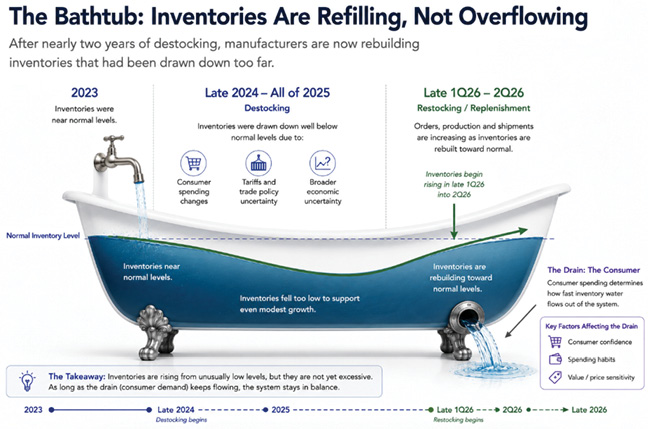
It shows that, following a prolonged destocking cycle from late 2024 through 2025, manufacturers reduced inventories in response to weaker consumer spending, tariff uncertainty, and economic concerns. As inventories were drawn down to unusually low levels, even modest pickups in demand became sufficient to trigger replenishment.
The resulting increase in production, orders, and shipments doesn’t necessarily reflect a broad-based economic boom. Rather, it suggests supply chains are rebuilding inventories that had fallen below sustainable levels. For packaging markets, the distinction is important: Corrugated demand can improve meaningfully during a restocking cycle even as consumer sentiment and end-market demand remain relatively subdued.
Historically, announced price increases can trigger prebuying as customers attempt to avoid higher costs, yet our surveys suggest that this behavior hasn’t been widespread. Only a handful of box producers reported customers placing such orders, particularly among distribution-related accounts. Containerboard buyers also noted little evidence of prebuying. Some took advantage of spot opportunities, which are typically limited in size and often involve odd specifications or aging inventory.
The economics of a large-scale prebuy are challenging. A 5,000-ton-a-month corrugator attempting to buy an additional month’s worth of inventory at roughly $700 per ton would need to commit about $3.5 million in working capital before storage, handling, and financing costs. Though such a purchase might prolong a $50-per-ton increase, a large portion of those savings would be eaten by warehousing and logistics costs and the time value of money.
The same constraints apply on the box side, where inventories require even more warehouse space and can tie up capital for longer. End users would need both the physical capacity to store additional supply and sufficient confidence in demand to justify the purchase. The more probable explanation for improving shipment trends is instead a combination of inventory replenishment and strengthening industrial activity, which looks more like a restocking cycle than the beginning of a boom.
The Perfect Price Storm
The corrugated industry’s benchmark containerboard index lifted prices again earlier this year, and we weren’t particularly surprised. To understand why, it helps to look back over the past 18 months.
Major integrated producers have removed roughly 4 million tons of containerboard capacity since the beginning of 2025. The gap between demand and available capacity had widened to a point where mill operating rates were struggling to remain above 90%. Most of the exiting capacity was virgin-based and likely would have required significant capital spending to remain viable, particularly in recovery boiler systems. With potential investments approaching $300 million a site—often to modernize part of a mill without meaningfully improving machine speed or scale—closure became the more rational economic decision.
Even after the closures, market conditions remained challenging entering 2026. Sluggish demand and tariff uncertainty weighed on box shipments, while winter weather likely cost the industry several shipping days during the first quarter. Industry shipments trailed the prior year by nearly 2%, and mill operating rates still struggled to stay above 93%. Exports helped offset some domestic weakness.
Then the market changed. March box shipments increased 3.4% year over year, and box producers indicated that strength may have persisted through much of the second quarter. As noted earlier, manufacturing activity appears to be improving as inventories are replenished after nearly two years of destocking. Domestic demand may have increased roughly 5% quarter over quarter just as mills were entering maintenance season.
Most mills take maintenance downtime during the second quarter, ranging from a few days to several weeks depending on the scope of work. Scheduled downtime is a normal part of the industry’s operating rhythm and is generally reflected in capacity assumptions. This year, several mill officials told Green Markets that restart efforts proved more difficult than expected. In some cases, machines required an additional week or more to return to normal operating levels after maintenance was completed.
Those lost tons aren’t reflected in published capacity figures. As one paper seller told Green Markets, “Downtime may be baked into capacity, but lost productivity is not.” Another seller suggested investors should expect productivity to emerge as a recurring theme during second-quarter earnings discussions: “Expect to hear that a lot.”
The productivity challenges weren’t limited to scheduled maintenance. A fatal accident at Nippon Dynawave’s Longview, Washington, facility also disrupted production at NORPAC, which relies on Nippon for steam and power as part of the former Weyerhaeuser complex. The outage affected the availability of both linerboard and medium grades at a time when inventories were already tightening.
Several buyers said some orders were canceled due to limited availability. NORPAC’s recent acquisition by International Paper may become a focus for independent buyers, particularly if fewer tons are ultimately made available to the open market.
Operating data due at the end of July may show the industry running near 93%–94%, a level that wouldn’t normally suggest severe tightness. Yet the figures may mask a much tighter supply situation if mills struggled to ramp up following outages.
Inventories that appeared comfortable at roughly 4.5 weeks at the end of the first quarter may have been depleted quickly, while lead times stretched to six weeks from four almost overnight. Orders that previously arrived on time began showing up days or even weeks late. Even some integrated producers were said to be unable to find supply.
Meanwhile, demand was no longer deteriorating. Driven by inventory replenishment, improving industrial activity or both, box orders increased just as supply was becoming less reliable. That combination may explain the industry’s latest round of price increases: The market found itself caught between recovering demand and impaired productivity and turned to pricing to restore balance.
The next test is whether those increases hold. Industry operating data should provide a clearer picture of what actually transpired during the quarter. Major integrated producers’ reported shipment growth will be a key data point, along with exports.
If low-priced export tons continue to move aggressively into overseas markets, domestic buyers may challenge the sustainability of higher prices. However, if inventories have truly been drawn down and productivity remains challenged, the industry’s pricing power may prove stronger than many expected at the start of the year.

Ryan Fox is a corrugated market analyst at Green Markets, a Bloomberg company. He can be reached at rfox93@bloomberg.
