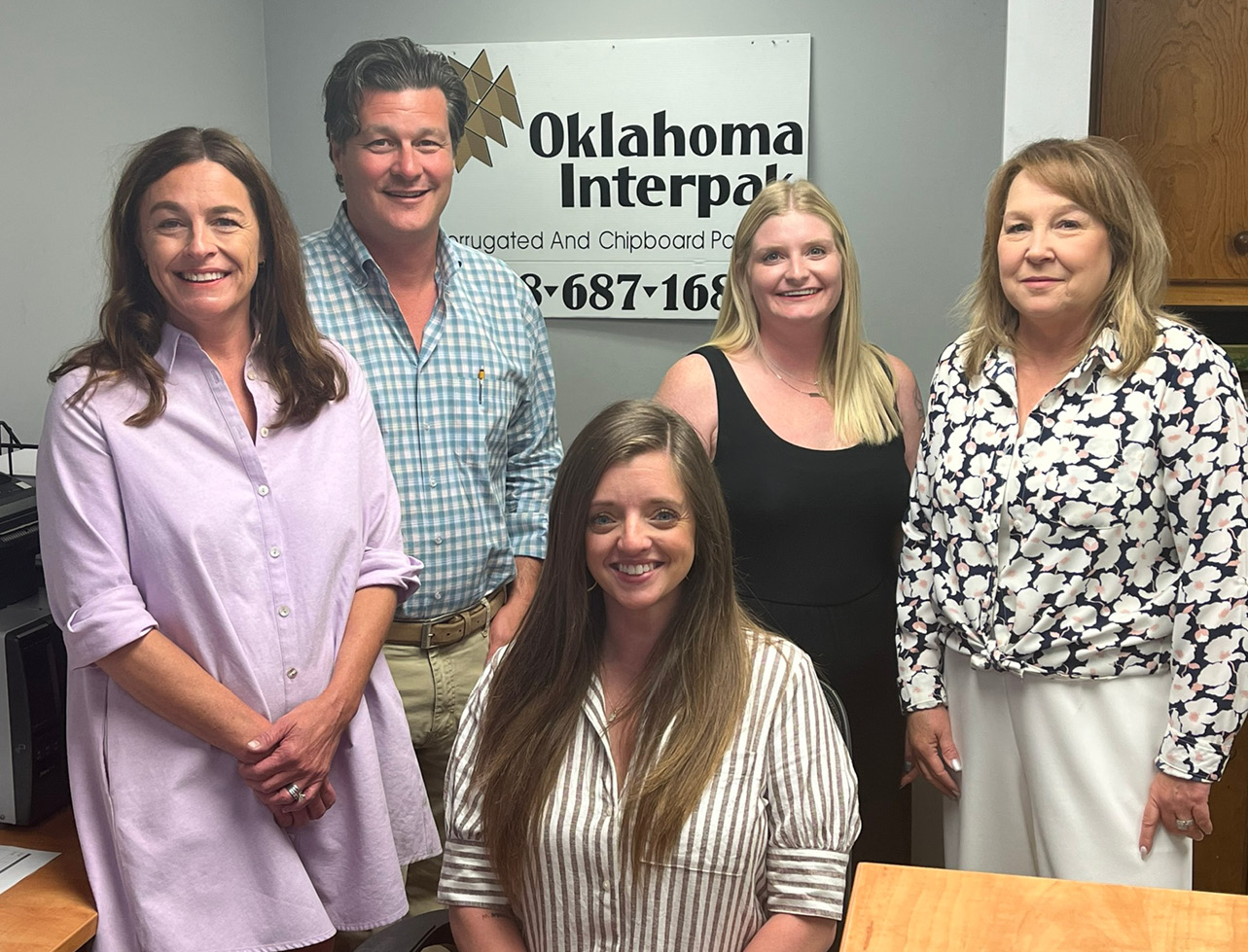
The Oklahoma Interpak leadership team (from left): Julie Elgin, owner and chief financial officer; Eric Elgin, owner, president, and CEO; Becca Beaty, receptionist and customer service; Andrea Eaton-Steele, customer service representative; and Anita Brown, customer service and purchasing manager. Not pictured: Trent Bennett, plant supervisor. (Photos courtesy of Oklahoma Interpak.)
Company: Oklahoma Interpak
Established: 1980
Joined AICC: 2005
Phone: 918-687-1681
Website: www.okinterpak.comHeadquarters: Muskogee, Oklahoma
Owners: John Schilt and Eric and Julie Elgin
The early years of Oklahoma Interpak tell a curious story of oddball, do-whatever-it-takes-to-make a-buck entrepreneurship and being-in-the-right-place-at-the-right-time good luck. Eric Elgin, president and CEO, and Julie Elgin, chief financial officer, now also own the company, which was originally founded in the late 1970s by a local man in Muskogee, Oklahoma. Now in its fourth decade of operation, Oklahoma Interpak is a nationally recognized specialty supplier of corrugated and chipboard partitions, selling directly to end users and the corrugated packaging industry as a trade partner. The company employs 45 full-time and approximately 15 temp-to-perm employees working three shifts in its 50,000-square-foot facility on 19 acres in Muskogee.
Julie related the story of those early years. Her father, John Schilt, had his own company—Professional Packaging, or ProPack—which began in 1979 with a disparate product mix of corrugated pallets and contract packaging services. “We made corrugated pallets and assembled and screen-printed coffee pots,” she remembers. “We started in a barn at our house, but later he needed more space because the building he was in at the time was being sold.”
It was at that point in 1984 that Schilt, in his search for more space, learned of Lloyd Webster’s desire to sell Oklahoma Interpak, a corrugated partition maker with only one principal customer, a glass manufacturer in southeast Oklahoma. So Schilt bought the company, adding partitions to his eclectic service menu.
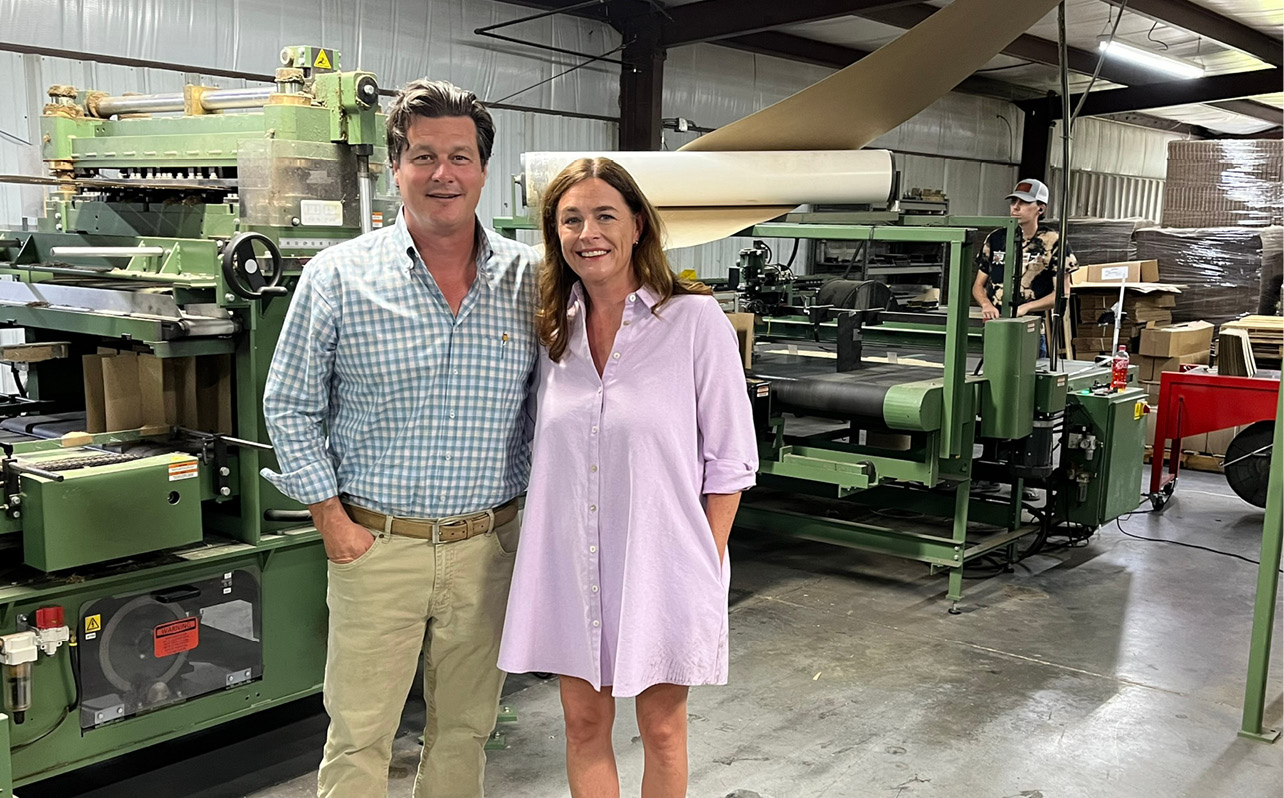
Eric and Julie Elgin alongside one of their two Premier Paper Converting Machinery full auto line chipboard partition machines.
Schilt ran Oklahoma Interpak single-handedly until the early 2000s. Eric and Julie Elgin, meanwhile, were successful in their own careers—he in selling medical services and she as an accountant for a major firm in Tulsa—with no real thought about the company. But as Julie explains, the events of September 11, 2001, prompted them to reevaluate their plans. “Well, it was after 9/11, and you know that kind of shook everybody up a little bit as far as what’s worthwhile in your life,” Julie says. “Eric and I always knew we wanted to work together in our own business. That’s when my father asked us if we’d have any interest.”
Adds Eric, “We were living in Tulsa, but my company had a branch down here in Muskogee, and I was down here calling on customers. And he said, ‘Come on by; let me show you the place.’ So I came down, went through the plant, and he was telling me all about it. I think in about three weeks after that, I was working here.”
Julie, for her part, left her position at PriceWaterhouseCoopers, and they both started working at the company on October 29, 2001.
With the Elgins’ arrival at Oklahoma Interpak as employees—not yet owners—a newfound energy was felt in the company, prompted primarily by Schilt’s declaration to Eric that he would receive no compensation on any existing partition business, which at the time was due to that single customer, the glass manufacturer in southeast Oklahoma. “No. 1, right when I started, Julie’s dad told me you’ll never get a commission off my customer,” Eric recalls. “And he told me they might be out of business in five years anyway.”
With that revelation, he devoted himself to working in the plant, learning processes, and running machines to be better equipped for sales—what he was best at doing anyway. Eric remembers how his father-in-law provided further guidance for him as he hit the road. “I asked him, ‘So who do I call on?’ And he said, ‘I don’t know; I haven’t made a sales call in 10 years.’
“I know our primary customer is a
glass factory, so I’m going to start calling on glass factories,” he says. “It did not take long for me to realize that this was going to be a long, hard road; you just don’t go into a glass company and start selling partitions.”
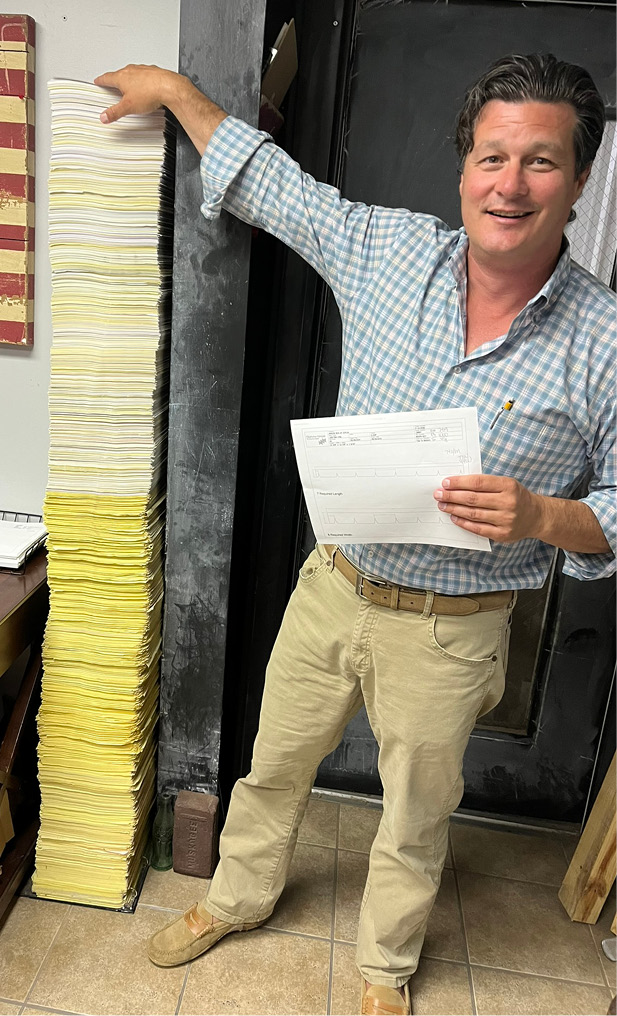
Eric points to the column of purchase orders he’s been keeping in his office since 2005, when the company installed its first chipboard partition machinery. He estimates the stack to contain about 19,000 orders.
So, in the category of being-in-the-right-place-at-the-right-time good luck, Eric called on a Hiram Walker bottling plant in Arkansas, where he was immediately shown the door. “I didn’t get past the entry gate,” he says. “So, then I walked into a [corrugated] box plant in Fort Smith, and I said, ‘Hey, I’m Eric from Oklahoma Interpak. Do you guys ever need partitions?’ And they were, like, ‘Yeah.’ And that’s when I really learned that a good strategy for us might be to sell into the trade.”
While Eric was learning the ropes, Oklahoma Interpak continued to manage an active but shrinking contract packaging segment, a part of its entrepreneurial, do-whatever-it-takes-to-make-a-buck service. “When [Julie and I] got here, we were still contract packaging for a company called Crosby McKissick,” he says. “They made cable clips consisting of a U-bolt, base, and two nuts. And then there were the discs. We used to get 40,000 pounds of metal discs —you know, like canning lids. And basically, we would get 40,000 pounds of these and package them in 50 lb. boxes. These were used as roofing washers—the metal discs that keep the nail head from pulling through the roofing paper. That was probably our last contract packaging job, which ended in 2019.”
Eric’s entry into the company gave Schilt a unique partner in the company’s future vision. As Julie explains about her father’s personality, “He was an engineer; he wasn’t a people person. He was super smart, and he and Eric were like yin and yang because Eric is a people person and my dad was the machine person. So together, they really did work well. They weren’t cut from the same cloth to where they would butt heads. In fact, Eric was the buffer most of the time between me and my dad.”
Schilt’s machine aptitude appealed to Eric and his vision for the growth of the company. In his early work in the plant, Eric experienced firsthand the inefficiency of the older corrugated partition equipment long in the company’s possession. And Eric, in his entrepreneurial sales mode, saw an opportunity for the addition of chipboard partitions to the company’s product offerings and thus a new avenue to profit from a growing market.
“I desperately wanted to get into the chipboard partition business because all we made were corrugated partitions, and every time I’d go in to make a sales call they’d ask, ‘Do you make chipboard partitions?’ And every time I’d say, ‘No.’ So I spent a lot of time trying to convince somebody to use corrugated partitions, but they’re generally more expensive and sometimes they’re just not the right option. So, the solid fiber partition was the thing I really wanted us to get into.”
His instincts were well-founded. The paperboard partition manufacturing sector, a subset of folding carton and corrugated packaging industries, is a $6.5 billion business. According to a report from Future Market Insights, the industry is expected to grow from its current level to more than $10 billion in 2033. The sector is dominated by a few large publicly traded players such as Sonoco, International Paper, and WestRock and then a number of independents focusing on service, quick turnaround, and quality. Key markets served include agriculture, glass and beverage, cosmetics and pharmaceuticals, electronics, and automotive, among many others, and demand is expected to continue to grow as product manufacturers look for more sustainable product protection alternatives such as paperboard and corrugated.
In their effort to modernize the company, improve efficiency, and tap new markets, Eric and Schilt put their heads together, looking into chipboard paper supply and machinery. Schilt had shied away from the chipboard business early on because of his doubts about the vertical integration of the industry and reliability of paper supply. “I don’t know whether he was correct or not,” Eric recalls. “But we researched getting paper supply and machinery, and we ended up ordering a brand-new partition assembler and a stripper machine.”
Admitting their inexperience, Eric adds, “John and I ran the first order; it took all day, and the invoice was only $300.”
As the company grew, along with its profitability, Julie’s financial and accounting background came into play. In 2005, she, Eric, and Schilt created a new entity, EJ Leasing LLC, as an ownership vehicle through which the company could purchase its new equipment. “I’d say during that time—2005 to 2010—we did the most amount of investment in a very short period of time,” Eric says. “And that was to just get efficient or into the chipboard industry.”
In 2010, the EJ Leasing vehicle would also play a critical role in the Elgins’ eventual ownership stake in the company. As Julie recalls, her father was asked by their corporate accountant at one of the company’s annual meetings what his future plans were about ownership transition. “‘I don’t know’ was his response,” she says. “But then he really liked the idea they presented of our owning half of the business.”
Eric adds, “So when we started talking about ownership in the company for Julie and me, we took our equity in EJ Leasing and rolled it into Oklahoma Interpak.”
Partition equipment being a very specialized capital purchase, the number of domestic and even international suppliers is limited. For its initial investment in the chipboard partition market—the years being 2005 to 2010—Oklahoma Interpak chose Premier Paper Converting Machinery of New Berlin, Wisconsin. Its full auto line machines take two rolls of chipboard, cut, and assemble partitions using only one operator. The addition of this capacity allowed Oklahoma Interpak to expand production and reduce the number of employees at its partition machine centers and assign them to other operations. The company now has 14 Premier Paper assembler and stripping machines, plus two of Premier Paper’s full auto lines under roof; the second of these full auto lines being their most recent machine addition in 2022. The full auto lines are two machines “we always run 24 hours a day,” says Eric.
In the succeeding years, Eric and Julie eyed a further expansion of the business, this time adding 10,000 square feet of production area. In this part of the plant, the Elgins added two Solema assembler machines and one Solema A-style six-cell assembly machine. Solema is based in Pedrengo, Bergamo, Italy, with a North American sales office in Crawfordsville, Indiana. Eric says the addition of the automated chipboard lines from Premier Paper Converting and Solema machines has improved efficiency and throughput and reduced labor needed in the partition production process. “We have a competitive business,” he says. “We are competitive through automation and lower overhead.”
The Elgins rely on a core group of key members of their team to keep the business running smoothly. In the plant, Trent Bennett is the supervisor for the first shift, serving as Eric’s eyes and ears on daily operations. He’s been with Oklahoma Interpak for over 10 years. Anita Brown, a 20-year veteran, specializes in customer service, purchasing, and shipping, watching eagle-eyed over everything coming in and going out of the plant. Andrea Eaton-Steele, seven years with the company, is the principal customer service representative and resident expert with computer-aided design and the sample table, while Becca Beaty, six years, handles the office, accounts payable, and accounts receivable, and assists Julie.
All agree that Oklahoma Interpak’s key to success is its laser-focused customer service built on the personal relationships cultivated with customers. Says Eaton-Steele, “You build a rapport with these people and then you get to know them on a personal level, not just business-related.”
Beaty adds, “When I answer the phone and it’s one of our customers calling, you feel that 95% of the time they know us on a personal level. They’re like, ‘How was your weekend? How is your family?’”
This sensitivity to customer service comes from the top, and it was born out of the Elgins’ experience early on in the company when only one principal customer existed. Since then, they have carefully sought to ensure that no one customer has any more than a single-digit share of their business.
“It’s not a criticism of my father’s way of doing business,” says Julie, “because when he had that one customer, it was a very profitable company. But we’ve always made it a goal that no one customer can dominate.”
A specialty product used by consumers and original equipment manufacturers, assembled partitions, whether corrugated or chipboard, are a key value-added component of a final package assembly. Eric and Julie have diversified and grown a small producer into a national presence, expanding and investing in innovative technology to be more competitive. This year, they are eyeing an expansion of the building to accommodate work-in-process and raw material inventory, freeing up floor space for manufacturing capacity.
Oklahoma Interpak’s slogan is “We Divide. You Conquer.™” And indeed, that’s what the Elgins have done for their diverse customer base. Asked if he had a formal elevator speech to elaborate on that slogan, Eric, after thinking on it a while, says, “Well, I don’t really have an elevator speech for Oklahoma Interpak, but I have sold a lot of partitions on elevators.”
Steve Young is AICC’s ambassador-at-large. He can be reached at 202-297-0583 orsyoung@AICCbox.org.